LONDON: Prime Minister Boris Johnson said Britain was now past the peak of its coronavirus outbreak and promised to set out a lockdown exit strategy next week, despite rising deaths and criticism of his government’s response.
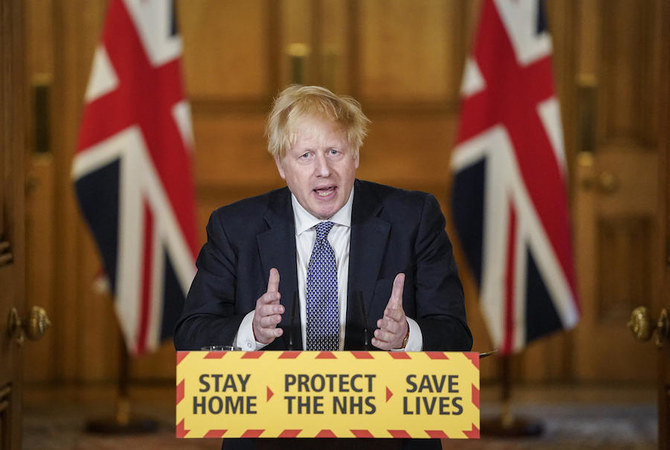
Holding his first news conference since recovering from COVID-19, and a day after his fiancee gave birth, Johnson offered hope to locked-down Britons, but urged them to stick with restrictions designed to slow the spread of the virus.
“I can confirm today that for the first time, we are past the peak of this disease,” Johnson said. “We’re past the peak and we’re on the downward slope, and we have so many reasons to be hopeful for the long term.”
Nevertheless, Britain now has the second-highest official COVID-19 death toll in Europe with more than 26,000 deaths.
That has put pressure on the government over its response to the outbreak and is fueling caution in lifting restrictions on movement in case that leads to a second spike.
But, with rising unemployment and many companies crippled, the government is coming under pressure to outline an exit strategy.
Johnson promised to set out next week a “menu of options” on how the lockdown could be relaxed, but said the exact dates of any change would be driven by scientific advice and data.
The government is also facing questions over its likely failure to meet a target Heath Minister Matt Hancock set of carrying out 100,000 daily tests for the virus by the end of April, with testing seen as key to ending the lockdown.
Johnson returned to work on Monday having recovered after being infected with the virus, which left him gravely ill in intensive care at the peak of the outbreak.
Delaying any paternity leave, he earlier headed a virtual meeting of his cabinet.
Johnson imposed strict economic and social limits six weeks ago to slow the spread of the virus, and his ministers have since repeatedly refused to discuss when it will end. Instead, the government has set five broad conditions which must be met before restrictions can be relaxed.
“It’s thanks to that massive collective effort to shield the NHS (National Health Service) that we avoided an uncontrollable and catastrophic epidemic, where the reasonable worst case scenario was 500,000 deaths,” he said.
A first review into the lockdown must come before May 7 and scientific advisers have been presenting ministers with a menu of options over how it might be eased.
The opposition Labour Party has accused the government of being slow to react to the crisis, by delaying the imposition of the lockdown and then failing to ramp up the provision of protective equipment to frontline staff and the number of tests.
Earlier, ministers indicated that their testing target is unlikely to be met.
NHS Providers, a body representing hospital, community and ambulance services in the state-run health service, said the 100,000 target was a “red herring” which could be distracting attention from ensuring those who needed a test got one.
“Testing is one area where, despite all the work delivered by trusts and the NHS, the health and care system as a whole has struggled to develop an effective, coordinated approach,” said Chris Hopson, chief executive of NHS Providers.
“Setting a target for a number of tests for 30 April may have had a galvanizing effect. But what matters most is an updated strategy to take us through the exit from lockdown.”


![]()

Britain is past coronavirus peak, says PM Johnson
Short Url
https://arab.news/rcty7
Britain is past coronavirus peak, says PM Johnson
- Johnson offered hope to locked-down Britons, but urged them to stick with restrictions designed to slow the spread of the virus
- Britain now has the second-highest official COVID-19 death toll in Europe with more than 26,000 deaths


Latest updates




© 2026 SAUDI RESEARCH & PUBLISHING COMPANY, All Rights Reserved And subject to Terms of Use Agreement.