

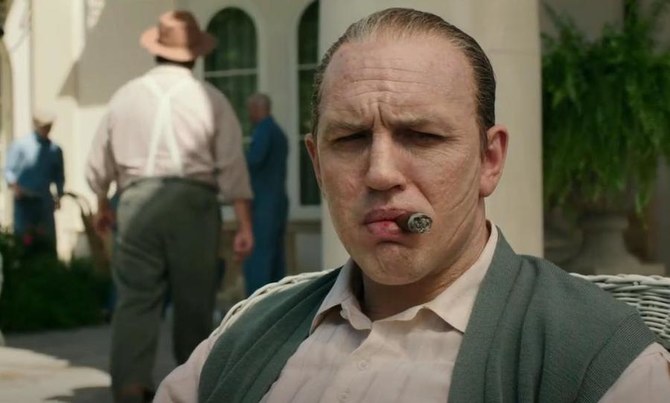
Capone: The degeneration of an evil mind

Tom Hardy as Capone. (Supplied)
Short Url
Updated 23 May 2020
Follow

Capone: The degeneration of an evil mind

CHENNAI: Several films have been made on Al Capone, the American mobster whose cold-blooded brutality became legendary in the American underworld. Of Italian descent, he first came to Chicago in 1919, when the city was notorious for bootlegging and rife with corruption. After committing countless crimes, he was finally caught and jailed in the early 1930s for tax evasion. He spent his last years in exile in Florida, where he lived under the watchful eye of the Federal Bureau of Investigation (FBI).
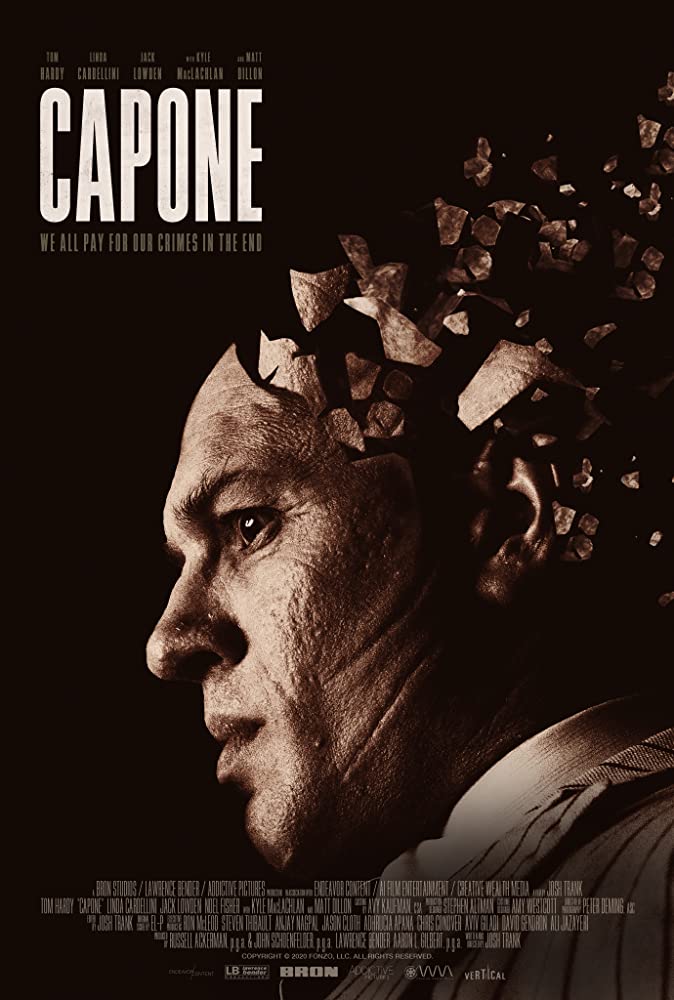


Josh Trank’s bio-drama follows Capone (played by Tom Hardy) as he lives out his final years in Florida. (Supplied)

In the latest take on the infamous gangster, Josh Trank’s bio-drama follows Capone (played by Tom Hardy) as he lives out his final years in Florida. As writer-director and editor, Trank narrates Capone’s twilight years through Hardy, with excellent results. There is a telling scene where Capone shoots a crocodile as it comes close to his fishing boat. His old gangster buddy, Johnny (played by Matt Dillon), quips: “You know, this is what happens when people spend too much time in Florida. They turn into ... hillbillies.” The scene artfully shows how Capone, with his bloodshot menacing eyes and a cigar stub between his lips, still thirsts for revenge.
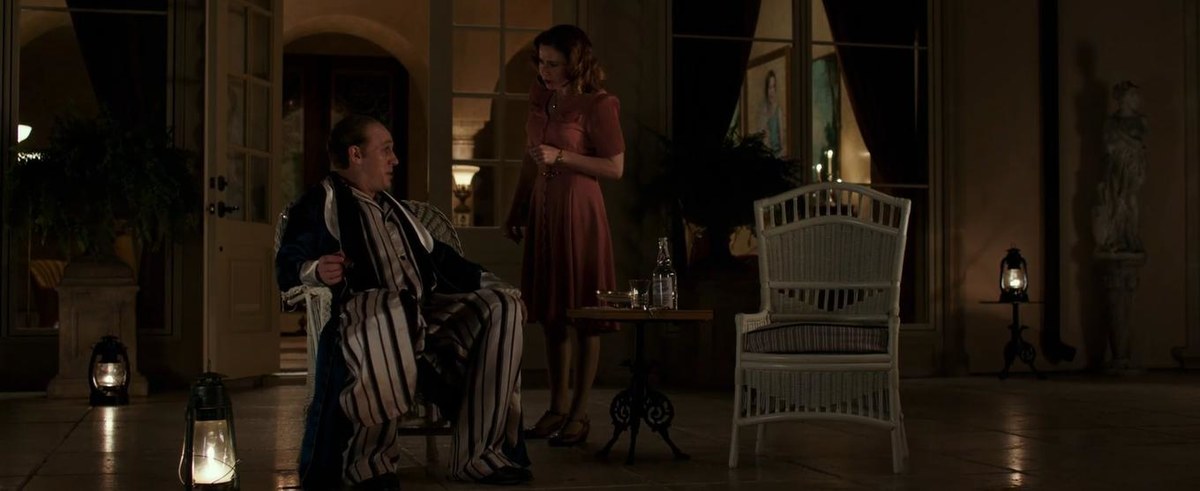


Linda Cardellini and Tom Hardy in Capone (2020). Supplied

Suffering from neurosyphilis, Capone has dementia and struggles to differentiate between reality and fantasy, facts from fragmented memories of a past he still considers glorious. He also fails to remember where he has stashed away $10 million, much to the annoyance of his family and others. Some try various means to get this information out, including a doctor and FBI agent Crawford (Jack Lowden). 

Peter Deming’s camerawork tries to lighten the mood by panning across the lush Florida landscape and Capone’s own bright green lawns. Despite all this beauty, however, a sense of fear pervades the 103-minute run time. We are never allowed to forget the mobster’s evil doings, such as the St. Valentine’s Day massacre. Capone, for his part, remains void of remorse, a perfect villain if there ever was one.


Saudi stars on show at third Diriyah Contemporary Art Biennale  

Updated 41 sec ago
Follow

Saudi stars on show at third Diriyah Contemporary Art Biennale  

  • Selected works from some of the local artists participating in this year’s exhibition 

Nouf Al-Harthi 

‘On the Red Sea’ 

Al-Harthi, who was born in Asir, is, according to the exhibition catalogue, “an interdisciplinary researcher, writer, and storyteller whose practice moves between sound, poetry, and music.” In a new commission for the biennale, she contributes this performance and poetry recital, which “focuses on sea sawdust, a type of marine bacteria that forms blooms during the hottest months.” As they decay, they turn from green to a reddish-brown, and it’s believed that the sighting of slicks of these bacteria is why the Red Sea is so named. In her piece, Al-Harthi uses sea sawdust “as a lens for deconstructing the relationship between human and non-human,” the catalogue states. “Reading the sea and the waves as sites of knowledge production, ‘On the Red Sea’ shifts our perspective through the biological and the mythical, weaving a network of envirionmental, historical, and linguistic relations.” 

Ahaad Alamoudi 

‘The Run’ 

The Jeddah-born multidisciplinary artist’s 2025 video features in the exhibition’s “Disjointed Choreographies” gallery, in which, the catalogue says, “artists grapple with their relationships to the past, celebrate the legacy of historical and cultural figures, and tells the stories that shape their world.” Alamoudi’s film shows a solitary runner “traversing printed banners that display static images of the very ground they occupy. As she runs through them, the land itself remains immutable and silent. The only sound is the steady rhythm of footsteps … amplifying both the futility and persistence of forward motion.” The video was shot in NEOM and “invites us to interrogate the narratives embedded in shifting lands — how symbols, screens, silences, and the cadence of sound shape our collective imagination.”  

Leen Aljan  

‘Takki’ 

The Jeddah-born architectural designer’s installation for the biennale is a giant takki board (takki is a card game similar to Uno) consisting of “modular, inhabitable forms made out of reclaimed wood from the tracks of the Hejaz Railway, which connected Damascus and Madinah. On the benches and tables are traditional folk games that are no longer played — or modernized versions of them.” The piece’s composition “echoes classical Hejazi courtyards and tiled interiors.” All of this ties into Aljan’s wider practice, in which she “investigates the intersection of cultural memory with sensory experience and spatial design.” 

Mohammad Al-Ghamdi  

‘Untitled’ 

This is one of three of Al-Ghamdi’s pieces on display in the biennale’s “A Hall of Chants” gallery, in which the works “map our complicated relationships to place and language.” The works are all mixed media on wood, and the catalogue describes them as “simultaneously contemporary and archaeological.” They are, it continues, “composed of reclaimed fragments carrying traces of social life, including a cable spool, decorative motifs, and a drawing on wood.” The artist is quoted as saying: “My work is not a nostalgic attempt to relive the past, but is rather an endorsement of the power of the past to create the future.” The works “invite viewers to witness the upheaval of matter and consider the enduring possibilities that reside within what is often overlooked, discarded, or deemed obsolete.” 

Ramy Alqthami  

‘Al Bitra’ 

The Jeddah-based artist’s work at the biennale is a collection of three photographs and a sculpture, created in 2014. Alqthami has “reconfigured a numbered concrete post — originally issued as a traditional marker of land ownership — into both sculpture and image” in the piece, which “originates in a personal history tied to (his) tribal roots in Saudi Arabia’s Taif region, where his family was assigned such a post to demarcate their land.” The post is the sculpture, while the photographs “point at its original location, shifting the marking stone from a local gesture of governance into a visual symbol.” It is a work that is supposed to invite a variety of interpretations, the catalogue states, “including as an instrument of power residing in the liminal space between ancestral knowledge and legal contracts.”