Saudi leadership commiserates with Pakistan over passenger plane crash

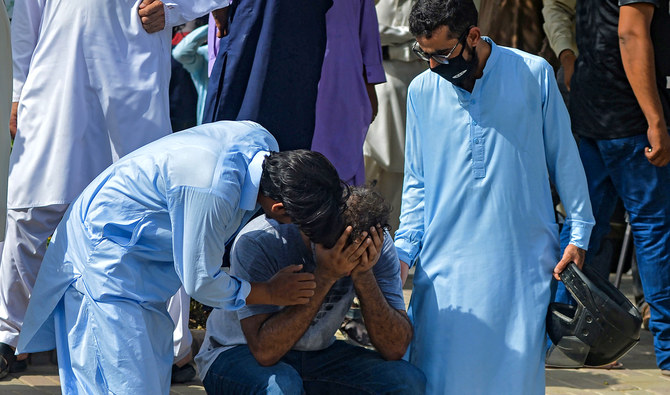
People comfort a relative of a victim near the site after a Pakistan International Airlines aircraft crashed in a residential area in Karachi on May 22, 2020. (AFP)
Short Url
Updated 02 June 2020
Follow

Saudi leadership commiserates with Pakistan over passenger plane crash

  • Wishes speedy recovery to the injured in a cable of condolences to President Alvi
  • The Friday crash left 97 people dead with two reported survivors

ISLAMABAD: Saudia Arabia’s King Salman and Crown Prince Mohammed bin Salman have expressed their condolences over the tragic crash of Pakistani passenger plane in Karachi that claimed 97 lives, reported the Saudi Press Agency on Saturday (SPA). 

In a cable of condolences sent to Pakistan’s President Dr. Arif Alvi, the Saudi leadership also wished speedy recovery to the injured, the SPA said.

Pakistan International Airlines 8303 flight with 99 people on board crashed in a residential area near Karachi airport on Friday. 

Only two passengers on board have survived while 19 bodies could be identified thus far, Sindh health department media coordinator, Meeran Yousuf, said in a Twitter post early Saturday.

Expressing solidarity with the people of Pakistan in this difficult time, the Saudi foreign ministry said, “The government of Saudi Arabia and its people stand with the brotherly government and people of the Islamic Republic of Pakistan in this tragic incident, asking Allah’s mercy for the deceased and wishing a speedy recovery to those injured, and hope that the brotherly Pakistani people will overcome these difficult times as soon as possible.”

ADB, Pakistan sign over $300 million agreements to undertake climate resilience initiatives

Updated 30 December 2025
Follow

ADB, Pakistan sign over $300 million agreements to undertake climate resilience initiatives

  • Pakistan ranks among nations most vulnerable to climate change and has seen erratic changes in weather patterns
  • The projects in Sindh and Punjab will restore nature-based coastal defenses and enhance agricultural productivity

ISLAMABAD: The Pakistani government and the Asian Development Bank (ADB) have signed more than $300 million agreements to undertake two major climate resilience initiatives, Pakistan’s Press Information Department (PID) said on Tuesday.

The projects include the Sindh Coastal Resilience Sector Project (SCRP), valued at Rs50.5 billion ($180.5 million), and the Punjab Climate-Resilient and Low-Carbon Agriculture Mechanization Project (PCRLCAMP), totaling Rs34.7 billion ($124 million).

Pakistan ranks among nations most vulnerable to climate change and has seen erratic changes in its weather patterns. In 2022, monsoon floods killed over 1,700 people, displaced another 33 million and caused over $30 billion losses, while another 1,037 people were killed in floods this year.

The South Asian country is ramping up climate resilience efforts, with support from the ADB and World Bank, and investing in climate-resilient infrastructure, particularly in vulnerable areas.

“Both sides expressed their commitment to effectively utilize the financing for successful and timely completion of the two initiatives,” the PID said in a statement.

The Sindh Coastal Resilience Project (SCRP) will promote integrated water resources and flood risk management, restore nature-based coastal defenses, and strengthen institutional and community capacity for strategic action planning, directly benefiting over 3.8 million people in Thatta, Sujawal, and Badin districts, according to ADB.

The Punjab project will enhance agricultural productivity and climate resilience across 30 districts, improving small farmers’ access to climate-smart machinery, introducing circular agriculture practices to reduce residue burning, establishing testing and training facilities, and empowering 15,000 women through skills development and livelihood diversification.

Earlier this month, the ADB also approved $381 million in financing for Pakistan’s Punjab province to modernize agriculture and strengthen education and health services, including concessional loans and grants for farm mechanization, Science, Technology, Engineering and Mathematics (STEM) education, and nursing sector reforms.