

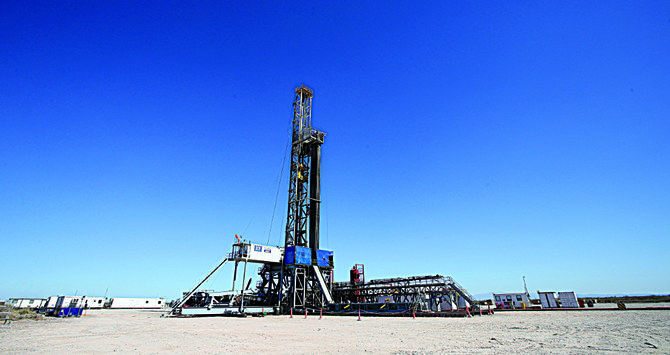
US shale bust slams rural economies as oil checks shrivel

For now, the US shale boom is over, with uncertain times ahead. (Reuters)
Short Url
Updated 23 May 2020
Follow

US shale bust slams rural economies as oil checks shrivel

  • US output could be hit by as many as 2 million barrels a day for the next two years

DEWITT COUNTY TEXAS: Royalties from oil pumped on Paul Ruckman’s land allowed the South Texas retiree to build a six-bedroom, seven-bathroom vacation home. He had plenty left over, and donated some of it to Helena, Texas, an 1800s ghost town that draws hundreds to historic buildings and gunfight re-enactments.

The worst oil bust in decades has slashed the bounty that flowed to millions of rural Americans like Ruckman, who said his royalty checks have plummeted 70 percent since January.

“I imagine they’re going to be dropping quite a bit more,” said Ruckman, who owns the land with his brothers.

The bust has erased tens of thousands of jobs in the drilling and service sectors, dried up local tax revenues and charitable largess that flowed along with crude oil to Texas, North Dakota and Oklahoma.

Thanks to modern drilling technology, shale has turned the United States into the world’s No. 1 energy producer, pumping as much as 13 million barrels per day (bpd) before prices crashed. It added about a percentage point to US GDP between 2010 and 2015. Shale-related jobs lifted the employment rate in Texas and North Dakota to a multiple of the national average.

In DeWitt County, Texas, 80 miles (129 kilometers) southeast of San Antonio, incomes shot up to sixth highest among the state’s 254 counties at the peak of the shale boom in 2014 from 116th a decade ago, based on US tax data.

Shale oil fed a global glut. OPEC and allied producers supported prices by cutting output, but this year Saudi Arabia and Russia briefly pumped more. Then fuel demand collapsed during the COVID-19 pandemic. Oil prices are about half January’s level, and many shale producers have shut wells.

US output could fall about 2 million bpd this year and next, Bank of America has estimated.

Ruckman is among 12 million US mineral owners who collect “mailbox money,” or payments for oil and gas extracted from their land. He declined to say how much his property drew, but residents in the heart of Texas’ Eagle Ford shale got bigger royalties than many, able to negotiate richer leases because the region came later to the boom.

Royalties, which can range from 12.5 percent to 25 percent of the value of oil and gas pumped, helped revitalize DeWitt and other communities in oil patches across the US.

John Baen, a Texas college professor who owns mineral rights in South Texas, collected as much as $100,000 a month in recent years. The payments have dwindled to $6,000 and by August, he said, “I’ll be lucky to get anything.”

The average oil-land owner collects about $500 a month, according to the National Association of Royalty Owners, but that will not last. April’s price crash was so sharp, falling at one point into negative territory, that minerals holder Jubilee Royalty Holdings received a $1 check that month from Exxon Mobil .

The shale boom paid off debt from restoring DeWitt’s pink granite and sandstone courthouse and expanding the jail. Oil helped finance the area’s Boys and Girls Club, which provides activities for area children.

It brought jobs that cut DeWitt’s unemployment rate to 2.6 percent in February from 8 percent a decade earlier. During that time, oil and gas jobs here roughly doubled, according to the Texas Independent Producers & Royalty Owners Association.

The boom enabled bookkeeper Karen Jensen Zielonka to find work managing a new restaurant in 2015 and later gave her accounting work for Cuero Oilfield Lodging, a nearby “man camp” for transient workers.

“When this first happened they said it would last 25 years,” said Zielonka.

But unemployment rose to 3.5 percent in March. Cuero Oilfield Lodging camp has been vacant since late March when shale jobs dried up, said manager Tammi Marks, who cut most of her staff.

“We’re doing a lot of praying,” she said.

Officials here and in other US shale patches are bracing for more cuts. The value of DeWitt’s mineral properties could fall this year by half, from $5.3 billion last year, county chief executive Daryl Fowler estimated.

Officials do not expect to reduce county jobs, “but it can happen,” said Fowler.

In the last oil bust, from 2015-2016, DeWitt’s average incomes fell 31 percent. That drop was short-lived, with pay rising again by 2018.

Oilfield worker Freddie Fuentes sailed through that period, without losing his job. He fears this one will sting much more.

“Right now we have about five weeks of work,” said Fuentes. “After that we’re done.”

Some drillers hope for a turnaround. Oil prices have bounced from the April bottom when US crude ended one day in negative territory. Prices now are about half January’s level.

Lonestar Resources is putting oil in storage tanks that typically hold brackish water, said Chief Executive Frank Bracken, counting on a price rebound.

Still, Bracken said, “royalty owners are going to see vastly diminished paychecks.”

This year’s crash might be much worse than recent downturns, said Amanda Weinstein, assistant professor of economics at the University of Akron, who has studied shale booms. Young people who lose jobs may “feel like there’s not as much for them in that town anymore,” and leave.

Williston, North Dakota, center of the Bakken shale field, was so devastated by the 1980s bust that it lagged the nation in economic growth until shale started there around 2006, Weinstein said.

At the Helena ghost town, oil royalties donated by Ruckman and others fixed a historic home whose porch had been propped up with a telephone pole. The historical society had hoped to spruce up the attraction with a visitor’s pavilion and new restrooms, said Trip Ruckman, Paul Ruckman’s cousin.

“Some plans are on hold given the situation,” he said.


Over 3k flights cancelled across the Middle East after attack on Iran by the US, Israel

Updated 01 March 2026
Follow

Over 3k flights cancelled across the Middle East after attack on Iran by the US, Israel

RIYADH: US and Israeli strikes on Iran led to widespread airspace shutdowns in the Middle East, canceling and rerouting thousands of flights and paralyzing key international travel corridors.

Flight cancellations affected seven airports across the Middle East, including Dubai and Abu Dhabi in the UAE, Doha in Qatar, and Manama in Bahrain.

Emirates Airlines said in a statement: “Due to multiple regional airspace closures, Emirates has temporarily suspended all operations to and from Dubai, up until 1500 hrs UAE time on Monday, 2 March.”

A flydubai spokesperson said the situation is evolving, and the airline is closely monitoring developments while coordinating with authorities to adjust its flight schedule.

“Our teams are working diligently to implement comprehensive welfare for all affected customers. The safety of our passengers and crew remains our highest priority,” the spokesperson said.

He added: “We are currently experiencing a high volume of calls and appreciate our customers’ patience while our teams work to assist everyone as quickly as possible.”

Qatar Airways announced that the airport will remain closed until at least the morning of March 2.

“Qatar Airways flights to, and from, Doha have been temporarily suspended due to the closure of Qatari airspace,” the airline said.

It added: “Qatar Airways will resume operations once the Qatar Civil Aviation Authority announces the safe reopening of Qatari airspace.”

Saudia also said in an official statement that it had canceled a number of flights due to developments in the region and the closure of airspace.

The organization said the decision was taken in line with aviation safety and security standards, noting that its Emergency Coordination Center is closely monitoring developments with relevant authorities.

Saudia urged passengers to verify the status of their flights before heading to the airport and said guests would be notified of updates through the contact details associated with their bookings.

The carrier added that further information would be announced in a subsequent statement if available.

Air Arabia also said its flights were experiencing cancellations, delays, or rerouting as a result of the evolving situation and airspace closures.

Airlines cited airspace closures and safety concerns as the main reasons for flight disruptions, urging passengers to check official channels for updates as the situation develops.

Israeli airspace also remained closed on March 1st. Israeli airline El Al said it was preparing a recovery effort to bring home Israelis stranded abroad once the airspace reopened.

Travelers were either stranded or diverted to other airports on Feb. 28 after Israel, Qatar, Syria, and Iran as well as Iraq, Kuwait and Bahrain, closed their airspace.

After the UAE announced a temporary partial airspace closure, FlightRadar24 recorded no flights over the country.

The closures affected key hub airports in Dubai, Abu Dhabi, and Doha. Emirates, Qatar Airways, and Etihad, airlines that operate from these hubs, normally handle around 90,000 passengers daily, with even more traveling to other Middle Eastern destinations, according to aviation analytics firm Cirium.

Airports hit by attacks

Two airports in the UAE reported incidents as the government there condemned what it called a “blatant attack involving Iranian ballistic missiles” on Feb.28.

Dubai International Airport, the UAE’s largest and one of the world’s busiest, reported four injuries, while Abu Dhabi’s Zayed International Airport said a drone attack killed one person and injured seven others. Strikes were also reported at Kuwait International Airport.

Though Iran did not publicly claim responsibility, the scope of retaliatory strikes that Gulf nations attributed to Iran extended beyond the US bases that it previously said it would target.

Flight delays, cancellations are likely to continue

“For travelers, there’s no way to sugarcoat this,” said Henry Harteveldt, an airline industry analyst and president of Atmosphere Research Group.

“You should prepare for delays or cancellations for the next few days as these attacks evolve and hopefully end,” he added.

To avoid conflict zones, airlines are rerouting Middle East flights over Saudi Arabia, adding hours and fuel costs, which could push ticket prices higher if the tensions persist.

The extra flights will strain air traffic controllers in the Kingdom, who may need to slow traffic for safety. Meanwhile, countries that closed their airspace will lose out on overflight fees from passing airlines.

Mike McCormick, former head of air traffic control at the FAA and now a professor at Embry-Riddle Aeronautical University, said some countries may reopen parts of their airspace in the coming days once US and Israeli officials provide airlines with details on military flight zones and Iran’s missile capabilities.

“Those countries then will be able to go through and say, ok, we can reopen this portion of our space but we’ll keep this portion of our airspace closed,” McCormick said.

“So, I think what we’ll see in the next 24 to 36 hours is how the use of airspace evolves as the kinetic activity gets more well-defined and as the capability of Iran to actually shoot missiles and create additional risk is diminished due to the attacks,” he added.

But it is unclear how long the disruption to flight operations could last. For comparison, the Israeli and US attack on Iran in June 2025 lasted 12 days.