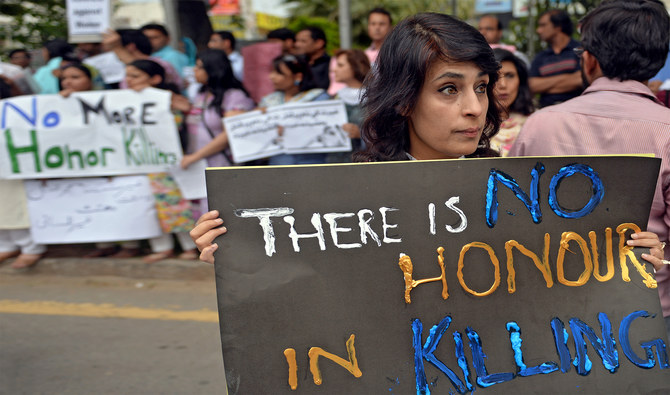
KARACHI: The latest “honor killing” of two teenage girls in Pakistan after a video of them with a man surfaced online shows women need better control over their digital presence, said an activist appointed to Facebook’s new oversight board this month.
The sisters were shot dead last week in Pakistan’s remote North Waziristan, the latest victims of a conservative honor code which has led to hundreds of deaths, including the 2016 strangling of social media star Qandeel Baloch by her brother.
“The Waziristan killings highlight how the Internet can be used against women, especially in a patriarchal society like Pakistan’s,” said Nighat Dad, a Pakistani lawyer who founded the country’s first cyber-harassment helpline.
“Because more and more people are getting access to technology, its dark side is also becoming visible, with the onslaught of the entire spectrum of harassment brought into the virtual world.”
Dad has achieved global prominence for her work to protect women online in a country where their modesty is prized and they are often not allowed to work outside the home, fraternize with men or choose their own husbands.
After winning recognition as one of Time magazine’s next generation of leaders in 2015 and a Human Rights Tulip award in 2016, this month Dad joined what some have dubbed Facebook’s “Supreme Court” to rule on whether certain content is allowed.
Most of the calls to the Digital Rights Foundation advocacy group, which Dad founded in 2012 with a focus on protecting women online, are about revenge porn — the blackmail of women by ex-partners or boyfriends over online posts of intimate images.
“There are pockets of people on the Internet that find and leak footage of women without their consent,” the 39-year-old told the Thomson Reuters Foundation.
“This online activity has very severe consequences for women ... in some segments of Pakistani society, a woman’s worth is measured using her ‘honor’, and the moment she ‘dishonors’ her family, she is often made to pay with her life.”
The murder of the two teenage girls has sparked debate in Pakistan around women’s digital safety, with the women who shared news of the killings also coming under fire online.
Dad said women needed the autonomy to control their own digital presence, rather than being stopped from using the Internet at all, which many men tried to do after social media star Baloch’s murder in 2016.
“There was a real fear that (women) could be killed for their online activities, even for so much as owning a phone,” Dad said, adding that distress calls to her charity surged by 50% in the wake of the killing.
“There needs to be work done on laws and implementation, as well as building better channels of reporting content against women on social media platforms and the Internet,” she said.


![]()

Pakistan’s ‘honor killings’ show women need digital skills, says Facebook oversight board member
Short Url
https://arab.news/gxk9m
Pakistan’s ‘honor killings’ show women need digital skills, says Facebook oversight board member
- Two teenage sisters were shot dead in Pakistan’s North Waziristan last week after they appeared in a video with a man
- The murder has sparked debate in Pakistan around women’s digital safety
Latest updates


© 2026 SAUDI RESEARCH & PUBLISHING COMPANY, All Rights Reserved And subject to Terms of Use Agreement.