

Qatar World Cup organizers fear coronavirus impact on 2022 football tournament

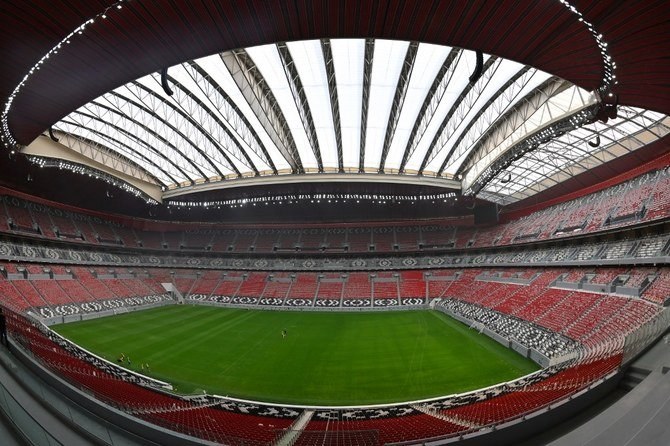
Above, inside Qatar’s new Al-Bayt Stadium in Doha, which will host matches of the FIFA football World Cup 2022, in this December 17, 2019 photo. (AFP file photo)
Short Url
Updated 21 May 2020
Follow

Qatar World Cup organizers fear coronavirus impact on 2022 football tournament

  • Many countries have been reporting a slowdown in their economies
  • World Cup is scheduled to be played in November-December 2022

DUBAI: 2022 FIFA World Cup organizers are apprehensive football fans will not travel to Doha to watch games if the coronavirus pandemic continues to hold the global economy in dire straits.

Many countries have been reporting a slowdown in their economies while others are expected to go into historically deep recessions as the coronavirus pandemic, which affected 5 million people globally, shuttered businesses and caused industries to stall.

Major economies like the US have reported that retail sales fell a record 19 percent in April, and was a key reason why the American economy was contracting.

Britain’s economy shrank by a record 5.8 percent in March from February as the coronavirus crisis escalated, while its gross domestic product for the first three months of contracted by 2.0 percent from the fourth quarter of last year. British economic output is set to crash 14 percent this year owing to the coronavirus, the Bank of England earlier said.

Qatar has been promising that the World Cup would be affordable for fans, but has, itself, been affected by economic activity shutting down in so many countries.

The tiny Gulf nation still hopes six of its eight stadiums will be completed by the end of this year despite the COVID-19 disruption. But its effort to fast track the construction of these venues has also raised criticisms over the conditions of migrant workers that Doha brought in.

One TV documentary has claimed at least 1,400 migrant workers from Nepal have died while working on the football stadiums due to construction site accidents and squalid living conditions.

The frenetic construction work for the 2022 FIFA World Cup is claiming around 110 lives every year, according to Nepali government figures.

The World Cup is scheduled to be played in November-December 2022, rather than its usual June-July slot, which may provide more time for the resumption of international travel but remains blurry considering the current global economic situation.

“By 2022 I’m optimistic that we would overcome this pandemic as a human race collectively,” World Cup organizing committee secretary general Hassan Al-Thawadi meanwhile said.

“It will be one of the early opportunities for all of us to celebrate together, to engage together, to bring people together.”


Australia to ban citizen from returning to country under rarely-used terror laws

Updated 3 sec ago
Follow

Australia to ban citizen from returning to country under rarely-used terror laws

  • They were briefly freed on Monday before being turned back by Damascus for holding inadequate paperwork
SYDNEY: Australia ‌said on Wednesday it would temporarily ban one of its citizens held in a Syrian camp from returning to the country, ​under rarely-used powers aimed at preventing terror activity.
Thirty-four Australians in a northern Syrian facility holding families of suspected Daesh militants are expected to return home after their release was conditionally approved by camp authorities.
They were briefly freed on Monday before being turned back by Damascus for holding inadequate paperwork.
Australia has already ‌said it ‌would not provide any assistance to ​those ‌held ⁠in ​the camp, ⁠and is investigating whether any individuals posed a threat to national security.
“I can confirm that one individual in this cohort has been issued a temporary exclusion order, which was made on advice from security agencies,” Home Affairs Minister Tony Burke said in a statement on ⁠Wednesday.
Security agencies have not yet advised ‌that other members of the ‌group meet the legal threshold for ​a similar ban, he ‌added.
Introduced in 2019, the legislation allows for ‌bans of up to two years for Australian citizens over the age of 14 that the government believes are a security risk.
Prime Minister Anthony Albanese said on Wednesday some members of ‌the cohort, that includes children, had aligned themselves with a “brutal, reactionary ideology and ⁠that seeks to ⁠undermine and destroy our way of life.”
“It’s unfortunate that children are caught up in this, that’s not their decision, but it’s the decision of their parents or their mother,” he added.
News of the families’ possible return has caused controversy in Australia, where support for the right-wing, anti-immigration One Nation party has surged in recent months.
A poll this week found One Nation’s share of the popular vote at a ​record high of 26 percent, ​above the combined support for the traditional center-right coalition currently in opposition.