Pakistan braces for virus surge as top court orders restrictions lifted

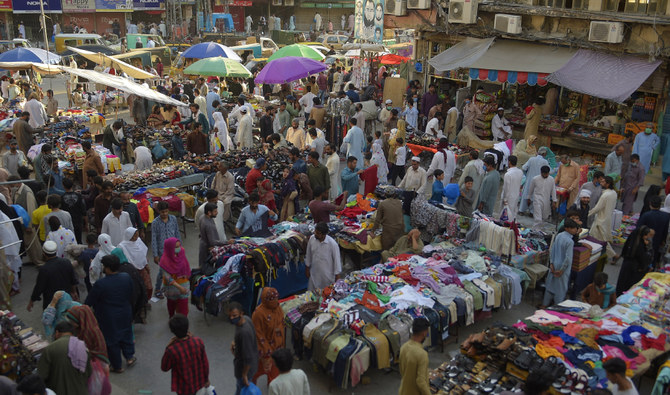
Peoples walk along Raja Bazar ahead of the Muslim Eid al-Fitr festival after the government eased a nationwide lockdown imposed as a preventive measure against the COVID-19 coronavirus in, in Rawalpindi on May 19, 2020. (AFP)
Short Url
Updated 20 May 2020
Follow

Pakistan braces for virus surge as top court orders restrictions lifted

  • Supreme Court said on Monday that coronavirus is 'not a pandemic in Pakistan'
  • With the Muslim Eid Al-Fitr holidays approaching, shops have been drawing massive crowds

KARACHI: Provincial governments and doctors warn that coronavirus infections will surge in Pakistan and overwhelm the health system, following the Supreme Court's decision to lift some of the remaining restrictions imposed on businesses to slow the outbreak.

The court ordered the government on Monday to reopen shopping malls and allow businesses to operate on weekends. It said that the virus outbreak "apparently is not a pandemic in Pakistan" and questioned why fighting it was "swallowing so much money."

With the Muslim Eid Al-Fitr holidays approaching, shops have been drawing massive crowds, which local authorities fear they will not be able to control following the court's order.

"We believe that if people continue to violate standard operating procedures (SOPs), it will aggravate the situation, lead to a surge in cases and collapse of the health system," Sindh Education and Labor Minister Saeed Ghani told Arab News on Tuesday, adding that the court has barred the authorities from sealing markets and imposing penalties on those who violate the SOPs.  

"It makes the administration powerless in implementing protective measures," he said. 

Liaquat Shahwani, spokesman of the Balochistan government, said that authorities in his province had already eased restrictions before the court's decision and the enforcement of virus precautions has been difficult as neither the traders nor their customers would obey. 

"We fear that opening bazaars and shopping malls will increase the infection rate, which is growing each day," he said, "But we have no option, as while stemming the virus is necessary, it is also necessary that people can earn to buy food."

"We respect the decision of the apex court," he added.

Doctors, meanwhile, say they have been overburdened by the outbreak and are increasingly falling victim to the virus. 

“More than 1,100 health officials have to stay at their homes after contracting the coronavirus. Health experts foresee a major surge in infections as the SOPs are not followed," Dr Qaiser Sajjad, secretary general of the Pakistan Medical Association (PMA), told Arab News. 

He said that Pakistan's current infection figures are not reflective of the situation on the ground.

On Tuesday, Pakistan reported nearly 44,000 COVID-19 cases and over 939 deaths. 

"We are inching 50,000 cases which is very high, but the real figures may be several times higher than that," Sajjad said, as the country of 210 million has so far tested only 400,300 people.

He added that the court's decision has shifted the responsibility to handle the outbreak from the health sector to the government and judiciary.


Pakistan to export halal meat worth $14.5 million to Tajikistan

Updated 6 sec ago
Follow

Pakistan to export halal meat worth $14.5 million to Tajikistan

  • Effective trade facilitation can increase bilateral Pakistan-Tajikistan trade to $300 million, says state media
  • PM Shehbaz Sharif approved Pakistan’s halal meat policy earlier this month in bid to boost meat exports

ISLAMABAD: Pakistan will export 143,000 tons of halal meat to Tajikistan worth $14.5 million in the near future, state media reported on Tuesday amid Islamabad’s efforts to bolster trade with Central Asian countries. 

Prime Minister Shehbaz Sharif, earlier this month, approved Pakistan’s halal meat policy that aims to boost Islamabad’s meat exports to Muslim states. 

In a high-level meeting on Dec. 24, Federal Minister for Food Security Rana Tanveer Hussain said Malaysia, Saudi Arabia, Iran and other Gulf countries are ready to import Pakistani fresh meat and rice. The minister said Tajikistan has expressed the demand to import nearly 100,000 tons of meat from Pakistan. 

“According to details, Pakistan will export one hundred and forty-three thousand tons of halal meat to Tajikistan, valued at 14.5 million dollars,” state broadcaster Radio Pakistan reported. 

It did not, however, specify a timeline as to when Islamabad planned to export the halal meat items to the Central Asian nation.

The state media said that effective trade facilitation will increase bilateral trade between Pakistan and Tajikistan to $300 million, strengthening regional economic integration.

Pakistan has recently attempted to increase its halal meat exports to other Muslim countries such as Malaysia. Both countries announced they had agreed to a $200 million halal meat trade quota during Sharif’s visit to Malaysia in October. 

A 2024 report by the Pakistan Bureau of Statistics (PBS) mentioned that the country exported meat worth $512 million in 2024, which included beef, mutton and poultry.

According to the PBS, the UAE remained Pakistan’s top meat export market in 2024 with exports to the Gulf nation reaching $201 million. Meanwhile, meat exports to Saudi Arabia recorded a growth of 65.1 percent last year valued at $141 million.