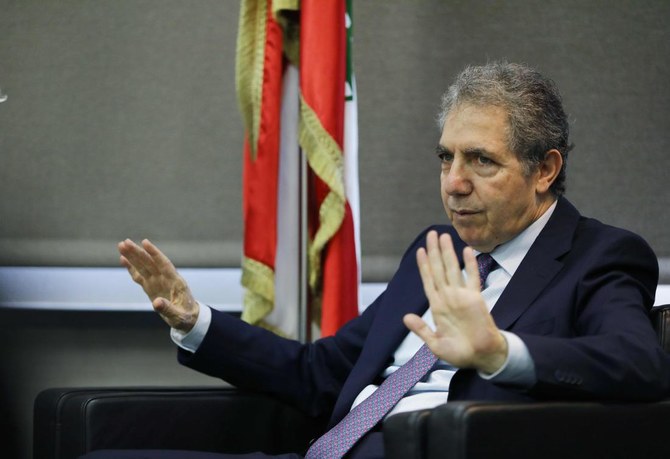
BEIRUT: Lebanon, whose currency has been pegged to the dollar for 23 years, is ready to float the pound only after it secures billions in aid, Finance Minister Ghazi Wazni said Friday.
Speaking to AFP after talks started Wednesday with the International Monetary Fund on a plan to rescue Lebanon’s free falling economy, he also said a restructuring of the banking sector would entail halving the number of banks in the country.
A hard currency crunch in recent months has strained the official fixed rate of 1,507 to the dollar, with the pound losing more than half of its value to fetch well over 4,000 on the black market.
“The IMF always asks for the freeing of the pound’s exchange rate,” Wazni said.
But “we need to change the stabilization policy to one of a flexible exchange rate in a first stage and for the forseeable future,” he said, referring to an initial managed flotation.
“When we receive financial support from abroad, we will transition to floatation” according to the market, he said.
“The Lebanese government has asked for a transitional period to pass through a flexible exchange rate before we reach floatation,” he added.
Wazni said the first phase would involve “a gradual increase of the exchange rate to the dollar,” in coordination with the central bank.
He said this was necessary because the government feared “huge deterioration of the pound exchange rate” otherwise.
Lebanon, which was hit last autumn by unprecedented protests, asked the IMF for financial assistance on May 1 after laying out a much-awaited financial rescue plan.
That plan aims to drum up billions of dollars in aid, reduce the deficit, restructure a colossal debt, and reorganize an oversized banking sector.
Wazni said the restructuring would be done “step by step.”
“Lebanon counts 49 commercial banks and it is normal for that number to decrease to around half of that in the next stage,” he said.
Lebanon is in the grips of a severe liquidity crunch, with depositors unable to make transfers abroad or withdraw dollars.
The Mediterranean nation is one of the most indebted countries worldwide with a debt equivalent to 170 percent of its gross domestic product.
It defaulted on a repayment for the first time ever in March.


![]()

Crisis-hit Lebanon ready to float pound after aid: Finance minister
Short Url
https://arab.news/9cysq
Crisis-hit Lebanon ready to float pound after aid: Finance minister
- A hard currency crunch in recent months has strained the official fixed rate of 1,507 to the dollar
- “When we receive financial support from abroad, we will transition to floatation” according to the market, Wazni said


Latest updates


© 2026 SAUDI RESEARCH & PUBLISHING COMPANY, All Rights Reserved And subject to Terms of Use Agreement.