

The Saudi entrepreneur keeping camel milk flowing in America

1 / 2
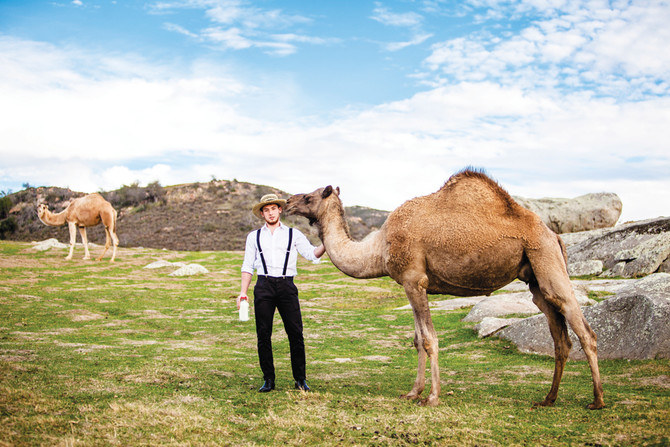
Walid Abdul-Wahab, who runs a company called Desert Farms, was brought up in Jeddah but moved to Los Angeles in 2008. (Supplied)
2 / 2
Desert Farms products have proved popular and the company model should prove resilient to tough economic times. (Supplied)
Short Url
Updated 15 May 2020
Follow

The Saudi entrepreneur keeping camel milk flowing in America

  • Walid Abdul-Wahab from Jeddah has built his camel milk company in California
  • The Desert Farms structure should prove resilient in tough economic times.

LOS ANGELES: When it comes to drinking milk, most Americans only think of cows. 

But a company run by a young Saudi entrepreneur has been trying to change habits after introducing camel milk to the US market.

Walid Abdul-Wahab, who runs a company called Desert Farms, was brought up in Jeddah but moved to Los Angeles in 2008 to study at the University of Southern California.

It was there he had the idea to introduce camel milk as an alternative dairy product to health-conscious customers.

“I wanted to bring something positive from back home where I’m from: Jeddah, Saudi Arabia,” Abdul-Wahab said. “I decided to introduce a new kind of breed of milk that is almost 10 times better than cow’s and goat’s milk and actually the closest milk to human breast milk.”

Abdul-Wahab set up partnerships with family farms rearing camels across the US to produce the milk domestically.

He is confident his hard work over the years means his business can ride through the challenges of the coronavirus pandemic.

“Whenever you’re dealing with food and your business is fully online, and you actually own your own customers, meaning that you have direct relationships, you know who’s buying, you know where they’re from, it’s very difficult for a business like that to be affected by any sort of recession,” he said. 

Abdul-Wahab said his company sells on Amazon and through the Desert Farms website as well as in regular retail stores.

Along with health conscious customers, another market is selling the milk to Muslims, particularly during Ramadan. 

Although mosques are closed in the US this Ramadan, Abdul-Wahab is working to ensure that Desert Farms can provide milk to Muslims observing the holy month during the shutdown.

As a young entrepreneur, he said he believes challenging times like these are when the best business ideas flourish.

“We’re not in a true recession but it does have a lot of similar traits and I do strongly believe that some of the best ideas are gonna come out during this time,” Abdul-Wahab said. 

He encouraged businesspeople in the Arab world who want to start companies in the US to go for it. “It's honestly the easiest country in the world to start any business you want,” he said.

On top of his business, Abdul-Wahab is trying to make sure his family stays fit and focused during the pandemic lockdown.

“Me and my kids are always extremely active,” Abdul-Wahab said. “We definitely keep a distance from everyone as much as possible, but that doesn’t mean we don’t go out. I take my kids to the park almost on a daily basis, and we just continue doing sports.”


Arab food and beverage sector draws $22bn in foreign investment over 2 decades: Dhaman 

Updated 16 sec ago
Follow

Arab food and beverage sector draws $22bn in foreign investment over 2 decades: Dhaman 

JEDDAH: Foreign investors committed about $22 billion to the Arab region’s food and beverage sector over the past two decades, backing 516 projects that generated roughly 93,000 jobs, according to a new sectoral report. 

In its third food and beverage industry study for 2025, the Arab Investment and Export Credit Guarantee Corp., known as Dhaman, said the bulk of investment flowed to a handful of markets. Egypt, Saudi Arabia, the UAE, Morocco and Qatar attracted 421 projects — about 82 percent of the total — with capital expenditure exceeding $17 billion, or nearly four-fifths of overall investment. 

Projects in those five countries accounted for around 71,000 jobs, representing 76 percent of total employment created by foreign direct investment in the sector over the 2003–2024 period, the report said, according to figures carried by the Kuwait News Agency. 

“The US has been the region's top food and beverage investor over the past 22 years with 74 projects or 14 projects of the total, and Capex of approximately $4 billion or 18 percent of the total, creating more than 14,000 jobs,” KUNA reported. 

Investment was also concentrated among a small group of multinational players. The sector’s top 10 foreign investors accounted for roughly 15 percent of projects, 32 percent of capital expenditure and 29 percent of newly created jobs.  

Swiss food group Nestlé led in project count with 14 initiatives, while Ukrainian agribusiness firm NIBULON topped capital spending and job creation, investing $2 billion and generating around 6,000 jobs. 

At the inter-Arab investment level, the report noted that 12 Arab countries invested in 108 projects, accounting for about 21 percent of total FDI projects in the sector over the past 22 years. These initiatives, carried out by 65 companies, involved $6.5 billion in capital expenditure, representing 30 percent of total FDI, and generated nearly 28,000 jobs. 

The UAE led inter-Arab investments, accounting for 45 percent of total projects and 58 percent of total capital expenditure, the report added, according to KUNA. 

The report also noted that the UAE, Saudi Arabia, Egypt, and Qatar topped the Arab ranking as the most attractive countries for investment in the sector in 2024, followed by Oman, Bahrain, Algeria, Morocco, and Kuwait. 

Looking ahead, Dhaman expects consumer demand to continue rising. Food and non-alcoholic beverage sales across 16 Arab countries are projected to increase 8.6 percent to more than $430 billion by the end of 2025, equivalent to 4.2 percent of global sales, before exceeding $560 billion by 2029. 

Sales are expected to remain highly concentrated geographically, with Egypt, Saudi Arabia, Algeria, the UAE and Iraq accounting for about 77 percent of the regional total. By product category, meat and poultry are forecast to lead with sales of about $106 billion, followed by cereals, pasta and baked goods at roughly $63 billion. 

Average annual per capita spending on food and non-alcoholic beverages in the region is projected to rise 7.2 percent to more than $1,845 by the end of 2025, approaching the global average, and to reach about $2,255 by 2029. Household spending on these products is expected to represent 25.8 percent of total expenditure in 13 Arab countries, above the global average of 24.2 percent. 

Arab external trade in food and beverages grew more than 15 percent in 2024 to $195 billion, with exports rising 18 percent to $56 billion and imports increasing 14 percent to $139 billion. Brazil was the largest foreign supplier to the region, exporting $16.5 billion worth of products, while Saudi Arabia ranked as the top Arab exporter at $6.6 billion.