

Pakistan approves agriculture relief package to support farmers

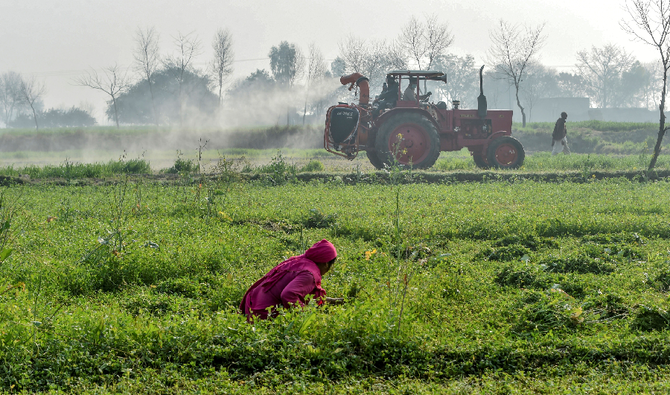
In this picture taken on February 23, 2020, officials of the Agriculture Department on a tractor spray pesticides to kill locusts as a farmer works in a field in Pipli Pahar village in Pakistan's central Punjab province. (AFP)
Short Url
Updated 14 May 2020
Follow

Pakistan approves agriculture relief package to support farmers

  • Agriculture contributes 18.5 percent to Pakistan’s GDP and provides 38.5 percent employment to the national labor force
  • Farmers reject the package, saying it will only benefit ‘seed and pesticide mafia’

ISLAMABAD: Pakistan on Wednesday approved a Rs56.6 billion agriculture relief package for farmers to provide them subsidy on fertilizers, cotton seed, pesticides and sales tax on locally manufactured tractors amid the coronavirus pandemic.

The stimulus package is part of the Rs100 billion out of Rs1200 billion coronavirus relief package already announced for small and medium enterprises and the agriculture sector.

The Economic Coordination Committee of the Cabinet (ECC) – an apex federal institution to discuss and decide economic and financial matters – has approved the package as prepared by the Ministry of National Food Security and Research.

Under the package, the government is offering a Rs37 billion subsidy to farmers on the purchase of fertilizers. This amount will include a subsidy of Rs925 per bag on phosphorus fertilizers and Rs243 per bag on urea and other nitrogen fertilizers.

The government is expecting an offtake of about 3.04 million tons for urea and 0.95 million tons for the phosphate fertilizers in the upcoming cultivation season.

The fertilizer share in the cost of production for major crops is estimated to be around 10 to 15 percent. “The provision of subsidy would reduce cost of production for farmers,” the ECC said in a statement, adding that this would also increase farmers’ affordability to use quality fertilizers for their crops.

Other items in the relief package include a reduction of Rs8.8 billion in mark-up of agriculture loans, Rs2.3 billion subsidy on cotton seed and Rs6 billion subsidy on pesticides.

The government has also granted a subsidy of Rs2.5 billion on the sales tax on locally-manufactured tractors for a period of one year.

Provincial governments will be responsible for the utilization of the relief package, though a clear-cut implementation mechanism for it is yet to be devised.

In Pakistan, the agriculture sector contributes 18.5 percent to the country’s Gross Domestic Product (GDP) and provides 38.5 percent employment to the national labor force, though it has always remained a low priority for successive governments.

“Over the last decade, the performance of agriculture sector has fallen short of desirable level, mainly because of stagnant productivity of all important crops,” said the Pakistan Economic Survey 2018-19.

Farmers on the other hand rejected the package, saying it will only benefit “seed and pesticide mafia” in the absence of an effective mechanism for its implementation.

“The government should give interest-free loans to small farmers to help them bear the escalating cost instead of playing these gimmicks,” Mian Muhammad Umair Masood, general-secretary of the Pakistan Kissan Ittihad, told Arab News on Wednesday.

He said the government should also announce a fixed electricity rate for tube-wells along with lowering the cost of phosphorus fertilizers from Rs3,800 to Rs2,400 per bag and urea fertilizers from Rs1,650 to Rs1,200 per bag.

“Farmers are using decades-old bt2 cotton seed which is highly susceptible to pests and other diseases,” Masood said. “The government should invest in seed research instead of doling out funds to mafia in the name of farmers.”


IMF warns against policy slippage amid weak recovery as it clears $1.2 billion for Pakistan

Updated 11 December 2025
Follow

IMF warns against policy slippage amid weak recovery as it clears $1.2 billion for Pakistan

  • Pakistan rebuilt reserves, cut its deficit and slowed inflation sharply over the past one year
  • Fund says climate shocks, energy debt, stalled reforms threaten stability despite recent gains

ISLAMABAD: Pakistan’s economic recovery remains fragile despite a year of painful stabilization measures that helped pull the country back from the brink of default, the International Monetary Fund (IMF) warned on Thursday, after it approved a fresh $1.2 billion disbursement under its ongoing loan program.

The approval covers the second review of Pakistan’s Extended Fund Facility (EFF) and the first review of its climate-focused Resilience and Sustainability Facility (RSF), bringing total disbursements since last year to about $3.3 billion.

Pakistan entered the IMF program in September 2024 after years of weak revenues, soaring fiscal deficits, import controls, currency depletion and repeated climate shocks left the economy close to external default. A smaller stopgap arrangement earlier that year helped avert immediate default, but the current 37-month program was designed to restore macroeconomic stability through strict monetary tightening, currency adjustments, subsidy rationalization and aggressive revenue measures.

The IMF’s new review shows that Pakistan has delivered significant gains since then. Growth recovered to 3 percent last year after shrinking the year before. Inflation fell from over 23 percent to low single digits before rising again after this year’s floods. The current account posted its first surplus in 14 years, helped by stronger remittances and a sharp reduction in imports. And the government delivered a primary budget surplus of 1.3 percent of GDP, a key program requirement. Foreign exchange reserves, which had dropped dangerously low in 2023, rose from US$9.4 billion to US$14.5 billion by June.

“Pakistan’s reform implementation under the EFF arrangement has helped preserve macroeconomic stability in the face of several recent shocks,” IMF Deputy Managing Director Nigel Clarke said in a statement after the Board meeting.

But he warned that Islamabad must “maintain prudent policies” and accelerate reforms needed for private-sector-led and sustainable growth.

The Fund noted that the 2025 monsoon floods, affecting nearly seven million people, damaging housing, livestock and key crops, and displacing more than four million, have set back the recovery. The IMF now expects GDP growth in FY26 to be slightly lower and forecasts inflation to rise to 8–10 percent in the coming months as food prices adjust.

The review warns Pakistan against relaxing monetary or fiscal discipline prematurely. It urges the State Bank to keep policy “appropriately tight,” allow exchange-rate flexibility and improve communication. Islamabad must also continue raising revenues, broadening the tax base and protecting social spending, the Fund said.

Despite the progress, Pakistan’s structural weaknesses remain severe.

Power-sector circular debt stands at about $5.7 billion, and gas-sector arrears have climbed to $11.3 billion despite tariff adjustments. Reform of state-owned enterprises has slowed, including delays in privatizing loss-making electricity distributors and Pakistan International Airlines. Key governance and anti-corruption reforms have also been pushed back.

The IMF welcomed Pakistan’s expansion of its flagship Benazir Income Support Program, which raises cash transfers for low-income families and expands coverage, saying social protection is essential as climate shocks intensify. But it warned that high public debt, about 72 percent of GDP, thin external buffers and climate exposure leave the country vulnerable if reform momentum weakens.

The Fund said Pakistan’s challenge now is to convert short-term stabilization into sustained recovery after years of economic volatility, with its ability to maintain discipline, rather than the size of external financing alone, determining the durability of its gains.