

China cuts Australian beef imports after row over virus probe

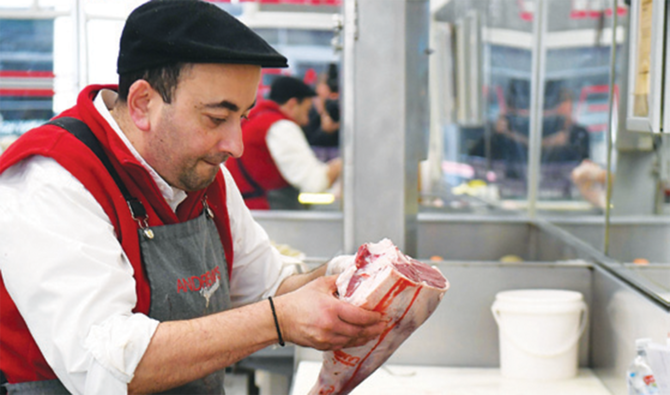
China’s beef ban raises fears of a trade standoff with Australia. (AFP)
Short Url
Updated 13 May 2020
Follow

China cuts Australian beef imports after row over virus probe

  • The four abattoirs account for around 35 percent of Australia’s beef exports to China in a trade worth about Aus$1.7 billion ($1.1 billion), according to national broadcaster ABC

SYDNEY: China suspended imports from four major Australian beef suppliers on Tuesday, just weeks after Beijing’s ambassador warned of a consumer boycott in retaliation for Canberra’s push to probe the origins of the coronavirus.

Analysts said the move raised concerns of a possible standoff between Australia and its most important trading partner that could spill over into other crucial sectors as it struggles to navigate the disease-induced economic crisis.

Federal Trade Minister Simon Birmingham said shipments of meat from four abattoirs had been suspended over “minor technical” breaches related to Chinese health and labelling certificate requirements.

“We are concerned that the suspensions appear to be based on highly technical issues, which in some cases date back more than a year,” he said.

“We will work with industry and authorities in both Australia and China to seek to find a solution that allows these businesses to resume normal operations as soon as possible.”

The four abattoirs account for around 35 percent of Australia’s beef exports to China in a trade worth about Aus$1.7 billion ($1.1 billion), according to national broadcaster ABC.

Chinese foreign ministry spokesman Zhao Lijian said in Beijing that the suspension was due to violations of “inspection and quarantine requirements.”

Zhao also blasted Australia’s demand for a coronavirus inquiry as “erroneous words and deeds” and warned against “using the epidemic to engage in political manipulation.”

But he denied a link between the suspension and the inquiry, saying they are “different things.”

Beijing has also flagged major tariffs on Australian barley over allegations it is dumping the grain in China — selling it for less than it costs to produce. The Australian Financial Review newspaper suggested Beijing is considering duties of 73.6 percent.

Saudi Arabia leads outcome-based education to prepare future-ready generations: Harvard Business Review

A Harvard sign is seen at the Harvard University campus in Boston, Massachusetts, on May 27, 2025. (AFP)
Updated 10 February 2026
Follow

Saudi Arabia leads outcome-based education to prepare future-ready generations: Harvard Business Review

  • The Riyadh-based school group developed a strategy that links every classroom activity to measurable student competencies, aiming to graduate learners equipped for the digital economy and real-world contexts

RIYADH: Saudi Arabia’s education system is undergoing a sweeping transformation aligned with Vision 2030, shifting from traditional, input-focused methods to outcome-based education designed to equip students with future-ready skills, Harvard Business Review Arabic reported.

The transformation is being adopted and spearheaded by institutions such as Al-Nobala Private Schools, which introduced the Kingdom’s first national “learning outcomes framework,” aimed at preparing a generation of leaders and innovators for an AI-driven future, the report said.

Al-Nobala has leveraged international expertise to localize advanced learning methodologies.

The Riyadh-based school group developed a strategy that links every classroom activity to measurable student competencies, aiming to graduate learners equipped for the digital economy and real-world contexts. The school’s group approach combines traditional values with 21st-century skills such as critical thinking, communication, innovation and digital fluency.

According to the report, the shift addresses the growing gap between outdated models built for low-tech, resource-constrained environments and today’s dynamic world, where learners must navigate real-time information, virtual platforms, and smart technologies.

“This is not just about teaching content, it’s about creating impact,” the report noted, citing how Al-Nobala’s model prepares students to thrive in an AI-driven world while aligning with national priorities.

The report noted that Saudi Arabia’s Ministry of Education has paved the way for this shift by transitioning from a centralized controller to a strategic enabler, allowing schools such as Al-Nobala to tailor their curriculum to meet evolving market and societal needs. This is part of the long-term goal to place the Kingdom among the top 20 global education systems.

Al-Nobala’s work, the report stated, has succeeded in serving the broader national effort to link education outcomes directly to labor market demands, helping to fulfill the Vision 2030 pillar of building a vibrant society with a thriving economy driven by knowledge and innovation.

Last February, Yousef bin Abdullah Al-Benyan, Saudi Arabia’s minister of education, said that the Kingdom was making “an unprecedented investment in education,” with spending aligned to the needs of growth and development. He said that in 2025, education received the second-largest share of the state budget, totaling $53.5 billion.