First female police center in tribal areas gives women hope for justice

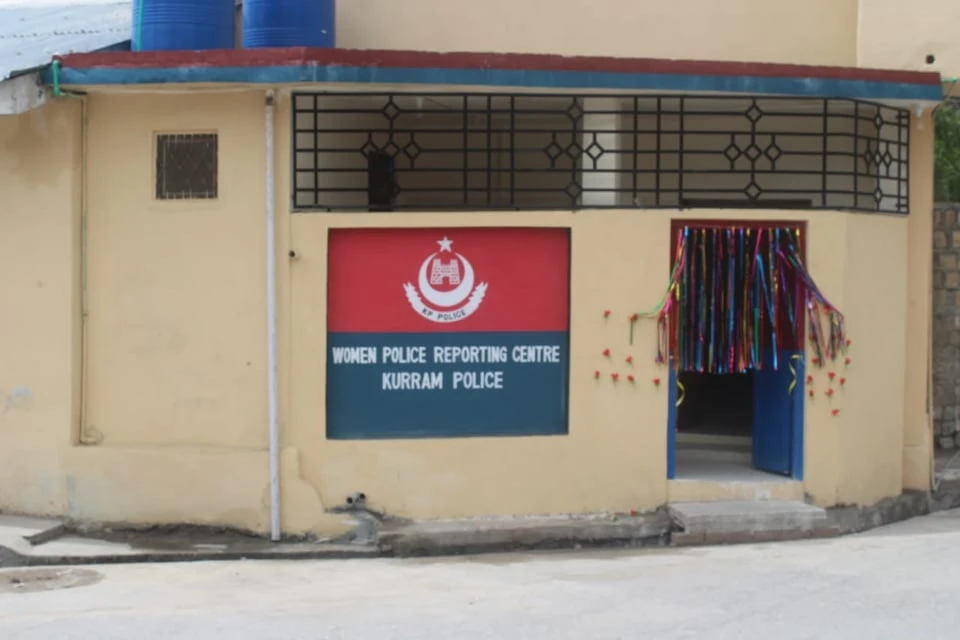
The first police reporting center for women in Kurram district, Khyber Pakhtunkhwa, is seen during its inauguration in Parachinar on May 1, 2020. (Photo courtesy: Kurram Police)
Short Url
Updated 11 May 2020
Follow

First female police center in tribal areas gives women hope for justice

  • The center in Parachinar has 14 female police personnel and all facilities needed to assist women who seek help
  • Most of the problems faced by women in the region are related to domestic violence at the hands of in-laws

PESHAWAR: Police in Kurram have launched the first female reporting center in Khyber Pakhtunkhwa's tribal districts, in hopes of expanding women's access to justice in a region where they had been traditionally deprived of it.

"I observed that women were reluctant to approach police stations with complaints, so I decided to launch a separate reporting center for them," Kurram District Police Officer (DPO) Muhammad Quraish Khan told Arab News

He said that when he took his post last year, he found local police stations completely unaccommodating to women.
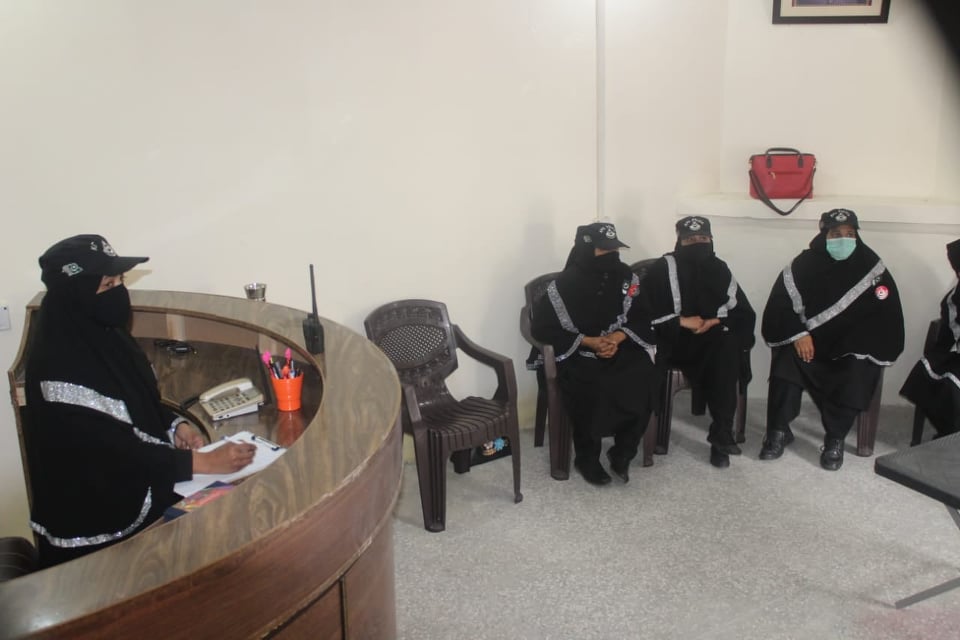


Female officers are on duty at Kurram district's first police reporting center for women in Parachinar on May 1, 2020. (Photo courtesy: Kurram Police)

"My idea was to provide an environment for women in this male-dominated tribal society to come without hesitation and register their complaints," he said.

Inaugurated on May 1, the spacious center in Parachinar, the capital of Kurram, has 14 female police personnel and all facilities needed to assist women who come to seek help. It also has a playground for children whose officer mothers are on duty.

"I am getting immensely positive feedback from locals," Khan said, adding that if this pilot project is successful, he would recommend the establishment of similar centers in other tribal areas.

While such facilities already exist in other parts of Khyber Pakhtunkhwa, in the tribal region the very idea of women seeking justice is revolutionary and may also prove lifesaving.

"In tribal culture, women can't go outside alone to file a complaint with male police. This adds to their burdens, leads many young women to commit suicide to get rid of their problems forever," Naila Altaf, a social activist from the district, told Arab News.

Most of the problems, she said, are related to the tribal society's joint-family system, which is marred by domestic violence at the hands of in-laws.

Barriers to reporting and seeking formal help are often fear of tarnishing family members, getting into bigger trouble or unawareness of one's own rights.

"Women are hesitant to complain, especially when their problems involve domestic issues," Khan confirmed. 

Since the center's inauguration, he said, about three women a week come to lodge reports — the district's population is about 620,000. 

But more will come in the future, Khan believes, as with special training underway, his female police officers will be able to provide a sense of security to women and ensure that their privacy is kept, so that gradually there would be more confidence in the police system.

According to Mahrukh Jabeen, a graduate from Kurram district, the new initiative is a step forward in women's empowerment and their access to justice and law enforcement.

"Women in tribal areas have yet to be able to benefit from the merger of tribal districts with Khyber Pakhtunkhwa. The transition is very slow, so the female reporting center will somehow mitigate the situation," she said.

The introduction of police in Pakistan's tribal areas — the erstwhile Federally Administered Tribal Area (FATA) — followed the 2018 constitutional amendment, which merged the region with Khyber Pakhtunkhwa and revoked archaic British colonial-era laws, bringing in modern systems of justice and law enforcement.

Khan is aware that the changes will require long-term efforts and work on social perceptions before they are fully implemented. The female reporting center aims to ensure that women would not be left out in the process.

"The transition period of the tribal region will take time," he said, "We're here for women to get their constitutional rights."

Pakistan accuses India of manipulating Indus waters, warns of risks to regional peace

Updated 6 sec ago
Follow

Pakistan accuses India of manipulating Indus waters, warns of risks to regional peace

  • India announced in April it was putting the Indus Waters Treaty in abeyance over a gun attack in disputed Kashmir it blamed on Pakistan
  • Islamabad says it has witnessed ‘unusual, abrupt variations’ in the flow of Chenab river, accusing New Delhi of ‘material breaches’ of treaty

ISLAMABAD: Pakistan on Friday accused India of manipulating flows of Indus waters in violation of a 1960 water-sharing treaty, warning that unilateral actions over the transboundary waters could heighten tensions and pose risks to regional peace.

The Indus Waters Treaty (IWT), mediated by the World Bank, divides control of the Indus basin rivers between the two nuclear-armed neighbors. India said in April it was holding the treaty “in abeyance” after a gun attack in Indian-administered Kashmir killed more than 26 tourists. New Delhi blamed the assault on Pakistan, Islamabad denied it.

The treaty grants Pakistan rights to the Indus basin’s western rivers — Indus, Jhelum, and Chenab — for irrigation, drinking, and non-consumptive uses like hydropower, while India controls the eastern rivers — Ravi, Beas, and Sutlej — for unrestricted use but must not significantly alter their flow. India can use the western rivers for limited purposes such as power generation and irrigation, without storing or diverting large volumes, according to the agreement.

Speaking at a televised press briefing, Pakistani Deputy Prime Minister Ishaq Dar accused New Delhi of “material breaches” of the IWT that may have consequences for regional stability, citing “unusual, abrupt variations” in the flow of Chenab river from April 30 to May 21 and from Dec. 7 to Dec. 15.

“These variations in water flows are of extreme concern for Pakistan as they point to unilateral release of water by India into River Chenab. India has released this water without any prior notification or any data- or information-sharing with Pakistan as required under the treaty,” he said.

“India’s most recent action clearly exemplifies the weaponization of water to which Pakistan has been consistently drawing attention of the international community.”

There was no immediate response from New Delhi to the statement.

Dar said this water “manipulation” occurs at a critical time in Pakistan’s agricultural cycle and directly threatens the lives and livelihoods as well as food and economic security of its citizens.

He shared that Indian actions prompted Indus Water Commissioner Mehar Ali Shah to write a letter to his Indian counterpart, seeking clarification on the matter as provided under the Indus Waters Treaty.

“We expect India to respond to the queries raised by Pakistan’s Indus water commissioner, refrain from any unilateral manipulation of river flows, and fulfill all its obligations in letter and spirit under the Indus Waters Treaty provisions,” the Pakistani deputy premier said.

Dar also accused India of consistently trying to undermine the IWT by building various dams, including Kishenganga and Ratle hydropower projects, which he said sets “a very dangerous precedent.”

“Alarmingly, India is now subverting the treaty’s own dispute resolution mechanism by refusing to participate in the Court of Arbitration and neutral expert proceedings. India is pursuing a deliberate strategy to sabotage the well-established arbitration process under the treaty provisions,” he said.

The South Asian neighbors have been arguing over hydroelectric projects on the shared Indus river system for decades, with Pakistan complaining that India’s planned hydropower dams will cut its flows.

In August, the International Court of Arbitration rendered an award on issues of general interpretation of the IWT, explaining the designed criteria for the new run-of-river hydropower projects to be constructed by India on the western rivers of Chenab, Jhelum and Indus, which Islamabad said vindicated its stance.

In its findings, the Court of Arbitration declared that India shall “let flow” the waters of the western rivers for Pakistan’s unrestricted use. In that connection, the specified exceptions for generation of hydro-electric plants must conform strictly to the requirements laid down in the Treaty, rather than to what India might consider an “ideal” or “best practices approach,” according to the Pakistani foreign office.

“Pakistan would like to reiterate that Indus Waters Treaty is a binding legal instrument that has made an invaluable contribution to peace and stability of South Asia,” Dar said.

“Its violation, on the one hand, threatens the inviolability of international treaties and on the other, it poses serious risks to regional peace and security, principles of good neighborhood, and norms that govern inter-state relations.”