

Pakistan’s exports to decline by $3 billion due to pandemicー commerce minister

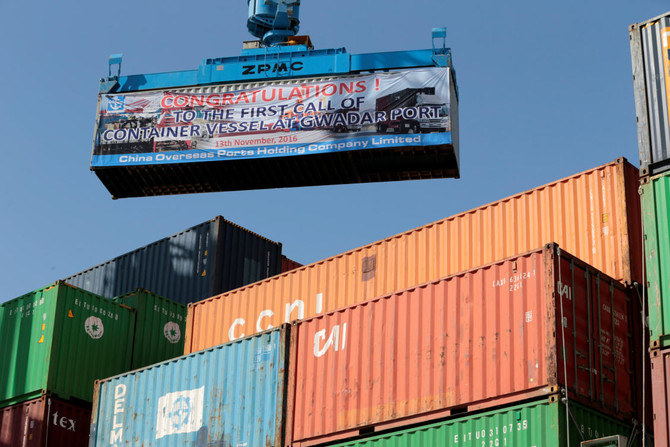
A container is loaded on to the first Chinese container ship to depart after the inauguration of the China Pakistan Economic Corridor port in Gwadar in 2016. (File/Reuters)
Short Url
Updated 11 May 2020
Follow

Pakistan’s exports to decline by $3 billion due to pandemicー commerce minister

  • Food exports to the Middle East have substantially increased in the same time period
  • Says Pakistan will allow the export of personal protective equipment masks and sanitizers to offset export revenue losses

KARACHI: Pakistan’s exports are expected to decline by around $3 billion during the current fiscal year due to sluggish global demand and ensuing lockdowns following the coronavirus pandemic, Pakistan’s commerce minister said on Sunday.
The South Asian country’s exports plunged by a massive 54 percent in April 2020 compared to the same month last year, and stood at $957 million. The overall exports from Pakistan during July-April 2019-20 declined by 3 percent to $18.4 billion, Pakistan Bureau of Statistics data shows.
“I think approximately the export would decline by $2 billion to $3 billion due to COVID-19,” Abdul Razak Dawood, adviser to Prime Minister for Commerce, Textile and Investment told Arab News in an exclusive interview.

The declining trend shows the country will be unable to achieve its $25 billion export target set for the current fiscal year. However, government officials say they are trying hard to recoup part of lost export revenues by product diversification.

“Our main exports is textile and they (textile exporters) are adjusting by going to medical markets,” Dawood said and added: “We are going to allow exports of various medical items such as masks, uniforms (protective suits) and other related textile-made products and sanitizers”. 

The de facto commerce minister also said trade queries from different countries were continuously pouring in about the exports of medical products.

“Many inquires are flowing in and they are asking if we would allow exports and we have responded,” Dawood said. He added they would be allowed and that he was confident the country would compensate for the substantial amount of its losses from exports.

Pakistan largely relies on the export of textile products which make up more than 50 percent of its total exports. During the last fiscal year the country was able to export $22.98 billion worth of goods of which the share of textile goods was $13.33 billion.

“We are working on diversification of products and diversification of geographical markets. Central Asian Republics and Africa are our major focus,” Dawood said. “We are also looking to USA and Europe as potential markets for our textile made medical products,” he added.  

The Middle East remains one of Pakistan’s major trading partners-- where the demand for food products has increased substantially after the lockdowns.

“Our exports to the Middle East have increased by around 26 percent during the current year. In Middle East the demand of meat, poultry and rice has substantially increased,” Dawood said. 

Recently, Pakistan has made inroads into African markets where the demand for tractors, textile and food products was surging until COVID-19 arrested growth.

“Before COVID-19, our exports to the African market were increasing and this year an increase has also been witnessed as compared to last year. But unfortunately due to COVID-19 what we were expecting has not been achieved,” he added.

Responding to a question about the upcoming federal budget which is expected to be announced in the first week of next month, the commerce minister said the major focus would be on the promotion of domestic commerce.

“In budget as far as the ministry of commerce is concerned.. we have our major focus on rationalization of the tariff so that our program of ‘Made in Pakistan’ is given attention,” he said. 

Dawood added that under the current circumstances, efforts were underway to rely less on imports and encourage manufacturing in Pakistan.


Pakistan police book man for wounding buffalo with ax in Bahawalpur district

Updated 9 sec ago
Follow

Pakistan police book man for wounding buffalo with ax in Bahawalpur district

  • Complainant accuses a landowner in Ahmadpur East of attacking buffalo for straying into his fodder field 
  • Pakistan police register case against suspect under Pakistan Penal Code for injuring cattle 

ISLAMABAD: Police in Pakistan’s eastern Bahawalpur district registered a case on Sunday against a landowner for wounding a buffalo with ax for straying into his fodder field, in another case of animal brutality in the country. 

As per a copy of the police complaint seen by Arab News, the complainant Bashir Ahmad, a laborer and resident of the Ismail Pur area of the Ahmadpur East city, said the incident took place on Jan. 24. 

Ahmad said he arrived at his home after work on Saturday to find that his buffalo had escaped. Ahmad searched for the animal along with two others he cited as eyewitnesses in his report. They discovered that the buffalo had strayed into a fodder field nearby owned by a man named Manzoor Hussain.

“During this time, Manzoor Hussain came with an ax and as we watched, attacked both of the front legs of the buffalo,” the police report quoted Ahmad as saying. 

The complainant said the buffalo collapsed as a result of the assault. It did not mention whether the buffalo had died or not. 

Ahmad said the suspect abused him and the other eyewitnesses and left the area after they arrived. 

“Manzoor Hussain has committed a grave injustice by injuring my buffalo,” the report quoted Ahmad as saying. “I want action to be taken against him.”

Police registered a case against Hussain under Sections 427 [mischief causing damage to the amount of fifty rupees] and 429 [mischief by killing or maiming cattle of any value or any animal of the value of fifty rupees] of the Pakistan Penal Code. 

Local media reported the suspect had been arrested following the police complaint. 

Animal abuse cases in Pakistan have frequently made headlines over the years. In June 2024, a local landlord in the southern Sanghar district was accused of chopping off a camel’s leg after it strayed into his fields for grazing. 

The story, which triggered an uproar on mainstream and social media, led to the camel being transported to an animal shelter in Karachi for treatment. Six suspects were arrested by the police. 

In another incident in the southern Umerkot district during June 2024, a camel was found dead with its legs amputated. 

In July 2024, a man was arrested in Pakistan’s eastern Shahpur city for chopping off a buffalo’s tongue.

Pakistan’s existing animal cruelty laws, rooted in the Prevention of Cruelty to Animals Act of 1890, prohibit various forms of animal cruelty, including beating, overdriving, and mutilation. 

The legislation also prescribes penalties for breaches of these anti-cruelty provisions, which can include fines and imprisonment, though these are not always effectively enforced.