British Airways parent IAG dives into huge quarterly loss

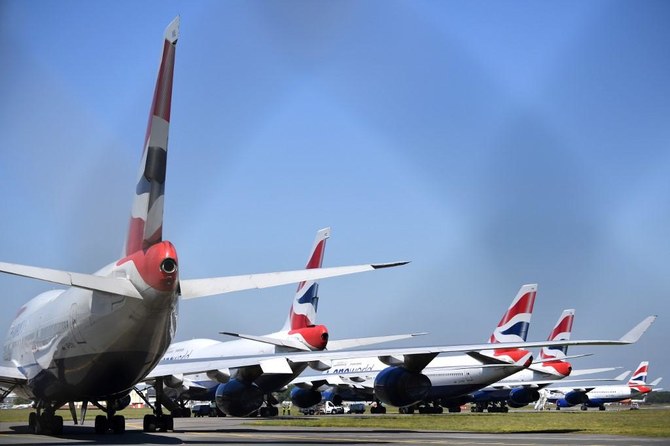
IAG, which flies British Airways, slashed its passenger capacity by a staggering 94 percent from late March. (AFP)
Short Url
Updated 07 May 2020
Follow

British Airways parent IAG dives into huge quarterly loss

  • Huge net loss of $1.8 billion in the three months to the end of March
  • IAG slashed its passenger capacity by a staggering 94 percent from late March

LONDON: British Airways owner IAG said Thursday it plunged into the red in the first quarter as the coronavirus pandemic grounded planes, adding that pre-crisis passenger demand would not return until 2023.
The company suffered a huge net loss of $1.8 billion (€1.68 billion) in the three months to the end of March, when the global aviation sector began to be ravaged by the deadly COVID-19 outbreak.
That contrasted with profit after tax of $74.9 million in the first quarter of 2019, IAG said in a statement.
News of the sharp loss comes one week after IAG outlined plans to axe up to 12,000 BA staff, as it struggles to cope with evaporating demand for air travel.
IAG on Thursday added that group revenue slid 13 percent to $4.9 billion in the first quarter.
“The results for the quarter were significantly impacted by the outbreak of COVID-19, which has had a devastating impact on the global airline and travel sectors, with the spread of the virus worldwide, resulting in lockdowns and travel restrictions and advisories, particularly from late February 2020 onwards,” the London-listed group said.
IAG, which flies also Spanish airline Iberia and Irish carrier Aer Lingus, slashed its passenger capacity by a staggering 94 percent from late March.
“Most of the loss in the quarter occurred in the last two weeks of March,” said outgoing chief executive Willie Walsh, noting that IAG “had a strong balance sheet and liquidity position coming into this crisis.”
“We are taking all appropriate actions to preserve cash, reduce and defer both capital spending and operating costs and secure additional financing,” he said.
Walsh added that IAG was planning for a “meaningful return” to flight services in July “at the earliest” — but cautioned that this was dependent on easing lockdowns and travel restrictions.
“We do not expect passenger demand to recover to the level of 2019 before 2023 at the earliest,” he said.
“This means group-wide restructuring is essential in order to get through the crisis and preserve an adequate level of liquidity. We intend to come out of the crisis as a stronger group.”
Most of its aircraft have been grounded apart from those being used for operating limited passenger, repatriation and cargo-only flights, the company said.
IAG added that Walsh would finally be replaced by Iberia boss Luis Gallego on September 24 after his start date had been put back because of the coronavirus outbreak.


S&P affirms UAE sovereign credit ratings at AA/A-1+ amid regional tensions

Updated 8 sec ago
Follow

S&P affirms UAE sovereign credit ratings at AA/A-1+ amid regional tensions

JEDDAH: The UAE’s sovereign credit ratings have been affirmed at AA/A-1+ with a stable outlook, as S&P Global Ratings highlighted the country’s strong fiscal buffers, diversified economy, and policy flexibility in the face of escalating regional conflict.

The agency cited the UAE’s consolidated net assets, estimated at 184 percent of gross domestic product in 2026, and its low general government debt of around 27 percent of GDP, as key buffers against economic shocks.

Sovereign credit ratings play a key role in determining a country’s borrowing costs and investor demand for its debt. A high rating signals strong fiscal health and policy stability, helping governments attract foreign investment and access global capital markets at favorable terms.

S&P noted that “our baseline forecasts carry a significant amount of uncertainty” amid heightened tensions involving Iran, Israel, and the US, including potential threats to key infrastructure.

The report added: “We also believe the authorities will deploy their substantial policy flexibility to counteract the effects of volatility stemming from geopolitical tensions in the Gulf region on economic growth, government revenue, and its external accounts.

“We believe this flexibility will enable the UAE to withstand periods of low oil prices and, more importantly, the temporary disruption of oil production and export routes.”

The UAE is facing a tense geopolitical environment amid escalating Iran-Israel-US conflicts. Threats around the Strait of Hormuz have nearly stopped vessel traffic, fueling oil market volatility and investor concern.

The ratings agency also emphasized the UAE’s diversified economic base, with non-oil sectors accounting for roughly 75 percent of GDP, as a stabilizing factor.

Strategic infrastructure, including the Abu Dhabi Crude Oil Pipeline to Fujairah, enables the country to bypass the Strait of Hormuz and safeguard oil exports, while ADNOC’s overseas storage investments further mitigate risk.

Despite the risks, S&P expects sectors such as financial services, trade, and tourism to remain resilient. It forecasts that UAE growth will moderate to 2.2 percent in 2026, down from 5 percent in 2025, reflecting potential impacts from expatriate outflows, reduced tourism revenue, and lower real estate demand.

S&P cautioned, however, that “we now expect weaker economic and external performance due to increased intensity, scope, and potential duration of conflict in the Middle East,” underscoring that prolonged disruption could weigh on fiscal and external accounts.

The affirmation underscores investor confidence in the UAE’s ability to navigate short-term geopolitical challenges while maintaining long-term stability. Analysts said the country’s large liquid asset buffer and effective policy tools will likely contain the credit impact of regional tensions and support continued economic growth.

The UAE has consistently maintained strong and stable sovereign credit ratings, reflecting a resilient and diversified economy, as well as prudent fiscal management.

Despite occasional caution during regional tensions or oil market swings, ratings have remained high, underscoring the country’s policy flexibility, fiscal strength, and appeal to global investors.