

UAE disallows elderly, children inside shopping malls and retail stores as coronavirus precaution

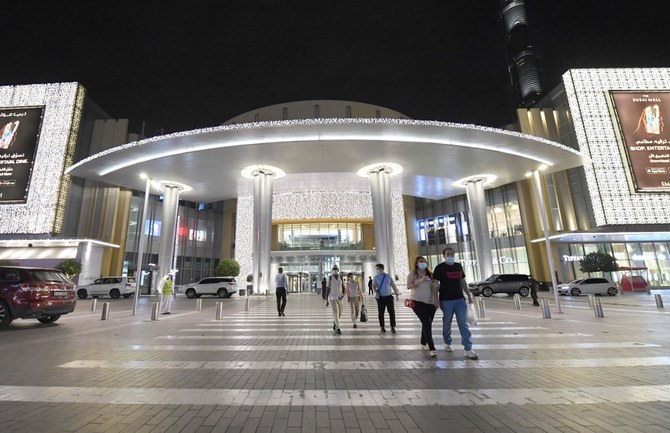
People wearing masks for protection against the coronavirus leave Dubai Mall on April 28, 2020 after the government eased lockdown restrictions. (AFP)
Short Url
Updated 07 May 2020
Follow

UAE disallows elderly, children inside shopping malls and retail stores as coronavirus precaution

DUBAI: The UAE has disallowed entry for people over the age of 60 and children younger than 12 from entering shopping malls, cooperative societies and supermarkets as a safety precaution the coronavirus, state news agency WAM has reported.

They are also prohibited from entering retail stores located outside shopping centers, the Ministry of Health and Prevention and the National Emergency Crisis and Disaster Management Authority said in a in a joint announcement.

“These precautions are in order to ensure their health and safety,” the statement said.

Global health officials have confirmed studies that those in the same age cohorts are at most risk of contracting coronavirus, which has affected over 3.6 million individuals and has resulted into over quarter a million deaths.

In the UAE, total coronavirus infections reached 15,192 as of Tuesday, May 5, while fatalities have risen to 146.

“The decision was made as part of the precautionary measures and restrictions governing the re-opening of shopping malls and commercial centers in the UAE,” WAM reported.


In major policy shift on Syria, UN Security Council lifts sanctions on Hayat Tahrir Al-Sham

Updated 28 February 2026
Follow

In major policy shift on Syria, UN Security Council lifts sanctions on Hayat Tahrir Al-Sham

  • Move reflects evolving Syrian political landscape in the post-Assad era, ending a global freeze on assets, travel ban and arms embargo

NEW YORK CITY: The UN Security Council on Friday removed Al-Nusra Front, the militant group that evolved into Hayat Tahrir Al-Sham, from its so-called Daesh and Al-Qaeda Sanctions List.

The move signals a major shift in international policy toward Syria’s evolving political landscape in the post-Assad era, and ends a global freeze on assets, travel ban and arms embargo that have been imposed on the group since 2014.

Al-Nusra Front and Hayat Tahrir Al-Sham were led by Ahmad Al-Sharaa, formerly Abu Mohammed Al-Julani, who is now Syria’s president and was a leading figure in the offensive that toppled the Assad regime.

The consensus decision by the Security Council’s sanctions committee was announced by the UK, which holds the presidency of the Security Council this month and was acting in the absence of the chair of the committee. It followed a request by the new Syrian authorities to delist “Al-Nusrah Front for the People of the Levant.”

The decision means measures that were applied to Hayat Tahrir Al-Sham under Security Council Resolution 2734, adopted in 2024, no longer apply. As a result, UN member states are notrequired to freeze the group’s funds, restrict the movement of its representatives, or block the supply or transfer of arms and related materiel.

Al-Nusra Front was added to the sanctions list for its ties to Al-Qaeda and involvement in the financing and execution of militant activities during the war in Syria. The UN initially continued to treat the group’s successor organization, Hayat Tahrir Al-Sham, as a listed alias.

Al-Sharaa has said the group severed all prior transnational jihadist links and is now solely focused on local Syrian matters.