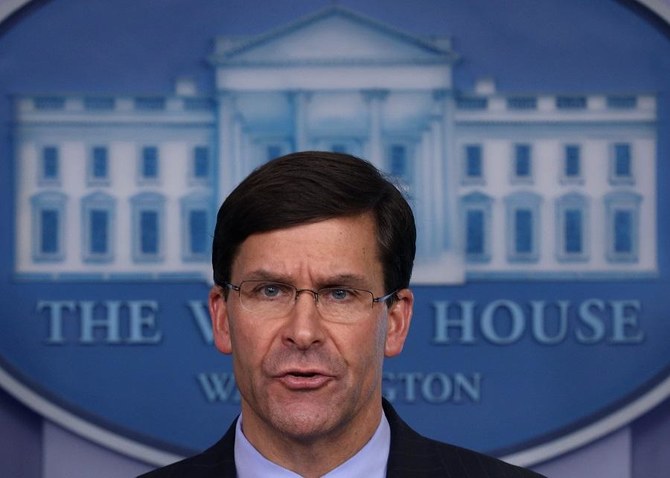
ROME: Russia and China are taking advantage of the coronavirus emergency to put their interests forward in Europe, US Defense Secretary Mark Esper said on Monday, describing Chinese efforts to promote Huawei mobile phone network equipment as malign.
“(The United States) is aware that some (countries) will try to use the pandemic as a way to invest in critical industry and infrastructure, with effect on security in the long term,” Esper told newspaper La Stampa, when asked whether China and Russia were trying to gain influence in Italy by sending aid.
“Potential opponents will almost certainly try to use their interest to put their interests forward and create divisions in NATO and Europe,” he said. “Huawei and 5G are an important example of this malign activity by China.”
Esper’s comments come at a time when some US officials have blamed China for the coronavirus outbreak. Secretary of State Mike Pompeo said on Sunday Washington had evidence the disease emerged from a Chinese lab, which Beijing strongly denies.
Both China and Russia have offered support to Italy, sending doctors, medical equipment and face masks to the country which was the first in Europe to be hit hard by the outbreak.
The United States has long advised countries to boycott Huawei, the world’s biggest maker of telecoms equipment, in setting up new 5G mobile phone networks, and also to scrutinize gear from another Chinese firm, ZTE.
Washington says the equipment could be used by China to spy on communications. Huawei and ZTE deny their gear poses a security threat.
“Dependence on Chinese suppliers could make crucial systems vulnerable to interruption, manipulation and espionage. This would put at risk our capacity to communicate and to share intelligence,” Esper said.
Russia’s assistance, including army medical staff, drew attention to the limited support Italy received from the European Union, and EU and NATO diplomats and officials have seen it as a geopolitical move.


![]()

China, Russia take advantage of virus emergency: US defense secretary
Short Url
https://arab.news/24jsh
China, Russia take advantage of virus emergency: US defense secretary
- Both China and Russia have offered support to Italy, sending doctors, medical equipment and face masks to the country
- Secretary of State Mike Pompeo said on Sunday Washington had evidence the disease emerged from a Chinese lab, which Beijing strongly denies


Latest updates


© 2026 SAUDI RESEARCH & PUBLISHING COMPANY, All Rights Reserved And subject to Terms of Use Agreement.