

Arab American professor to be memorialized in university scholarship

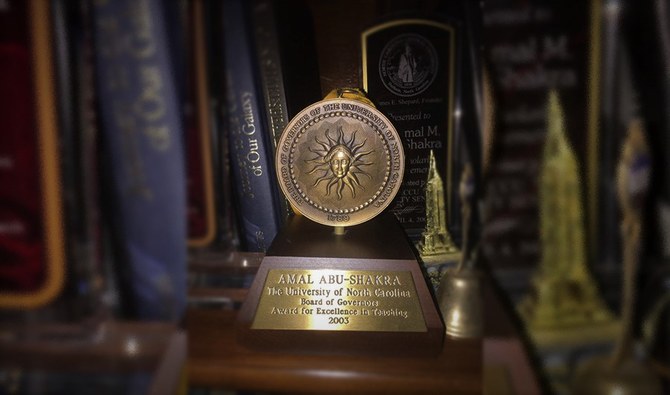
Award of Excellence in Teaching given to (late) Amal Abu-Shakra, Professor of biology and biochemistry at The University of North Carolina. (Supplied)
Short Url
Updated 04 May 2020
Follow

Arab American professor to be memorialized in university scholarship

  • Amal Abu Shakra was a professor of biology and biochemistry at North Carolina Central University
  • A colleague of hers at the Environmental Protection Agency is establishing a scholarship in her name

CHICAGO: For veteran Lebanese journalist Eyad Abu Shakra, writing about the challenges of life was one of his priorities, but that never eclipsed his love for his family. 

He said he was humbled to learn last week that his sister Amal Abu Shakra, a professor of biology and biochemistry at North Carolina Central University (NCCU) who died of complications from endometrial cancer in August 2017, would be honored with a scholarship in her name.

The news came from his brother-in-law Dr. Witold Winnik, who works at the US Environmental Protection Agency (EPA) at Research Triangle Park in North Carolina. 

He told Eyad that one of Amal’s colleagues at the EPA, Dr. David DeMarini, announced that he would establish a scholarship in her name at NCCU, which prides itself as being the first public liberal arts institution in the US for African-American students.

“David, a brilliant genetic toxicologist who retired this past March, is a former senior scientist at the EPA … and a colleague of my sister. He was her former boss and a very good friend,” Eyad told Arab News. 

“David informed me he always wanted to keep Amal’s memory alive. He said he knew how much she cared about her students. She was such a good soul. The best thing and least thing he could do was to start a scholarship in her name at her university, he told me.”

DeMarini said: “Amal was a wonderful scientist and one of the most thoughtful, kind and generous persons I ever met. Her great love of humanity and sense of humor were felt by all who knew her.”

Eyad, who began his media career in 1973 at An-Nahar newspaper in Lebanon, said Amal had fought cancer for 25 years.

“She phoned me in June (2017). She said she missed me and wanted to see me, and said this time would be different,” Eyad recalled, finding Amal in intensive care at the Duke University Medical Center.

“I stayed with her for a month. I saw the marked deterioration day by day … Eventually her bone marrow couldn’t produce blood platelets. When she died it was very painful.”

Eyad described Amal as “one of a kind, a brilliant scientist in biochemistry and toxicology.” She earned her bachelor’s degree from the American University of Beirut (AUB), her master’s from the University of London, and her PhD from the UK’s University of Surrey. 

A senior editor at Asharq Al-Awsat newspaper, Eyad asked Amal to write her biography to document her career researching biology, which he said appeared in the newsletter of AUB’s Worldwide Alumni Association, entitled “Reflections.”


Israel confirms ban on 37 NGOs in Gaza

A Palestinian woman carries wood for fire in the Nuseirat refugee camp in the central Gaza Strip on December 31, 2025. (AFP)
Updated 54 min 36 sec ago
Follow

Israel confirms ban on 37 NGOs in Gaza

  • UN has warned that this will exacerbate the humanitarian crisis in the war-ravaged Palestinian territory
  • Several NGOS have said the requirements contravene international humanitarian law or endanger their independence

JERUSALEM: Israel on Thursday said 37 humanitarian agencies supplying aid in Gaza had not met a deadline to meet “security and transparency standards,” and would be banned from the territory, despite an international outcry.
The international NGOs, which had been ordered to disclose detailed information on their Palestinian staff, will now be required to cease operations by March 1.
The United Nations has warned that this will exacerbate the humanitarian crisis in the war-ravaged Palestinian territory.
“Organizations that have failed to meet required security and transparency standards will have their licenses suspended,” Israel’s Ministry of Diaspora Affairs and Combating Antisemitism said in a statement.
Several NGOS have said the requirements contravene international humanitarian law or endanger their independence.
Israel says the new regulation aims to prevent bodies it accuses of supporting terrorism from operating in the Palestinian territories.
Prominent humanitarian organizations hit by the ban include Doctors Without Borders (MSF), the Norwegian Refugee Council (NRC), World Vision International and Oxfam, according to a ministry list.
In MSF’s case, Israel accused it of having two employees who were members of Palestinian militant groups Islamic Jihad and Hamas.
MSF said this week the request to share a list of its staff “may be in violation of Israel’s obligations under international humanitarian law” and said it “would never knowingly employ people engaging in military activity.”
‘Critical requirement’ 
NRC spokesperson Shaina Low told AFP its local staff are “exhausted” and international staff “bring them an extra layer of help and security. Their presence is a protection.”
Submitting the names of local staff is “not negotiable,” she said. “We offered alternatives, they refused,” hse said, of the Israeli regulators.
The ministry said Thursday: “The primary failure identified was the refusal to provide complete and verifiable information regarding their employees, a critical requirement designed to prevent the infiltration of terrorist operatives into humanitarian structures.”
In March, Israel gave NGOs 10 months to comply with the new rules, which demand the “full disclosure of personnel, funding sources, and operational structures.”
The deadline expired on Wednesday.
The 37 NGOs “were formally notified that their licenses would be revoked as of January 1, 2026, and that they must complete the cessation of their activities by March 1, 2026,” the ministry said Thursday.
A ministry spokesperson told AFP that following the revocation of their licenses, aid groups could no longer bring assistance into Gaza from Thursday.
However, they could have their licenses reinstated if they submitted the required documents before March 1.
Minister of Diaspora Affairs and Combating Antisemitism Amichai Chikli said “the message is clear: humanitarian assistance is welcome — the exploitation of humanitarian frameworks for terrorism is not.”
‘Weaponization of bureaucracy’
On Thursday, 18 Israel-based left-wing NGOs denounced the decision to ban their international peers, saying “the new registration framework violates core humanitarian principles of independence and neutrality.”
“This weaponization of bureaucracy institutionalizes barriers to aid and forces vital organizations to suspend operations,” they said.
UN Palestinian refugee agency chief Philippe Lazzarini had said the move sets a “dangerous precedent.”
“Failing to push back against attempts to control the work of aid organizations will further undermine the basic humanitarian principles of neutrality, independence, impartiality and humanity underpinning aid work across the world,” he said on X.
On Tuesday, the foreign ministers of 10 countries, including France and Britain, urged Israel to “guarantee access” to aid in the Gaza Strip, where they said the humanitarian situation remains “catastrophic.”
A fragile ceasefire has been in place since October, following a deadly war waged by Israel in response to Hamas’s unprecedented October 7, 2023 attack on Israel.
Nearly 80 percent of buildings in Gaza have been destroyed or damaged by the war, according to UN data.
About 1.5 million of Gaza’s more than two million residents have lost their homes, said Amjad Al-Shawa, director of the Palestinian NGO Network in Gaza.