

Iran’s great virus gamble: Mosques to reopen despite soaring death toll

1 / 2
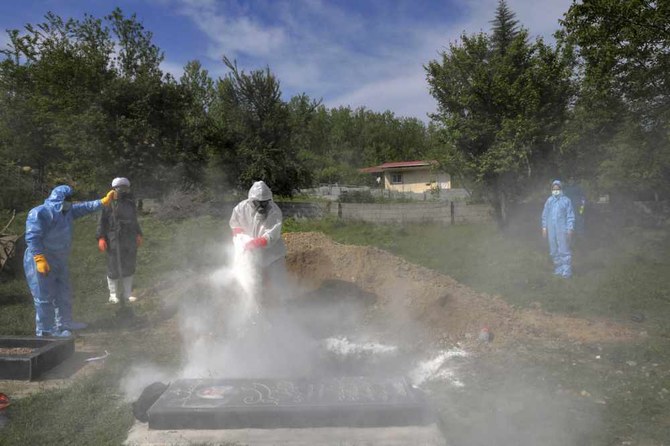
People wearing protective clothing attend the funeral of a victim who died from the new coronavirus, at a cemetery in the outskirts of the city of Ghaemshahr, north Iran, on May 1, 2020. (AP Photo/Ebrahim Noroozi)
2 / 2
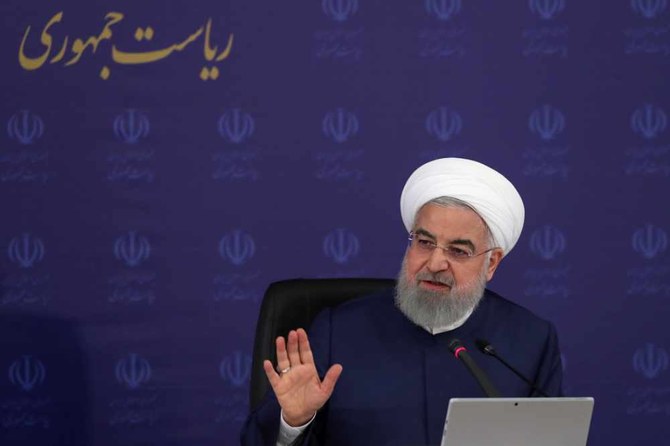
Iranian President Hassan Rouhani chairing a cabinet session in the capital Tehran on May 3, 2020. (Iranian Presidency photo via AFP)
Short Url
Updated 04 May 2020
Follow

Iran’s great virus gamble: Mosques to reopen despite soaring death toll

  • Experts say more are infected than Tehran’s official figures
  • Health officials fear new spike in cases

JEDDAH: Hundreds of mosques in Iran will reopen their doors on Monday despite a soaring death toll from the coronavirus and uncertainty over how many Iranians have been infected.

Health Ministry spokesman Kianoush Jahanpour reported 976 new virus cases on Sunday, taking the total to 97,424, and the official death toll rose by 47 to 6,203.

But experts and officials both inside and outside Iran have cast doubt on the country’s official COVID-19 figures, and say the real number of cases could be much higher than reported.

Nevertheless, President Hassan Rouhani said on Sunday 132 administrative districts, about a third of the country, would “reopen their mosques as of tomorrow.”

Mosques would open “while respecting the health protocols,” Rouhani said. “Social distancing is more important than collective prayer.” 

He argued that Islam considered safety obligatory, while praying in mosques was only “recommended.”

Iran was slow to react to the virus pandemic. Mosques and key religious shrines in Mashad and Qom were not closed until mid March, and clerics actively encouraged pilgrims to visit even as the outbreak became the worst in the Middle East and spread from Iran to other countries in the region.

Tehran eventually tried to contain the spread of the virus by closing universities, cinemas, stadiums and other public spaces. But it has risked a phased reopening of its economy since April 11, arguing that because of US sanctions it cannot afford to remain shut down.

A ban on intercity trips has been lifted, and malls have reopened despite warnings by some health officials of a new wave of infections. Schools and universities remain closed and cultural and sports gatherings are banned, though Rouhani said schools in low-risk areas would reopen soon.

Only “high-risk” businesses such as gyms and barbershops remain closed. “We will continue the reopenings calmly and gradually,” Rouhani said.

Meanwhile, Saudi Arabia reported 1,552 new virus cases on Sunday, taking the total to 27,011, and the death toll rose by eight to 184. Worldwide, the virus has infected more than 3.5 million people and killed nearly 250,000.

Jordan lifted all remaining restrictions on economic activity on Sunday in the latest easing of coronavirus lockdown rules to help jump-start the economy. Authorities in Amman have  been gradually lifting restrictions in the past two weeks to allow businesses back to work, but with lower levels of staff and strict social distancing and hygiene guidelines.

Industry Minister Tariq Hammouri said businesses and industries would now be able to resume full production. Public transport will return to normal service with safety guidelines, but universities and schools will remain closed and a night curfew will continue.

Jordan has reported 460 confirmed coronavirus cases and nine deaths but says it has contained the outbreak. 

Prime Minister Omar Razzaz won praise for a fast response to the pandemic, but as the economic impact deepened there was criticism from business groups and fears of social unrest. 

In the US, Secretary of State Mike Pompeo resumed Washington’s attack on China for being responsible for the pandemic.

“There is a significant amount of evidence that this came from that laboratory in Wuhan,” Pompeo said. “The best experts so far seem to think it was man-made. I have no reason to disbelieve that at this point.”


Israeli attacks on Lebanon kill four, including security officer and child

Updated 7 sec ago
Follow

Israeli attacks on Lebanon kill four, including security officer and child

  • Lebanon’s health ministry says Israeli strike on village of Yanuh in the south killed three people
  • Israeli gunfire also killed one person in the border village of Aita Al-Shaab
BEIRUT: Israeli attacks on Lebanon killed four people on Monday including a Lebanese security forces member and his child, hours after the Israeli army seized a member of Islamist group Jamaa Islamiya.
Israel frequently strikes Lebanon despite a November 2024 ceasefire aimed at ending more than a year of hostilities with militant group Hezbollah.
On Monday, Lebanon’s health ministry said an Israeli strike on the village of Yanuh in the south killed three people.
The Israeli military said the strike targeted Ahmad Ali Salameh, who it alleged was Hezbollah’s head of artillery and had been working to restore the group’s capabilities.
In addition to Salameh, the strike killed a member of Lebanon’s security forces and his three-year-old child, who were passing by, according to Lebanon’s state-run National News Agency (NNA).
The Israeli military said the incident was “under review” after it was made “aware of the claim that uninvolved civilians were killed.”
Later on Monday, the health ministry reported that Israeli gunfire killed one person in the border village of Aita Al-Shaab, with the Israeli military saying it killed a Hezbollah member.
It alleged he was “gathering intelligence on (Israeli) troops and operated to rehabilitate Hezbollah’s terrorist infrastructure in southern Lebanon.”
In addition to recurring attacks, the Israeli army still has troops deployed on five border positions in Lebanon it deems strategic.
Monday’s incidents come hours after the Jamaa Islamiya group, an ally of Palestinian militants Hamas, accused Israel of seizing one of its officials, Atwi Atwi, from his home in the Hasbaya district, south Lebanon, and taking him to an unknown location.
The group, which has claimed responsibility for multiple attacks against Israel during the war with Hezbollah, condemned “the Israeli occupation forces’ infiltration.”
The Israeli military said that it “apprehended a senior terrorist” in the group who was then “transferred for further questioning in Israeli territory.”
Atwi’s capture came hours after Lebanese Prime Minister Nawaf Salam completed a two-day visit to the south, which suffered extensive damage during the conflict with Hezbollah, with thousands displaced.
Salam in a statement condemned Atwi’s “abduction,” calling it a “blatant attack on Lebanese sovereignty, a violation of the ceasefire agreement and “a breach of international law.”
Hezbollah meanwhile called on the state to “take deterrent measures and firm and clear positions, and to act immediately at all political, diplomatic and legal levels, and to work seriously to protect citizens.”
Lebanon accuses Israel of having abducted several other citizens since the start of the hostilities.
Hezbollah lawmaker Hussein Al-Hajj Hassan said last month that Israel was holding “20 Lebanese prisoners,” alleging 10 had been abducted “inside Lebanese territory after the ceasefire.”
Lebanon says Israel must release these detainees and withdraw from the border positions it retains, in addition to halting air strikes on Lebanon.