

Bangladesh goes beyond duty to treat coronavirus-infected police officials

1 / 5
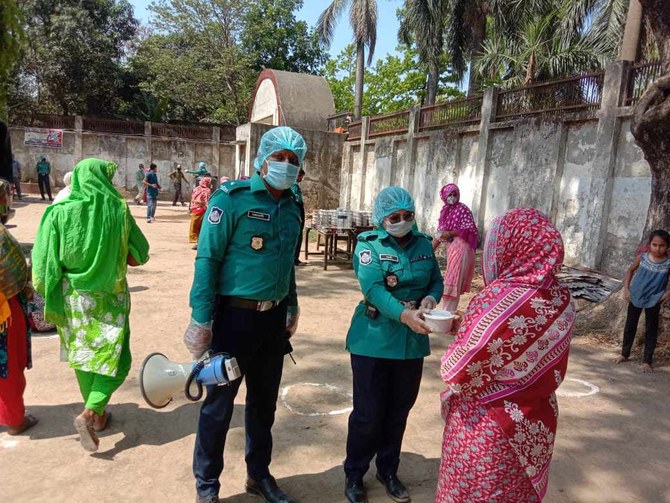
Dhaka Metropolitan Police officials distribute relief packages among the needy in the Mirpur area of Dhaka on April 23. (AN photo by Shehab Sumon)
2 / 5
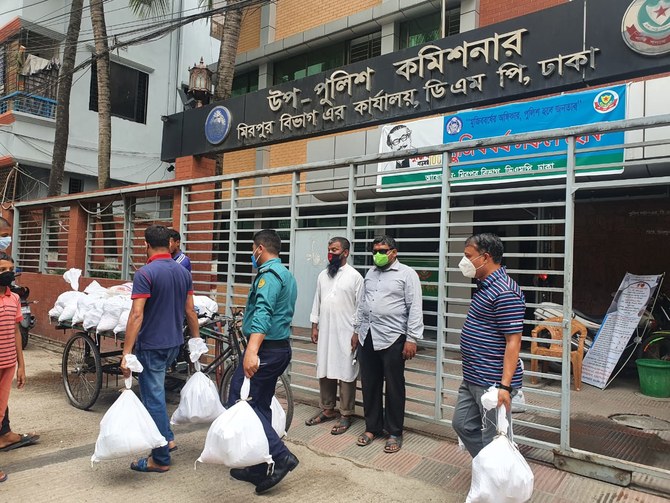
Dhaka Metropolitan Police officials distribute relief packages among the needy in the Mirpur area of Dhaka on April 23. (AN photo by Shehab Sumon)
3 / 5
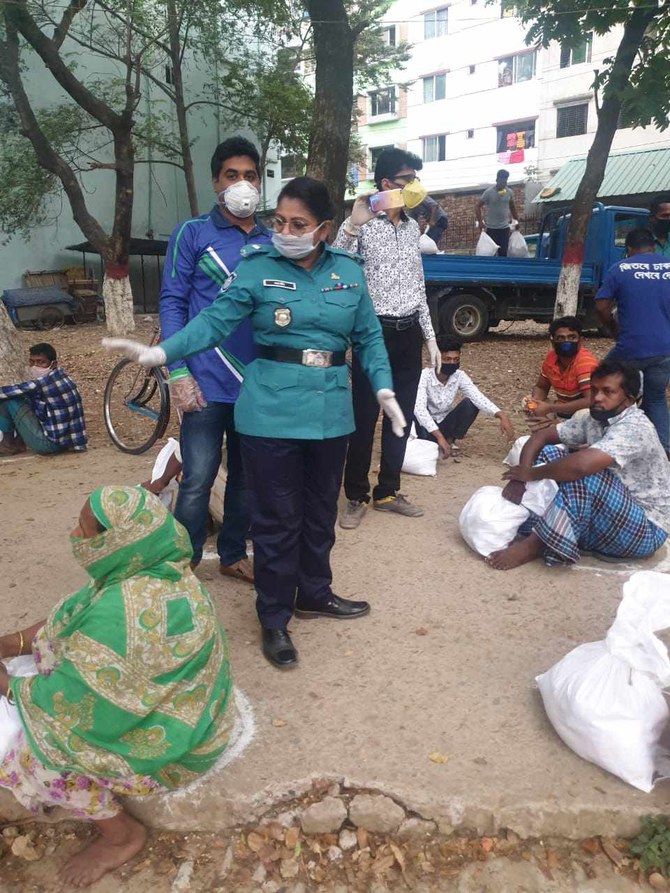
Dhaka Metropolitan Police officials distribute relief packages among the needy in the Mirpur area of Dhaka on April 23. (AN photo by Shehab Sumon)
4 / 5
Dhaka Metropolitan Police officials distribute relief packages among the needy in the Mirpur area of Dhaka on April 23. (AN photo by Shehab Sumon)
5 / 5
Dhaka Metropolitan Police officials distribute relief packages among the needy in the Mirpur area of Dhaka on April 23. (AN photo by Shehab Sumon)
Short Url
Updated 02 May 2020
Follow

Bangladesh goes beyond duty to treat coronavirus-infected police officials

  • Follows reports of five deaths and 741 infections among personnel on duty
  • Dhaka police hospital struggling to deal with rise in infections

DHAKA: Health authorities in Bangladesh were rushing to make arrangements for the treatment of Covid-19 positive police officials on Saturday following reports of five deaths in the past four days and 741 confirmed cases of infections.

The Central Police Hospital (CPH) in the capital, Dhaka, said that it was operating beyond capacity, with “560 Covid-19 infected officers under treatment at the facility which has only 250 beds.”

“To deal with the burden of extra patients we had to expand the hospital services to two other buildings,” said Dr. Hasan Ul Haider, the director of CPH and deputy inspector general of police, on Saturday. 

CPH officials said they were struggling to deal with the rise in infections with a limited number of health professionals.

“We have around 65 doctors and 70 nurses to deliver the services on the front line. But only one-third of the health professionals can provide services at a time due while maintaining the health protocols. The CPH is also considering outsourcing health professionals to meet the demands,” Haider said.

He added that out of 15 ICU beds, 10 were occupied on Saturday, despite the hospital making arrangements for additional ventilators.

With the nationwide lockdown imposed in March, police officials were deployed to ensure residents adhered to the strict quarantine and anti-virus measures across the country.

Nearly half of the infections were traced to the Dhaka Metropolitan Police area, prompting authorities to strengthen precautionary measures there. 

“At the beginning of the outbreak some police members were not very serious about wearing masks and other protective gear which might have exposed them to the contagious virus while delivering duties in the highly populated urban areas including city slums,” said Mahmuda Afroz Lucky, assistant deputy commissioner of Dhaka’s Mirpur Zone.

Although all police members were provided with personal protective equipment, many of them might have worn it improperly, she said, adding that all personnel had been trained in social distancing measures.

“We had made separate teams for three shifts who are on duty for seven days at a stretch. Moreover, to avoid congested living conditions in the police barracks, we have organized accommodation at different hotels and educational institutions for them,” Lucky said.

“On entering the barracks, police members should change their clothes ... and disinfect the barracks after each shift or at intervals of every six hours,” said Prof. Mozaherul Huq, former regional advisor of WHO’s Southeast Asia region. 

However, infected police officials expressed optimism that they would overcome the crisis through their collective effort. 

“I was admitted here with high fever and coughing one week ago and am feeling better in the last two days. Every day, my boss used to call me in the morning to know how I was doing. I am not feeling alone at all,” said a police constable requesting anonymity, as he is not authorized to speak to the media.

K. M. Kamrul Ahsan, the spokesperson for the police headquarters, added that all unit heads of police had been asked to ensure the “best treatment” for the infected personnel.

“In addition to 22 police hospitals across the country, we have made arrangements at five more private hospitals to treat the Covid-19 patients,” Ahsan said.

As of Saturday, there were 8,790 Covid-19 patients across the country, with 175 deaths reported.


French minister pledges tight security at rally for killed activist

Updated 6 sec ago
Follow

French minister pledges tight security at rally for killed activist

  • Deranque’s death has fomented tensions ahead of municipal elections next month and presidential polls next year
  • Macron has said there was no place in France “for movements that adopt and legitimize violence“

LYON: French police will be out in force at a weekend rally for a slain far-right activist, the interior minister said Friday, as the country seeks to contain anger over the fatal beating blamed on the hard left.
Quentin Deranque, 23, died from head injuries after being attacked by at least six people on the sidelines of a protest against a politician from the hard-left France Unbowed (LFI) party in the southeastern city of Lyon last week.
His death has fomented tensions ahead of municipal elections next month and presidential polls next year, in which the far-right National Rally (RN) party is seen as having its best chance yet at winning the top job.
President Emmanuel Macron, who is serving his last year in office, has said there was no place in France “for movements that adopt and legitimize violence,” and urged the far right and hard left to clean up their act.
Deranque’s supporters have called for a march in his memory on Saturday in Lyon.
The Greens mayor of Lyon asked the state to ban it, but Interior Minister Laurent Nunez declined to do so.
Nunez said he had planned an “extremely large police deployment” with reinforcements from outside the city to ensure security at the rally expected to be attended by 2,000 to 3,000 people, and likely to see counter-protesters from the hard left show up.
“I can only ban a demonstration when there are major risks of public disorder and I am not in a position to contain them,” he told the RTL broadcaster.
“My role is to strike a balance between maintaining public order and freedom of expression.”

- ‘Fascist demonstration’ -

Jordan Bardella, the president of anti-immigration RN, has urged party members not to go.
“We ask you, except in very specific and strictly supervised local situations (a tribute organized by a municipality, for example), not to attend these gatherings nor to associate the National Rally with them,” he wrote in a message sent to party officials and seen by AFP.
LFI coordinator Manuel Bompard backed the mayor’s call for a ban, warning on X it would be a “fascist demonstration” that “over 1,000 neo-Nazis from all over Europe” were expected to attend.
Two people, aged 20 and 25, have been charged with intentional homicide in relation to the fatal beating, according to the Lyon prosecutor and their lawyers.
A third suspect has been charged with complicity in the killing.
Jacques-Elie Favrot, a 25-year-old former parliamentary assistant to LFI lawmaker Raphael Arnault, has admitted to having been present at the scene but denied delivering the blows that killed Deranque, his attorney said.
Favrot said “it was absolutely not an ambush, but a clash with a group of far-right activists,” he added.
Italy’s hard-right Prime Minister Giorgia Meloni on Wednesday said the killing of Deranque was “a wound for all of Europe.”
Referring to her comments, Macron said everyone should “stay in their own lane,” but Meloni later said that Macron had misinterpreted her comments.
Opinion polls put the far right in the lead for the presidency in 2027, when Macron will have to step down after the maximum two consecutive terms in office.