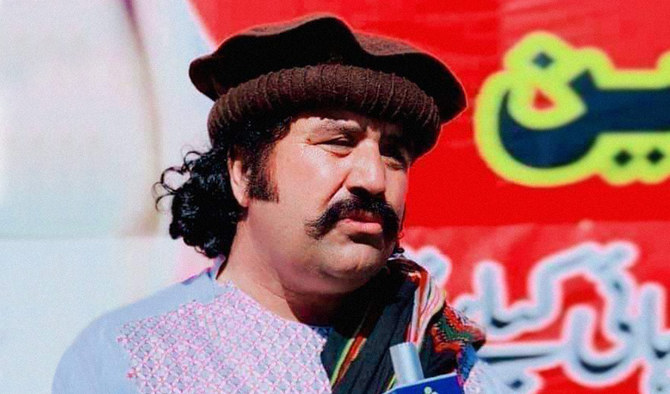
PESHAWAR: Arif Wazir, a senior leader of the Pashtun Tahaffuz Movement (PTM) died in an Islamabad hospital on Saturday, a day after he was attacked by unidentified gunmen in the South Waziristan tribal district, senior members of his party said.
The PTM which identifies as a Pashtun rights movement campaigns against what it alleges are military excesses against ethnic populations during anti-terrorism operations.
PTM emerged in 2018, after the killing of an ethnic Pashtun man by police in the port city of Karachi. The killing led to nationwide protests.
On Friday, minutes before iftar, indiscriminate firing from a moving car outside Wazir's home in Wana left the Pashtun leader critically wounded according to PTM leader Abdullah Nangyal. Following this, he was taken to Islamabad for treatment.
"But [I say] with a heavy heart, Arif Wazir embraced martyrdom on Saturday morning," Nangyal told Arab News.
Soon after his killing, rights group Amnesty International said in a statement that Pakistani authorities must carry out an independent and effective investigation into the attack on Wazir.
Mohsin Dawar, a member of Pakistan's national assembly and a PTM founding leader told Arab News that it was the responsibility of the state to ensure the protection of its citizens.
“It’s a failure of the state for not protecting its citizens," he said.
The deceased, who had been released from prison on bail a month ago after being charged with delivering an "anti-Pakistan" speech in April, was also the first cousin of sitting MNA Ali Wazir from South Waziristan. Nangyal said the lawmaker had lost over a dozen family members in recent years to armed assaults by militants.
Pakistan says members of the PTM are funded by foreign states and agencies. The PTM denies any external links.
Many PTM supporters are ethnic Pashtuns who hail originally from areas bordering Afghanistan, which used to be the center point of a long insurgency by Taliban and subsequent operations by the Pakistan army.


Senior PTM leader dies after Wana gun attack
https://arab.news/49k5q
Senior PTM leader dies after Wana gun attack

- Arif Wazir succumbed to his injuries in Islamabad a day after attack outside his South Waziristan home
- Was released from prison on bail last month after being charged with making anti-Pakistan speech

Pakistan approves $713 million to ease power sector’s cash flow constraints
- Finance minister chairs Economic Coordination Committee meeting to approve grants, review economic situation
- Pakistan is grappling with a ballooning “circular debt,” or unpaid bills and subsidies, that has choked its power sector
KARACHI: Pakistan’s top economic body this week approved a grant of $713 million to ease the power sector’s cash flow constraints, the Finance Division said in a statement, as Islamabad looks to reform its priority sectors.
The development took place as Finance Minister Muhammad Aurangzeb chaired a meeting of the Economic Coordination Committee (ECC) to approve grants for various projects and review the overall economic situation of the country.
“[ECC approved] another Technical Supplementary Grant amounting to Rs200 billion ($713 million) under the head of Government of Pakistan investment in DISCOs’ equity to address cash flow constraints in the power sector,” the Finance Division said on Thursday.
DISCOs, which handle billing, recoveries and grid maintenance, have long suffered from corruption and political interference.
Pakistan has attempted to privatize its loss-making state-owned enterprises to raise funds and reform them as envisaged under a $7 billion International Monetary Fund (IMF) program secured last year.
Prime Minister Shehbaz Sharif’s government plans to privatize three DISCOs, the Islamabad Electric Supply Company (IESCO), Faisalabad Electric Supply Company (FESCO) and Gujranwala Electric Power Company (GEPCO) in the months ahead.
The Pakistani government, which owns or controls much of the power infrastructure, is grappling with a ballooning “circular debt,” or unpaid bills and subsidies, that has choked the power sector and weighed on the economy.
The liquidity crunch has disrupted supply, discouraged investment and added to fiscal pressure, making it a key focus under Pakistan’s IMF program.
The ECC also approved, on the interior ministry’s proposal, a provision of Rs 4.775 billion [$17.19 million] as payment to 945 families of “missing persons” as identified by the Commission of Inquiry on Enforced Disappearances.
“The disbursement will be made under the supervision of the Commission in accordance with approved procedures,” it added.
Taking stock of the economic situation, the ECC noted that cumulative inflation for the period July–November averaged 5 percent, which it said was “significantly lower” than the 7.9 percent figure recorded during the corresponding period of the previous year.
It attributed this improvement to prudent fiscal management, effective price stabilization measures and close market monitoring by the government.


