SEOUL, South Korea: North Korean leader Kim Jong Un made his first public appearance in 20 days as he celebrated the completion of a fertilizer factory near Pyongyang, state media said Saturday, ending an absence that had triggered global rumors that he may be seriously ill.
The North’s official Korean Central News Agency reported that Kim attended the ceremony Friday in Sunchon with other senior officials, including his sister Kim Yo Jong, who many analysts predict would take over if her brother is suddenly unable to rule.
The official Rodong Sinmun newspaper published several photos of Kim wearing black and smiling as he looked around the factory and cut a red ribbon.
The KCNA said workers broke into “thunderous cheers” for Kim, who it said is guiding the nation in a struggle to build a self-reliant economy in the face of “head wind” by “hostile forces,” a clear reference to US-led sanctions over the North’s nuclear ambitions.
The agency said Kim warmly acknowledged the workers and said his late father and grandfather “would be greatly pleased” the factory was completed. The report didn’t mention any direct comment toward Washington or Seoul.
US President Donald Trump, speaking to reporters at the White House, declined to comment about Kim’s reappearance but said he would “have something to say about it at the appropriate time.”
It was Kim’s first public appearance since April 11, when he presided over a ruling Workers’ Party meeting to discuss the coronavirus and reappoint his sister as an alternate member of the powerful decision-making political bureau of the party’s central committee. That move confirmed her substantial role in the government.
Speculation about his health swirled after he missed the April 15 birthday celebration for his late grandfather Kim Il Sung, the country’s most important holiday, for the first time since taking power in 2011.
Without publishing images, state media reported he was carrying out routine activities outside public view, such as sending greetings to the leaders of Syria, Cuba and South Africa and expressing gratitude to workers building tourist facilities in the coastal town of Wonsan, where some speculated he was staying.
South Korea’s government, which has a mixed record of tracking Pyongyang’s ruling elite, repeatedly downplayed speculation that Kim, believed to be 36, was in poor health following surgery.
The office of President Moon Jae-in said it detected no unusual signs in North Korea or any emergency reaction by its ruling party, military and cabinet. Seoul said it believed Kim was still managing state affairs but staying at an unspecified location outside Pyongyang.
The possibly of high-level instability raised troubling questions about the future of the secretive, nuclear-armed state that has been steadily building an arsenal meant to threaten the US mainland while diplomacy between Kim and Trump has stalled.
Following an unusually provocative run in missile and nuclear tests in 2017, Kim used the Winter Olympics in South Korea to initiate diplomacy with Washington and Seoul in 2018.
That led to a surprising series of summits, including three between Kim and Trump, as Kim pursued diplomacy in hopes of ending crippling economic sanctions and obtaining security guarantees.
But negotiations have faltered in past months over disagreements in exchanging sanctions relief and disarmament steps, which raised doubts about whether Kim would ever fully deal away an arsenal he likely sees as his strongest guarantee of survival.
Kim entered 2020 vowing to build up his nuclear arsenal and achieve a breakthrough against sanctions while urging his nation to stay resilient in a struggle for economic “self-reliance.” Some experts say the North’s self-imposed lockdown amid the coronavirus crisis could potentially hamper his ability to mobilize people for labor.
It wasn’t immediately clear what caused Kim’s absence in past weeks. In 2014, Kim vanished from the public eye for nearly six weeks and then reappeared with a cane. South Korea’s spy agency said he had a cyst removed from his ankle.
Analysts say his health could become an increasing factor in years ahead: he’s overweight, smokes and drinks, and has a family history of heart issues.
If he’s suddenly unable to rule, some analysts said his sister would be installed as leader to continue Pyongyang’s heredity dynasty that began after World War II.
But others question whether core members of North Korea’s elite, mostly men in their 60s or 70s, would find it hard to accept a young and untested female leader who lacks military credentials. Some predict a collective leadership or violent power struggles.
Some experts say South Korea, as well as its regional neighbors and ally Washington, must begin preparing for instability that could come if Kim is sidelined by health problems or even dies. That could include North Korean refugees flooding South Korea or China or military hard-liners letting loose nuclear weapons.

North Korea’s Kim Jong Un appears in public amid health rumors
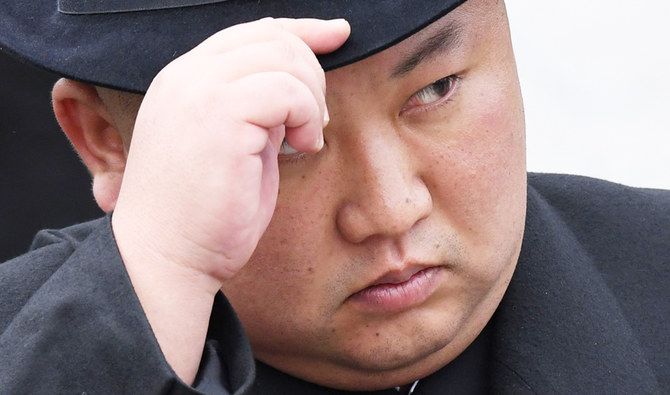
https://arab.news/8t65f
North Korea’s Kim Jong Un appears in public amid health rumors
- His absence unleashed a series of unconfirmed reports over his condition, triggering global fears over the North’s nuclear arsenal — and who would succeed Kim were he unable to lead
India’s wealthy embrace a new luxury symbol: water
- Tap water in India is not fit for human consumption
- Wealthy opt for premium water as wellness craze boosts industry
NEW DELHI: At an Indian gourmet food store, Avanti Mehta is organizing a blind tasting of drinks sourced from France, Italy and India. No, this isn’t wine, it’s water.
Participants use tiny shot glasses to check the minerality, carbonation and salinity in samples of Evian from the French Alps, Perrier from southern France, San Pellegrino from Italy and India’s Aava from the foothills of the Aravalli mountains.
“They will all taste different ... you should be choosing a water that can give you some sort of nutritional value,” said Mehta, who is 32 and calls herself India’s youngest water sommelier, a term usually associated with premium wine. Her family owns the Aava mineral water brand. Premium water is a $400 million business in the world’s most populous nation and is growing bigger as its wealthy see it as a new status symbol that fits in with a spreading wellness craze.
Premium Indian mineral water costs around $1 for a one-liter bottle, while imported brands are upwards of $3, or 15 times the price of the country’s lowest-priced basic bottled water.
Clean water is a privilege in the country of 1.4 billion people where researchers say 70 percent of the groundwater is contaminated. Tap water remains unfit to drink, and 16 people died in Indore city after consuming contaminated tap water in December.
Many in India see bottled water as a necessity and standard 20 US-cent bottles are available widely at convenience stores, restaurants and hotels. The market is worth nearly $5 billion annually and is set to grow 24 percent a year — among the fastest in the world.
Bottled water demand in United States or China is driven by convenience, making it a $30 billion-plus market in each country which will grow just 4-5 percent each year, Euromonitor says.
In India, the premium water segment is leading the surge in demand, accounting for 8 percent of the bottled water market last year compared to just 1 percent in 2021, Euromonitor said.
“Distrust of municipal water in some areas has escalated the demand for bottled water. Now, people understand how mineral water has more health benefits. It’s expensive, but the category will boom,” said Amulya Pandit, a senior consultant at Euromonitor specializing in the drinks market.
Among its consumers are New Delhi-based real estate developer B.S. Batra, who says his family uses only premium water at home to get more minerals and safeguard health.
“You feel different, more energetic during the day,” said Batra, 49, an avid badminton player.
“I consume mineral water even with whisky at home, and kids use it for their smoothies.”
Water lures Bollywood star, wealthy
The popular 20-cent plastic bottled water is mainly made by Pepsi, Coca-Cola and Indian market leader Bisleri. In addition, Indians who can afford it, install purifiers in their homes which clean the water but also remove most minerals.
Imported and local premium waters are luring wealthy consumers and businesses alike.
Bollywood star Bhumi Pednekar and her sister have launched Backbay — selling 750 ml cartons of mineral water for $2.2; Indian conglomerate Tata is expanding its premium water portfolio, and retailers and businesses are reporting higher sales.
Tata Consumer Products, also Starbucks’ partner in India, sells 20-cent bottled water, but premium water is its priority as it sees affluent, health-focused consumers willing to spend on the drink without worrying about the price, CEO Sunil D’Souza said in an interview.
“I don’t have to push water uphill...I see a long, long, long runway for the business,” he said.
Tata’s premium “Himalayan” mineral water factory — which a Reuters photographer visited — is located in the foothills of the Himalayan range in Himachal Pradesh state. Workers there largely keep a hands-free watch on machines filling plastic and glass bottles with water sourced from a natural underground aquifer.
Looking for springs
Most Indians prefer still water, and the sparkling variant remains niche. Tata said it plans to launch a sparkling Himalayan water, and is also scouting for natural springs for expanding its other offerings. At three Foodstories Indian gourmet stores, sales of premium waters tripled in 2025. Customer demand prompted the chain to import “light and creamy” Saratoga Spring Water from New York, which costs 799 rupees ($9) for a 355-milliliter (12-fluid-ounce) bottle, and stocks sold out within days, said co-founder Avni Biyani.
Indian mineral water brand Aava’s sales touched a record 805 million rupees ($9 million) last year, growing 40 percent a year since 2021. Tata said its basic and premium water portfolio will grow 30 percent a year, after growing tenfold to $65 million in six years.
Imported waters, which attract an over 30 percent tax, are pricier than Indian brands. Nestle’s Perrier and San Pellegrino, and Danone’s Evian retail for over 300 rupees, or $3.20, for a 750 ml bottle.
Nestle declined to comment, while Danone said the Indian bottled water market was growing at a “robust” pace but imported waters “tend to be niche and boutique.”
“When you open your tap, you’re not getting an Aava, Evian ... And that is what you’re essentially paying for,” said water sommelier Mehta.
At the water tasting session, some participants said they enjoyed the experience but many found the price hard to swallow.
“To be honest, it is kind of expensive,” said executive Hoshini Vallabhaneni, one of 14 people at the event. “For everyday use — it will burn a hole in the pocket.”


