Indonesia to reopen economy, resume ‘normal life’ by July

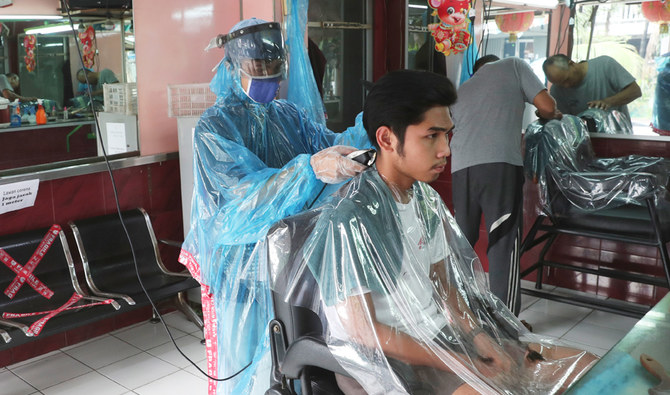
A barber in Jakarta wearing a face mask to protect against COVID-19 gives a customer a haircut. (AP)
Short Url
Updated 02 May 2020
Follow

Indonesia to reopen economy, resume ‘normal life’ by July

  • More regions are imposing stricter social restrictions amid a surge in infections — many of which have been imported from badly hit areas including Jakarta

JAKARTA: Indonesia is hoping to reopen the economy and resume “normal life” by July, according to government officials.
Doni Monardo, chief of Indonesia’s COVID-19 task force, said earlier this week that the government expects to see a decline in new cases from June, after ramping up testing in April and May and implementing aggressive contact tracing and stricter isolation measures for people exposed to the virus. “In July we would be able to start a normal life again,” he said.
The lead expert at the task force, epidemiologist and public health expert Wiku Adisasmito, stressed that minimizing the risk to human life must take precedence over reopening economic activity, which has come to a halt since the government introduced social distancing measures in mid-March.
“I want to make sure that there is no trade-off between the economy and public health. We know how to bring the economy back to life, but what we don’t know is how to bring our deceased patients back to life,” Adisasmito said in an online press briefing on Thursday. “We are now in process of analyzing and mapping the scenarios to restart the economy.”
More regions are imposing stricter social restrictions amid a surge in infections — many of which have been imported from badly hit areas including Jakarta. There have been more than 10,550 confirmed cases of COVID-19 in Indonesia as of May 1.
West Java Governor Ridwan Kamil said on Wednesday that leaders in all 17 regencies and cities in the province have agreed to submit a proposal to the Ministry of Health for large-scale restrictions across the province, which has so far only imposed strict measures partially, including in areas that adjacent to Jakarta.
The governor said he expects the ministry to approve the proposal early next week.
According to Monardo, the government is not in favor of enforcing a nationwide lockdown, which he claimed had resulted in “widespread outbreaks posing enormous risks” in “some densely populated regions and countries.”
“The decision not to choose a lockdown was a very good measure as we can maintain a balance between paying attention to health and socio-psychological aspects,” he said, adding that the restrictions in Jakarta — which have been in place since April 10 and have now been extended until May 22 — have had a positive effect, with COVID-19 cases in decline in the capital city.
While Jakarta recorded 142 new cases on Friday, after reporting less than a hundred daily infections over the preceding few days, the city’s official daily death toll from the disease has decreased consistently since mid-April.
Data from Jakarta’s coronavirus website showed that the number of burials taking place in accordance with COVID-19 protocols has been declining since April 22, when Jakarta Governor Anies Baswedan announced that restrictions in the city would be extended for another month to help flatten the COVID-19 curve further.


Bangladesh halts controversial relocation of Rohingya refugees to remote island

Updated 29 December 2025
Follow

Bangladesh halts controversial relocation of Rohingya refugees to remote island

  • Administration of ousted PM Sheikh Hasina spent about $350m on the project
  • Rohingya refuse to move to island and 10,000 have fled, top refugee official says

DHAKA: When Bangladesh launched a multi-million-dollar project to relocate Rohingya refugees to a remote island, it promised a better life. Five years on, the controversial plan has stalled, as authorities find it is unsustainable and refugees flee back to overcrowded mainland camps.

The Bhasan Char island emerged naturally from river sediments some 20 years ago. It lies in the Bay of Bengal, over 60 km from Bangladesh’s mainland.

Never inhabited, the 40 sq. km area was developed to accommodate 100,000 Rohingya refugees from the cramped camps of the coastal Cox’s Bazar district.

Relocation to the island started in early December 2020, despite protests from the UN and humanitarian organizations, which warned that it was vulnerable to cyclones and flooding, and that its isolation restricted access to emergency services.

Over 1,600 people were then moved to Bhasan Char by the Bangladesh Navy, followed by another 1,800 the same month. During 25 such transfers, more than 38,000 refugees were resettled on the island by October 2024.

The relocation project was spearheaded by the government of former Prime Minister Sheikh Hasina, who was ousted last year. The new administration has since suspended it indefinitely.

“The Bangladesh government will not conduct any further relocation of the Rohingya to Bhasan Char island. The main reason is that the country’s present government considers the project not viable,” Mizanur Rahman, refugee relief and repatriation commissioner in Cox’s Bazar, told Arab News on Sunday.

The government’s decision was prompted by data from UN agencies, which showed that operations on Bhasan Char involved 30 percent higher costs compared with the mainland camps in Cox’s Bazar, Rahman said.

“On the other hand, the Rohingya are not voluntarily coming forward for relocation to the island. Many of those previously relocated have fled ... Around 29,000 are currently living on the island, while about 10,000 have returned to Cox’s Bazar on their own.”

A mostly Muslim ethnic minority, the Rohingya have lived for centuries in Myanmar’s western Rakhine state but were stripped of their citizenship in the 1980s and have faced systemic persecution ever since.

In 2017 alone, some 750,000 of them crossed to neighboring Bangladesh, fleeing a deadly crackdown by Myanmar’s military. Today, about 1.3 million of them shelter in 33 camps in the coastal Cox’s Bazar district, making it the world’s largest refugee settlement.

Bhasan Char, where the Bangladeshi government spent an estimated $350 million to construct concrete residential buildings, cyclone shelters, roads, freshwater systems, and other infrastructure, offered better living conditions than the squalid camps.

But there was no regular transport service to the island, its inhabitants were not allowed to travel freely, and livelihood opportunities were few and dependent on aid coming from the mainland.

Rahman said: “Considering all aspects, we can say that Rohingya relocation to Bhasan Char is currently halted. Following the fall of Sheikh Hasina’s regime, only one batch of Rohingya was relocated to the island.

“The relocation was conducted with government funding, but the government is no longer allowing any funds for this purpose.”

“The Bangladeshi government has spent around $350 million on it from its own funds ... It seems the project has not turned out to be successful.”