

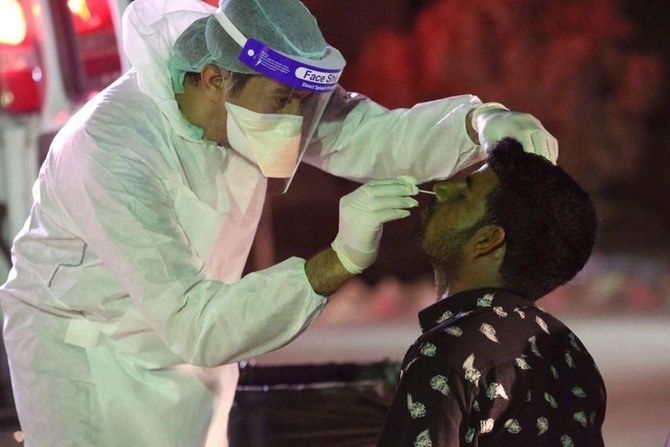
Success of Saudi Arabia's COVID-19 testing allows easing of restrictions for Ramadan

A variety of testing techniques have helped the Saudi Ministry of Health to track and treat coronavirus disease (COVID-19) cases, allowing the Kingdom to relax certain restrictions during Ramadan. (SPA)
Short Url
Updated 01 May 2020
Follow

Success of Saudi Arabia's COVID-19 testing allows easing of restrictions for Ramadan

  • Al-Aly announced 392 new recoveries, taking that total to 3,555
  • He warned shoppers to stay away from crowded areas and leave busy stores

JEDDAH: A variety of testing techniques have helped the Saudi Ministry of Health to track and treat coronavirus disease (COVID-19) cases, allowing the Kingdom to relax certain restrictions during Ramadan.

“We mark down geographical or populated areas where there’s a high chance of huge spread. They are dealt with by implementing preventive measures, and it is then treated as a concentrated area, which in turn protects the areas surrounding them,” said ministry spokesman, Dr. Mohammed Al-Abd Al-Aly.

Area evaluations and virus outbreak are being evaluated continuously, he added. “Whenever we feel the need to raise preventive measures on certain areas, or lessen them, it is all dependent on these evaluations.”

On Friday, 1,344 new cases of COVID-19 were recorded in the Kingdom, 17 percent of which were Saudis and 83 percent expats, taking the total number of cases in Saudi Arabia to 24,097. Of those, 20,373 were active and 117 patients were in a critical condition.

Al-Aly announced 392 new recoveries, taking that total to 3,555, with seven people passing away, raising the death toll to 169. The latest deaths involved a Saudi man and six expats from Makkah and Jeddah and aged between 46 and 75. All had been suffering from chronic diseases.

“Those who have a high risk of contracting the virus, aged 65 and above, or individuals with chronic diseases and weak immune systems should be careful and should not go outside to shop. It would be best if they stayed at home, and someone else do their shopping for them,” he said.

For those having to shop, he warned them to stay away from crowded areas and leave busy stores.

Individuals were also reminded to keep at least one-and-a-half meters’ distance from other people, wear a face mask, wash their hands or make sure to disinfect them when outside, pay for items electronically and not in cash, and avoid touching their faces.


Economic growth and resilience at heart of 2nd AlUla Emerging Market Economies Conference

Updated 03 February 2026
Follow

Economic growth and resilience at heart of 2nd AlUla Emerging Market Economies Conference

  • Event on Feb. 8 and 9 will bring together ministers, governors of central banks, policymakers, economic experts and international financial institutions
  • Emerging-market economies a ‘pivotal element’ in global economic system due to effect they have on growth and stability, says Saudi Finance Minister Mohammed Al-Jadaan

RIYADH: The second annual AlUla Conference for Emerging Market Economies, which Saudi Arabia will host next week, offers a platform to exchange views on global developments and discuss policies and reforms that support inclusive growth and strengthen economic resilience, the Kingdom’s finance minister said.

The event on Feb. 8 and 9 will bring together finance ministers, governors of central banks and policymakers, alongside economic experts and representatives of international financial institutions.

Organized by the Saudi Ministry of Finance in partnership with the International Monetary Fund, it takes place as emerging-market economies face mounting challenges amid rapid global economic change.

Finance Minister Mohammed Al-Jadaan said the decision to host the conference reflects Saudi Arabia’s ongoing commitment to efforts that support global financial and economic stability, and highlights the growing influence of emerging economies on worldwide growth.

Emerging-market economies represent a “pivotal element” in the global economic system due to the direct impact they have on economic growth and stability, he added.

“The AlUla Conference for Emerging Market Economies provides a unique platform for exchanging views on global economic developments, and discussing policies and reforms that will support inclusive growth and enhance economic resilience, in light of broader international cooperation that contributes to confronting common challenges,” Al-Jadaan said.

Kristalina Georgieva, managing director of the IMF, said the event would help emerging economies deal with growing uncertainty driven by technological change, demographic shifts and geopolitical tensions.

“The AlUla conference provides a vital platform for emerging economies to discuss how they can navigate the risks and embrace the opportunities ahead,” she said.

“In these times of sweeping transformations in the global economy, policymakers face a more challenging and uncertain environment. Countries should work together to strengthen resilience through sound macroeconomic and financial policies.”