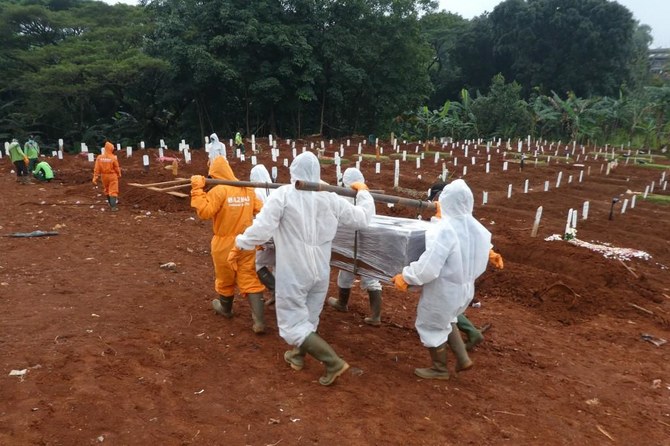
JAKARTA: Burials in Jakarta remained close to record highs in April, official data showed on Friday, indicating there may have been many more deaths from COVID-19 in the city than have been officially recorded.
The 4,377 burials, combined with 4,422 burials in March, indicate that 2,500 more people have died in the city in the past two months than the average for the period.
The burials data, from the website of the city’s parks and cemeteries department, does not identify the cause of death.
Jakarta is the center of the coronavirus outbreak in the world’s fourth most populous country. According to the central government, there had been 375 COVID-19 deaths in the capital as of Saturday.
Overall, Indonesia has had 800 deaths from the disease, Health Ministry official Achmad Yurianto said on Friday.
Asked about the Jakarta burial figures, Yurianto said that official figures for coronavirus deaths included only those who died after testing positive for the disease.
Some people who died with COVID-19 symptoms were not tested at all, while others had their samples collected “incorrectly,” Yurianto said. He did not elaborate on what the incorrect samples meant.
The March burial figure for Jakarta was the highest since such data began being collected a decade ago, nearly one third higher than any month in that period. City Governor Anies Baswedan said at the time: “I’m struggling to find another reason than unreported COVID-19 deaths.”
Baswedan could not be immediately reached for comment on Friday.
The April burials figure fell only slightly although many people left the city for their home villages in the first three weeks of the month.
A spokesman for the Jakarta provincial government declined to answer questions about the burials data and the number of people who had left the city.
“We don’t have daily data to get a precise trend. However, deducting for out-migration, it’s not slowing down yet,” said one Jakarta-based epidemiologist, who asked not to be identified.
Authorities introduced a soft lockdown on Jakarta in March, closing schools and some businesses. On April 24 travel out of the city was strictly banned in an effort to stop more people leaving for the annual post-Ramadan exodus from Greater Jakarta.
Indonesia has had 10,551 confirmed cases of the illness, the Health Ministry’s Yurianto said on Friday.
A Reuters review of data from 16 of Indonesia’s 34 provinces showed this week that more than 2,200 people have died with acute symptoms of COVID-19 but were not recorded as victims of the disease.


Burial numbers in Jakarta indicate coronavirus toll is higher than officially reported
https://arab.news/r2d8z
Burial numbers in Jakarta indicate coronavirus toll is higher than officially reported

- Jakarta is the center of the coronavirus outbreak in the world’s fourth most populous country


US hotels seek World Cup boost after tourism dip under Trump
- At the US hotels that Meade Atkeson manages, a drop in tourism weighs heavily on business — but hoteliers like him hope that World Cup enthusiasm will soon eclipse wariness over President
WASHINGTON: At the US hotels that Meade Atkeson manages, a drop in tourism weighs heavily on business — but hoteliers like him hope that World Cup enthusiasm will soon eclipse wariness over President Donald Trump’s policies.
The US hospitality sector has been reeling from a tourism slump in the world’s biggest economy, which became the only major destination to see a drop in foreign visitors last year.
“Just financially, it’s difficult when international travel is down,” Atkeson told AFP, noting that such visitors tend to stay longer and spend more.
Foreign travelers account for nearly a quarter of business at the three hotels under Sonesta group that he manages — two in Washington and a third in Miami Beach.
Yet, in the first eleven months of 2025, US official data showed that inbound travel dropped by 5.4 percent.
Canadians were noticeably absent, with travel plunging by 21.7 percent from 2024, translating to about four million fewer people. The decline was nearly seven percent for French visitors.
Industry professionals see this as a consequence of Trump’s policies, even if they may not openly say so.
Visitors have chafed at the Republican president’s sweeping tariffs on foreign goods, broadsides against other countries, tightening immigration rules and portrayal of certain Democrat-led cities as ridden with crime.
Canadians “were asked to be the 51st state, right?” Atkeson said.
“If you talk to Canadians, many of them have chosen not to travel out of conscience” or on principle, he added.
Brazilian tourists meanwhile “can go anywhere they want,” he said. “And so they may have gone to Europe, they may have gone to the islands.”
‘Fear’
Thousands of kilometers away, the major resort city of Las Vegas in Nevada — boasting 150,000 hotel rooms — has also had a bad year.
Elsa Rodan, a chambermaid at the Bellagio resort and casino, says her establishment is “blessed” compared with others.
But even so, it has had to lower prices to attract guests, added Rodan, a representative of the Unite Here union who spoke at a Washington press conference.
Unite Here President Gwen Mills urges for a renewed effort to lobby the Trump administration over policies and rhetoric that she believes are jeopardizing the sector employing more than two million people.
According to her, hoteliers are not pushing the government enough.
Employers express “fear, the fear of picking your head up,” she said.
Hopefully ‘better’
Fewer visitors and overnight stays, alongside a drop in revenue, have triggered a $6.7 billion shortfall for Nevada hotels in 2025, according to the American Hotel and Lodging Association (AHLA).
But the organization hopes that 2026 will be a turning point — it is counting on the World Cup, from June 11 to July 19, to attract visitors.
Eleven US cities will be hosting matches.
“It’s being equated to having nearly 80 Super Bowls in just over a month,” AHLA spokesman Ralph Posner told AFP.
“The economic lift won’t be limited to host cities,” he added. “Destinations across the country are hoping to benefit as international visitors extend their trips and travel between markets.”
Las Vegas, for example, hopes to draw fans who might stop there before or after a game in Los Angeles or Kansas City.
Organizers say that besides the seven million spectators in stadiums, the World Cup is set to attract 20-30 million tourists.
The whole event, they believe, can generate $30 billion for the US economy.
“I hope that things will look better,” Atkeson said.
His Miami hotel is under renovations and cannot host much World Cup-related activity.
But his Washington establishments are highlighting their proximity to Philadelphia, where several matches will be held.
Another complication is war in the Middle East following US-Israeli strikes on Iran, which could snarl travel.
“It’s a little too soon to tell how we’re going to do with that, but we’ll see,” he said.


