

Will coronavirus shock make Arab region ready for universal basic income?

1 / 6
Foreign workers stand in line as they wait to be checked for the novel coronavirus at a testing centre in the Naif area of Dubai, on April 15, 2020. (AFP)
2 / 6
A young boy drives a small vehicle loaded with recyclable items gathered at a landfill, to be sold for extra income, in the Iraqi holy city of Najaf on June 9, 2019. (AFP/File Photo)
3 / 6
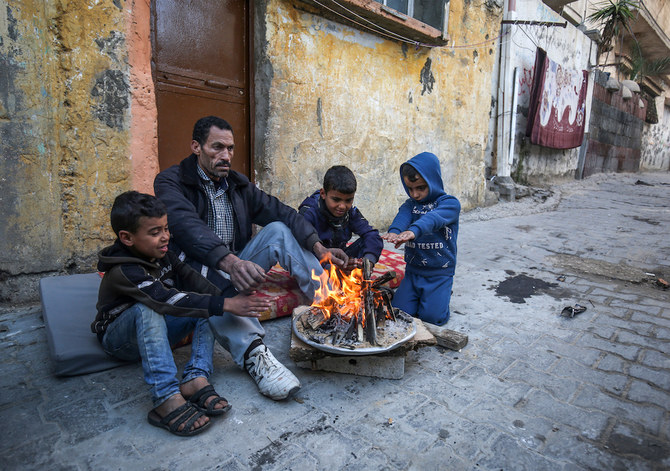
Palestinians sit by a fire at the Khan Yunis regugee camp in the southern Gaza Strip on January 28, 2020. (AFP/File Photo)
4 / 6
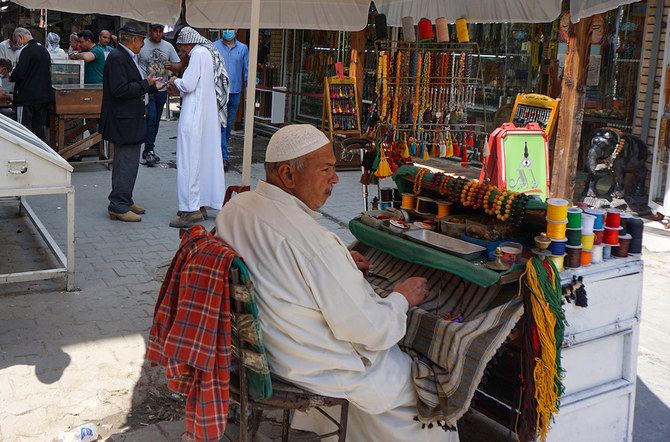
An Iraqi street vendor sells worry beads after measures of social distancing were eased by the authorities, ahead of the fasting month of Ramadan, in central Baghdad on April 22, 2020. (AFP/File Photo)
5 / 6
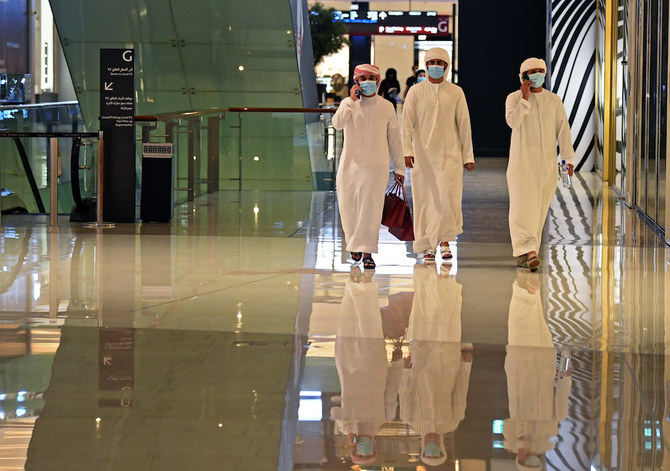
Emirati men, wearing protective masks to combat the spread coronavirus, walk in the Mall of Dubai on April 28, 2020, after the mall was reopened. (AFP)
6 / 6
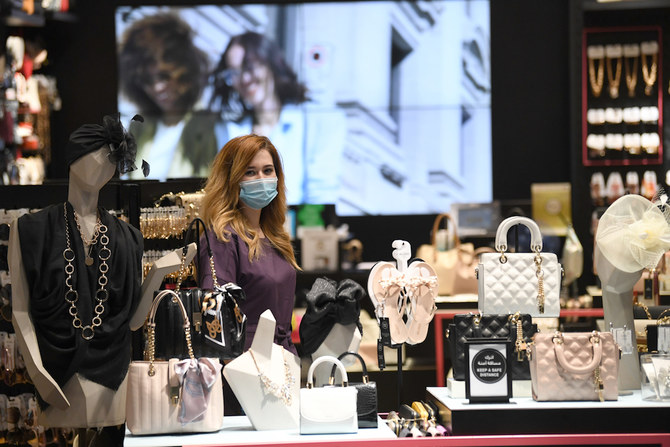
A vendor, wearing a mask for protection against the coronavirus, stands next to ladies handbags displayed for sale at a shop in the Mall of Dubai on April 28, 2020, after the shopping centre was reopened. (AFP)
Short Url
Updated 01 August 2020
Follow

Will coronavirus shock make Arab region ready for universal basic income?

  • How people will make basic ends meet under lockdown is a big question facing policymakers worldwide
  • Implementing universal basic income in the MENA region would cost 17.9% GDP, says an ILO study

DUBAI: Denmark’s government has guaranteed workers affected by the country’s lockdown a minimum of 75 percent of their salaries.

In Italy, populist politician Beppe Grillo is calling for regular payments to “Italians [who] won’t have a secure income in the next few months.”

In the US, House Speaker Nancy Pelosi is willing to look into instituting a universal basic income (UBI) for Americans, which was at the heart of former Democratic hopeful Andrew Yang's presidential campaign.

As people across the world are ordered to shelter in place to contain the spread of the coronavirus disease (COVID-19), how they will make basic ends meet has become one of the biggest questions facing policymakers.

Liberal activists are hoping that governments adopting cash transfers as a temporary emergency measure will be compelled to retain it once citizens have seen its benefits.

As in the rest of the world, however, the idea of guaranteeing everyone an income both tantalizes and terrifies the Arab region.

“No country in this world is ready for UBI, an unconditional payment to all residents without any conditions,” said Dr. Osman Gulseven, associate professor at Skyline University College in Sharjah.
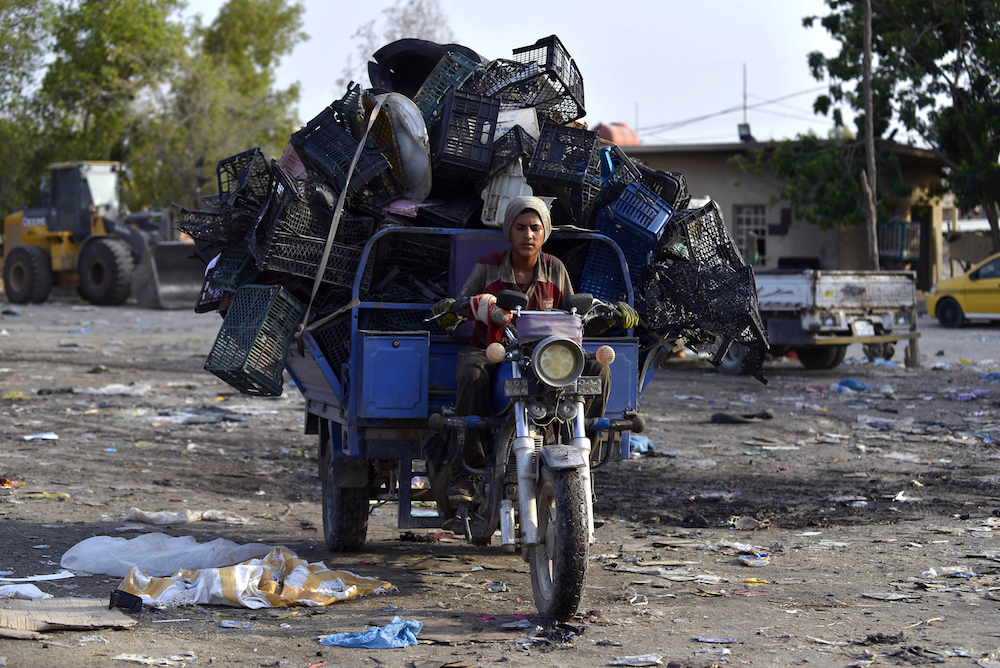


A young boy drives a small vehicle loaded with recyclable items gathered at a landfill, to be sold for extra income, in the Iraqi holy city of Najaf on June 9, 2019. (AFP/File Photo)

“This is not only economically infeasible but also financially impossible for most Arab countries. Those payments will come from taxes, which will again be collected from society — specifically the working middle class.

“It is quite illogical to transfer money from the working people to everyone else.”

Although some countries have initiated UBI-like schemes to shore up their COVID-19-battered economies, he does not view it as a potential long-term solution.

“This is an unprecedented crisis period,” Gulseven told Arab News. “Typically, any money paid by the government has to be financed from somewhere. Printing money will cause inflation, which has devastating effects on the economy.”

Taxing more from sales and income will further crimp economic activity, in his view.

Opinion

This section contains relevant reference points, placed in (Opinion field)

“It is also impossible to pay back everything without financial resources,” Gulseven said. “Arab countries do not have the financial means for UBI. Only a few Gulf countries with substantial currency reserves can afford UBI, that too only for their citizens.”

Gulseven’s view is seconded by George Politis, visiting lecturer at the Costas Grammenos Centre for Shipping, Trade and Finance, who says UBI will not work in periods of financial distress.

“We need normality, functioning economies, growth and prosperity,” he said. “Once normality is achieved, the key indicators to study will be GDP per capita, public spending-to-GDP ratio, and poverty levels in order to calculate how much is needed for a given population and whether the state can afford the cost.”
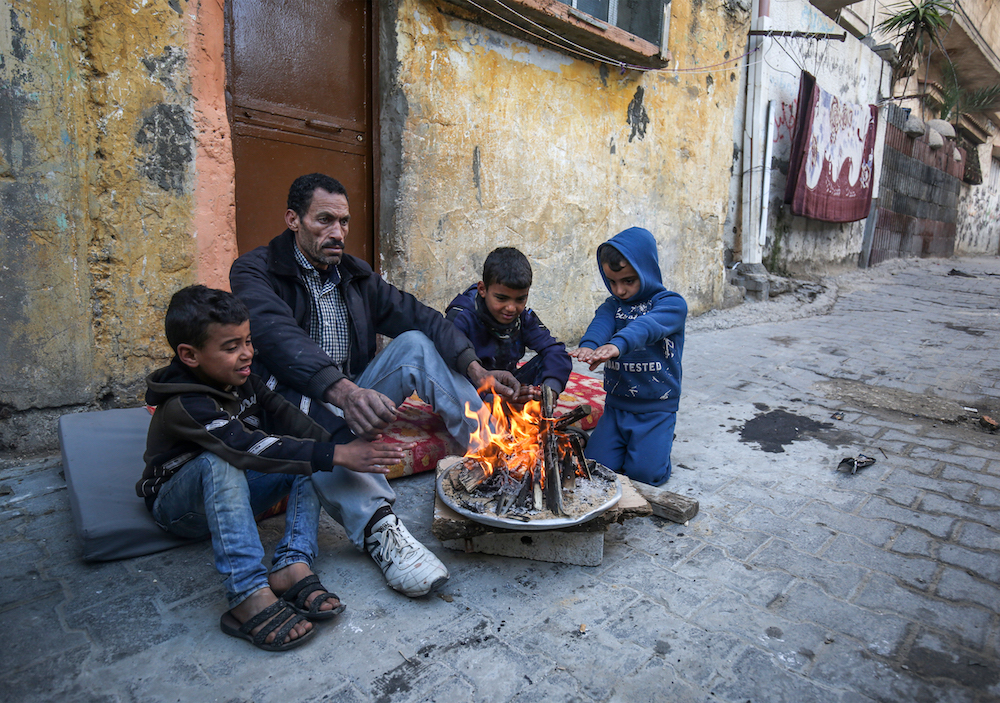


Palestinians sit by a fire at the Khan Yunis regugee camp in the southern Gaza Strip on January 28, 2020. (AFP/File Photo)

Politis said UBI in emerging markets could only work through an international or regional body since states cannot self-finance such a policy.

“The lesson from the EU is that there is little appetite among larger and smaller economies for mutual financial collaboration towards surviving the current crisis,” he said.

The International Labor Organization (ILO) estimated in 2018 that UBI’s impact on poverty and inequality depends on such factors as the level of benefits, their capacity to meet people’s needs, and sources of funding.

FASTFACT

17.9%

GDP cost of UBI if adopted in MENA. (Source: ILO)

The study found that the cost would range from 17.9 percent of GDP in the Middle East and North Africa (MENA) region to about 25 percent of GDP in Asia, Europe and Latin America.

“Some UBI proposals have the potential to advance equity and social justice, and others do not,” the ILO report said.

“Governments that consider implementing a UBI should carefully examine all options, including the progressive or regressive aspects of the proposed measures, the winners and losers, and the potential risks and trade-offs.”


An Iraqi street vendor sells worry beads after measures of social distancing were eased by the authorities, ahead of the fasting month of Ramadan, in central Baghdad on April 22, 2020. (AFP/File Photo)

According to Dr. Albadr Al-Shateri, former politics professor at the National Defense College in Abu Dhabi, UBI would be an excellent idea for the Arab world, but the groundwork has yet to be laid.

“The development of citizenship in the Western context passed through three phases: first civil liberties, then political participation and finally economic rights,” he told Arab News.

“The Arab world, or any other region for that matter, cannot skip stages.”

He said most Arab countries will be hard-pressed to implement UBI as such a scheme requires sustainable economic structures, something most of them lack.

“Many Arab countries rely on one or two products to maintain their income, which are subject to the vagaries of the international market,” Al-Shateri said.

“Even if states in the Levant can maintain a sustainable economy, UBI would be hard to sustain. And if a good segment of the population expects regular income from the government, failure to meet that expectation would have dire political consequences.”

Al-Shateri says the dual shock of wars and the COVID-19 pandemic does not bode well for the future of the MENA region.

“Gulf Cooperation Council (GCC) countries are not in position to extend a helping hand because of the fall of oil prices, the economic slowdown and the war in Yemen,” he said.

Even before the COVID-19 storm hit, economic conditions in many Arab countries were precarious at best.

Lebanon was already on the verge of collapse, and Syria was reeling from the aftermath of the civil war, which had also damaged the Jordanian economy.

The Palestinian economy remains heavily dependent on the generosity of foreign donors.


A vendor, wearing a mask for protection against the coronavirus, stands next to ladies handbags displayed for sale at a shop in the Mall of Dubai on April 28, 2020, after the shopping centre was reopened. (AFP)

“The Levant region might experience more political conflict as a result of the economic woes,” Al-Shateri said.

Cyril Widdershoven, director at Verocy, a Dutch consultancy advising on investments, energy and infrastructure risks and opportunities in the Arab region, concurs with Al-Shateri’s gloomy prognosis.

“Jordan is struggling owing to a lack of reserves, desert agriculture and high unemployment,” he told Arab News.

If the GCC countries are hit by an economic crisis, foreign workers from Egypt, Jordan and Lebanon would face unemployment, which in turn would affect the budgets of their home countries because of the dependence on Gulf remittances, Widdershoven explained.

“Priority should be given in the post-coronavirus era to diversification of economy, population control and sustainable GDP growth. Demand for migration will increase as fewer opportunities at home will force young people to look towards the US, EU and Australia.”

The potential and most obvious solution for many is International Monetary Fund (IMF) assistance, although it already has applications for support from more than 90 countries, says Politis, who is also a part of the Faculty of Finance at Cass Business School at the University of London.

“The terms for funding will probably be more relaxed than before. After all, this is a global humanitarian problem,” he told Arab News.

“Additionally, a number of local foundations and ultra-wealthy individuals could support people in need, such as refugees and immigrants.”

Some experts expect Levant countries to seek IMF support and use Arab Monetary Fund help for the financing of essential activities.

“There is a very sharp decline from remittances to Levant countries. I expect a devaluation in the Jordanian dinar as there are just not enough reserves to keep the exchange rate pegged to the US dollar,” Gulseven said.


Emirati men, wearing protective masks to combat the spread coronavirus, walk in the Mall of Dubai on April 28, 2020, after the mall was reopened. (AFP)

“Poverty and income inequality have always been a significant problem in the region. While I think poverty will increase, I do not see any mass hunger situation.

“The Levantine area has fertile soil suitable for many kinds of agricultural activities and the region is a major exporter of grain, fruit and vegetable.”

Gulseven says the crisis is likely to give a boost to agricultural activities in the Arab region, adding that it is essential that enough of this food supply stays within the region.

“As long as we stay in peace together, we can withstand these difficult times,” he told Arab News. “However, standing together means a fair sharing of income and reduced inequality.

“People in the Levant are already questioning the role of the government in society, and the hungry and desperate will start taking action because they will think they have nothing to lose.

“Now is not the right time for any kind of internal or regional conflicts, so decision-makers should treat the ensuring of food and social safety for all as a matter of utmost importance.”


‘People are suffering in a way you can’t even imagine’: Al Arabiya journalist recounts Sudan devastation

Updated 21 December 2025
Follow

‘People are suffering in a way you can’t even imagine’: Al Arabiya journalist recounts Sudan devastation

  • Al Arabiya anchor Layal Alekhtiar’s journey through Sudan exposes the brutal reality behind the headlines
  • Millions are displaced, aid deliveries blocked, and camps are filled with traumatized women and children

RIYADH: Al Arabiya anchor Layal Alekhtiar arrived in Sudan expecting to interview the de facto president. What she encountered along the way, over six harrowing days on the ground, reshaped her understanding of violence, survival, and the limits of language itself.

Speaking to Arab News after her return, Alekhtiar described what she witnessed not as collateral damage or the fog of war, but as something far more deliberate and systematic: a “gender-ethnic genocide.”

What she saw was a campaign of targeted killings of men and the mass rape of women that has shattered entire communities and displaced millions. “People are suffering, suffering in a way you cannot imagine,” Alekhtiar told Arab News.

“Firstly, I am speaking about the displaced people in the refugee camps. Fifty percent of the women who had arrived there had been raped. These are the women I encountered in the camps.

“For them (the militias), this is something they have to do to the women before allowing them to exit the war zone that they are in.

“Some of the women are much older, some of them are young girls, very young girls, 13, 14, 15, 16, and they have children who they don’t even know who the father is because they were raped by three or four, multiple masked men.”

Since the conflict erupted in April 2023, the civil war in Sudan — driven by a power struggle between the Sudanese Armed Forces and the Rapid Support Forces — has displaced millions and left a trail of murder and sexual violence in its wake.

Alekhtiar does not believe placing further sanctions on Sudan is necessarily the solution. (Supplied)

Men are killed before reaching aid sites while women and girls are often raped so violently they require surgery. Mothers are found dead, still clutching their children. Pregnancies from gang rape are widespread.

This was not abstract reporting for Alekhtiar. It was what she saw.

She travelled to Port Sudan on Dec. 2 to interview Abdel Fattah Al-Burhan, the head of the Sudanese Armed Forces and Sudan’s de facto president.

However, at the request of his office, the interview was to take place in Khartoum — a city without functioning airport infrastructure and retaken from the RSF only in March.

With a small team — a videographer, producer and driver — Alekhtiar undertook the gruelling 12-hour drive from Port Sudan to the capital.

“Looking from one area to another area, you see the difference, you see the depression, you see it on the faces, you see it on the street, you see it everywhere, and you see the effect of the war,” she said.

The destruction was physical as well as psychological. “We saw so many cars and even RSF trucks that were scorched and burned on the side of the road.”

What unsettled her most was not only the scale of the devastation, but the fact that it was inflicted by Sudanese on Sudanese.

“What I have heard from them, there is no way someone can be a human being and can do that. No way. It’s impossible,” she said.

“And the way the city, the way Khartoum is destroyed, no way a person in their own country would do something like this. It’s crazy.”

Along the journey, Alekhtiar spoke to locals wherever she could, asking what they wanted from a war that had consumed their lives.

“They don’t want war. Definitely, they want peace. All of them want that. But at the same time they will not accept being under the leadership of the RSF. For them, there’s no way. And this is something I have heard from all of the people I have spoken to. I did not hear otherwise.”

From outside Sudan, the conflict is often reduced to brief news alerts. Alekhtiar says those accounts fall far short. When asked whether the coverage reflects reality on the ground, she replied without hesitation: “No, not at all, not at all.”

Nearly everyone she met had lost everything — homes destroyed, savings wiped out when banks were looted and burned. According to UNHCR, nearly 13 million people have been forced from their homes, including 8.6 million internally displaced.

Alekhtiar does not believe placing further sanctions on Sudan is necessarily the solution. (Supplied)

On the road from Port Sudan to Khartoum, the scale of death was impossible to ignore. Alekhtiar recalls seeing clouds of flies everywhere, drawn by bodies buried hastily or not at all along the route.

During her six days in the country, her team stopped in Al-Dabbah, where UNHCR tents shelter displaced civilians. What she saw there still stays with her. “I want to emphasize one thing and it is very alarming,” she said.

“What I was witnessing in the camps was only women and children; there were no men. The only men I saw were very old in age. It’s a genocide. They are killing all men. They cannot go out.

“What we saw in the videos, it was real,” she said, referring to the graphic footage of atrocities circulating on social media. “It’s not true that it was one video and the reality is different than that. No, it was real.

“It’s a gender-ethnic issue. It is really a genocide. I’m not just using the word genocide for the sake of using the word. This is actually a genocide.”

Life in the camps was defined by scarcity. There were no spare clothes, almost no supplies, and most people slept directly on the ground. The UN was scrambling to respond, Alekhtiar said, but had never anticipated displacement on this scale.

She watched buses arrive packed with women, screaming babies in their arms. When she asked why the infants were crying, the answer was devastatingly simple.

“Because they are hungry … they are breastfeeding and we cannot feed them because we have not eaten,” they told her. The women’s bodies, starved and exhausted, could no longer produce milk.

UN staff told Alekhtiar they lacked resources as funding was insufficient. RSF fighters were also blocking the main roads, preventing aid from reaching those who needed it most.

Alekhtiar wished she had more time in the camps because this — bearing witness and amplifying suffering — is the core purpose of journalism, she said.

What the women told her there continues to haunt her. Rape survivors said they were treated as slaves, stripped of humanity by their attackers. “They need help, on a psychological level, human level, all levels,” Alekhtiar said.

“These women, I don’t know how they will live later. Some of them cannot talk. They are sitting and looking at me; they cannot talk. Some of them keep crying all day long. Some of them don’t go out of the tent.

“Some of them have kids with them. They don’t know who these kids are, because they found them on their way, and they took them, because they were children alone.

“One woman told me she took a child from his mother’s arms who was murdered, and the child doesn’t speak, even at his age of 3 years, he stopped being able to speak. So many stories, so many stories.

“The problem is the war is still ongoing, and they will come from other cities in their millions. We are not talking about tens or hundreds of thousands. We are talking about millions.”

Alekhtiar does not believe placing further sanctions on Sudan is necessarily the solution.

Alekhtiar does not believe placing further sanctions on Sudan is necessarily the solution. (Supplied)

“The international community, countries, right now are announcing sanctions on Sudan, but that’s not enough,” she said.

“What people need there is support, humanitarian support, and they need real support from the whole world to stop this war because it’s not a normal war.

“A whole race is being killed. Being killed because they want to change the identity of one region. It’s a genocide.”

International sanctions have targeted individuals accused of mass killings and systematic sexual violence. The UK has sanctioned senior RSF commanders over abuses in El-Fasher.

The US, meanwhile, has sanctioned the Sudanese Armed Forces over the use of chlorine gas, a chemical weapon that can cause fatal respiratory damage.

Asked about her own experience in the field, Alekhtiar said the availability of clean water was among the biggest challenges she faced.

“Showering was not an option,” she said, as most water came out black, contaminated, its contents unknown.

She barely ate, overwhelmed by what she was witnessing.

“I was crying all the time there, to be honest. I was sick for two days when I arrived back,” she said.

“After you leave, you become grateful for what you have when you see the suffering of others. They changed my whole perspective on life. It changed me a lot.”