

Japan’s Abe says cannot hold Olympics unless pandemic contained

1 / 2
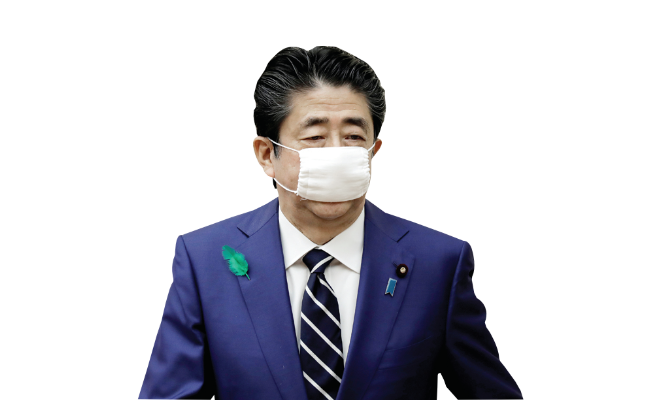
Shinzo Abe
2 / 2
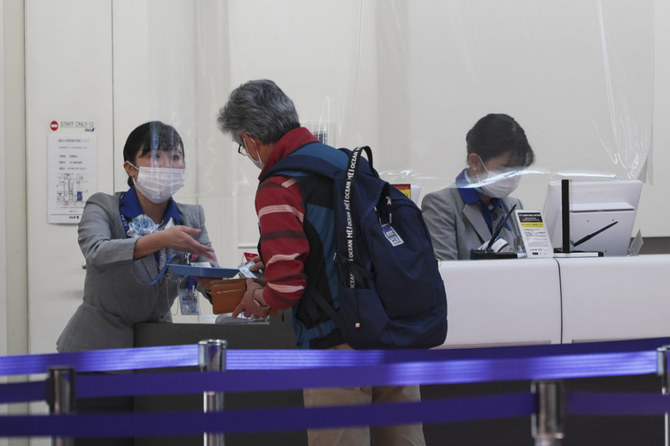
A passenger is attended by a ground staff of an airline at a domestic terminal of Haneda Airport in Tokyo, at the start of Golden Week holiday on April 29, 2020. (AP Photo/Eugene Hoshiko)
Short Url
Updated 30 April 2020
Follow

Japan’s Abe says cannot hold Olympics unless pandemic contained

  • Japan postponed the Games until July 2021 because of the coronavirus crisis
  • Japan has registered 13,895 COVID-19 infections, including 413 deaths

TOKYO: Japanese Prime Minister Shinzo Abe said on Wednesday that the Tokyo Olympics could not take place next year unless the coronavirus pandemic is contained, as the city’s governor called for an extension of the nationwide state of emergency.

The International Olympic Committee and the Japanese government last month postponed the Games until July 2021 because of the coronavirus crisis.

With the epidemic’s worldwide infection rate climbing and experts suggesting a vaccine is a long way off, doubts have been raised about the chances of holding the huge event next year.

“We’ve been saying the Olympic and Paralympic Games must be held in a complete form, in that athletes and spectators can all participate safely. It would be impossible to hold the Games in such a complete form unless the coronavirus pandemic is contained,” Abe said in response to an opposition lawmaker.

Abe’s summary of the situation was later underlined by IOC President Thomas Bach.

“The IOC fully agrees with the position of Prime Minister Abe,” Bach said in response to a question from Reuters.

“From the very beginning of this crisis, we established the principle that the Olympic and Paralympic Games can only be organized in a safe environment for everyone involved. This principle has driven all our decisions so far, and we remain committed to it in the future.”

Abe has staked part of his legacy as Japan’s longest-serving premier on holding the Games and was hoping for a boom in tourism and consumer spending. Japan has gathered some $3 billion in domestic sponsorship, an Olympic record, and spent close to $13 billion on preparations.

The prime minister said on Wednesday that the Olympics “must be held in a way that shows the world has won its battle against the coronavirus pandemic,” and cautioned that Japan should “brace for a protracted battle.” 

Tokyo confirmed 47 new infections on Wednesday. The national tally stands at 13,895 infections, including 413 deaths, national broadcaster NHK said.

The Nikkei business daily reported on Wednesday night that the government was planning to extend the nationwide emergency by about one month and that it would make a final decision after hearing from experts at a meeting on Friday.

While Japan’s tally is still low compared with other nations, critics say the country is not doing enough testing to reveal the scope of a problem that has put huge strains on some of its hospitals.

Top-ranked Aryna Sabalenka powers her way into the quarterfinals at the Australian Open

Updated 25 January 2026
Follow

Top-ranked Aryna Sabalenka powers her way into the quarterfinals at the Australian Open

  • Aryna Sabalenka rolls over the 19-year-old Canadian in just 31 minutes on Rod Laver Arena
  • Sabalenka will be up against an even younger player in the quarterfinals, 18-year-old Iva Jovic

MELBOURNE: Top-ranked Aryna Sabalenka, attempting to win her third Australian Open title in four years, reached the quarterfinals on Sunday with a victory over No. 17 Victoria Mboko of Canada 6-1, 7-6 (1).
Sabalenka, using a high-powered serve that produced three aces in the first set, rolled over the 19-year-old Canadian in just 31 minutes on Rod Laver Arena.
Sabalenka was not quite as dominant in the second set — producing a few more unforced errors — against Mboko, who played well enough to beat many players but not the two-time Australian Open champion.
“What an incredible player for such a young age,” the 27-year-old Sabalenka said of the young Canadian. “It’s incredible to see these kids coming up on Tour. I can’t believe I say that. I feel like I’m a kid.”
“She pushed me so much, and I’m happy to be through,” Sabalenka added in her on-court interview.
Sabalenka led the second set 4-1, and then failed to convert three match points while leading 5-4. Mboko slowly took back the momentum and forced a tiebreaker only for Sabalenka to dominate.
It was the 20th straight tiebreak victory for Sabalenka.
“I try to — not to think this is a tiebreak and play point by point, and I guess that’s the key to consistency,” she said.
Sabalenka won this Grand Slam in 2023 and 2024 and was the runner-up last year against Madison Keys. The Belarussian has also won two US Open titles.
Sabalenka will be up against an even younger player in the quarterfinals — 18-year-old American Iva Jovic.
The No. 29-seeded Jovic defeated Yulia Putintseva 6-0, 6-1 on John Cain Arena in just 53 minutes as she advanced to her first Grand Slam quarterfinal.
In a later match Sunday on Rod Laver Arena, the top-seeded man Carlos Alcaraz of Spain faced American No. 19 Tommy Paul for a spot in the quarterfinals.
Alexander Zverev and Coco Gauff, the third seeds on the men and women’s side, also played later for spots in the quarterfinals.