Pakistan braces for COVID-19 peak in late June

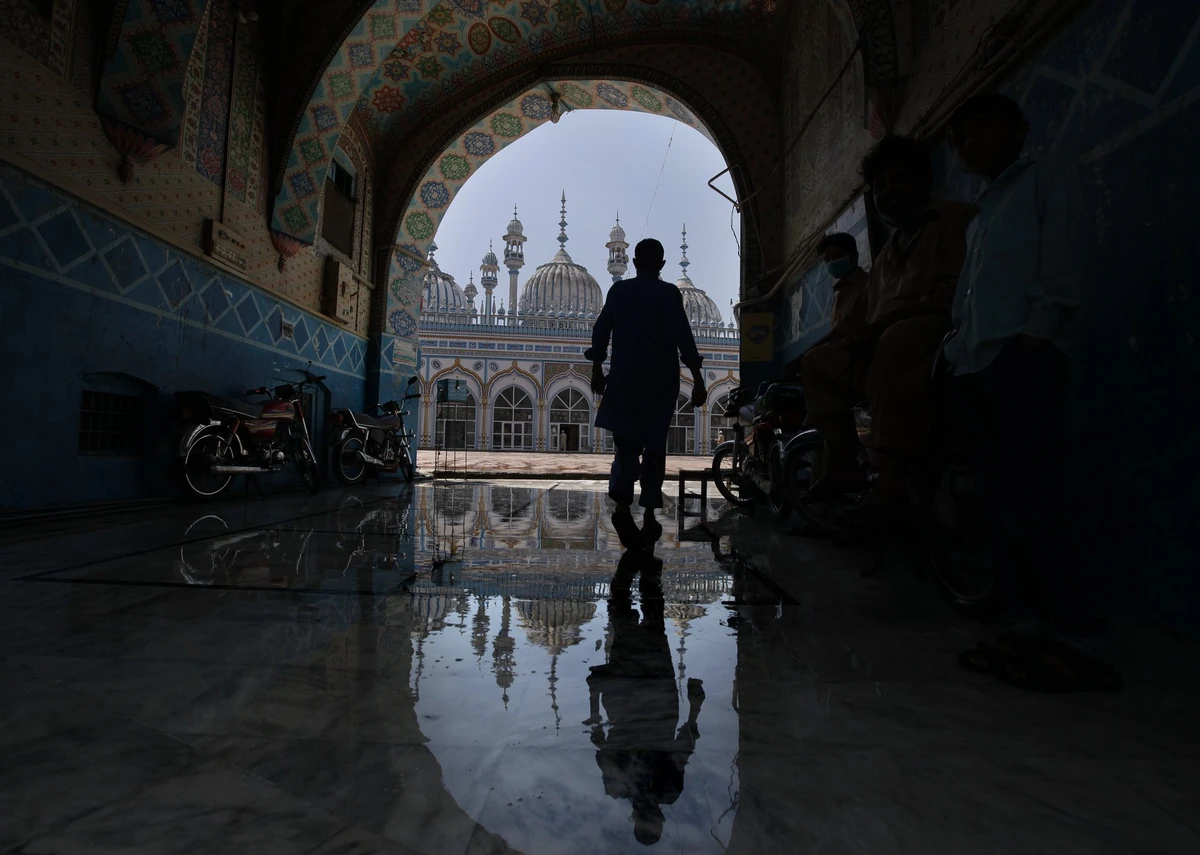
A Muslim worshiper arrives to attend noon prayers at a mosque, in Rawalpindi, Pakistan, April 21, 2020. (AP Photo)
Short Url
Updated 30 April 2020
Follow

Pakistan braces for COVID-19 peak in late June

  • Government designs special package for frontline health workers
  • Pakistan will partly lift transportation lockdown to facilitate movement ahead of Eid

ISLAMABAD: Pakistan is likely to reach the peak of coronavirus infections around the end of June, Planning Minister Asad Umer announced on Wednesday.
"On the basis of available data from last two months and also after analyzing world data, we are expecting the peak of COVID-19 in Pakistan somewhere between the end of June and early July," the minister who heads the National Command and Operation Center (NCOC) told reporters in Islamabad. 
NCOC is responsible for coordinating Pakistan's coronavirus response.
As the country has recently observed a sharp rise in known virus cases, the minister attributed it to Pakistan's increasing COVID-19 testing capacity, which he said had improved from around 2,000 to above 8,000 tests in the past two weeks.
"Right now, the number (of known cases) is above 15,000, but still this data is not conclusive as there may be many other people out there who have not been tested so far," he said, adding that with 26 deaths in the past 24 hours the country has witnessed the highest daily mortality rate, bringing the COVID-19 toll to 335.
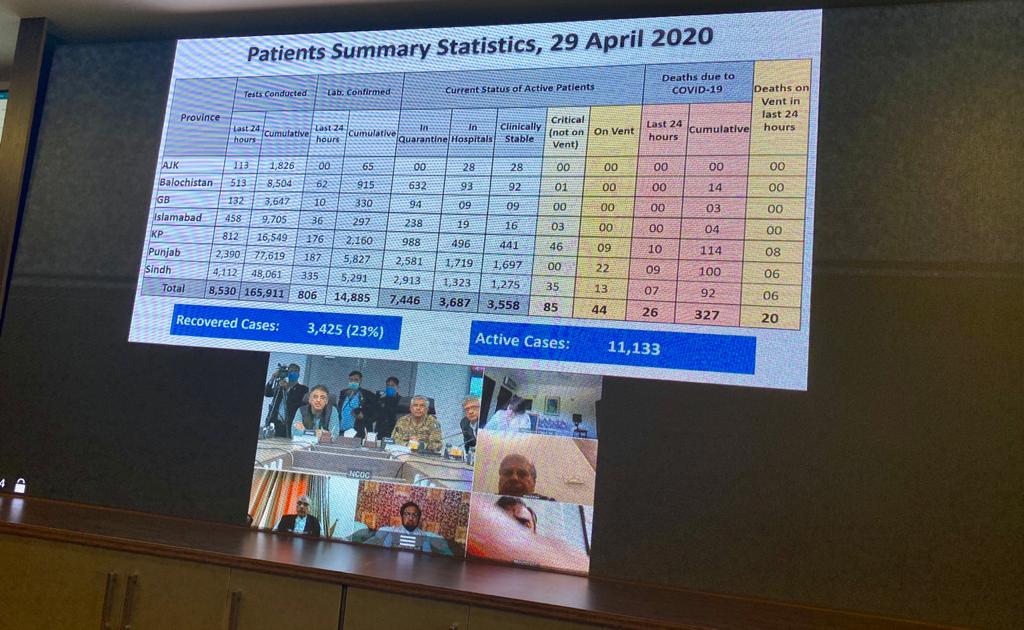


Planning Minister Asad Umer and NCOC representatives participate in a media briefing on COVID-19 in Islamabad on April 29, 2020. (AN photo)

In its testing efforts, Pakistan relies on polymerase chain reaction (PCR) tests, which according to Umer are 70 percent accurate. Currently, 52 laboratories across the country test samples for the virus, Dr. Mirza, the prime minister's special assistant on public health, said during the same NCOC briefing.
Despite the rising numbers of cases, the Pakistani government is planning to partly lift its transportation lockdown to facilitate movement ahead of the Eid holidays next month.
"We are making very stringent SOPs for the opening of public transport as we have to open intercity and interprovincial bus services by the end of Ramadan to facilitate public to travel to their homes before Eid," Umer said.
NCOC consists of provincial and federal institutions as well as the military. Its standing committee is chaired by Dr. Mirza and it has all provincial health ministers as members. "Federal and provincial information ministries are also part of NCOC to help us spread relevant information," Umer said.
One of the main current problems in Pakistan's efforts to contain the outbreak is the safety of its medical workers. Dr. Mirza said a special scheme has been designed for them.
"We are focusing on the safety of health workers as 480 of them have contracted COVID-19, which is a cause of great concern for us. We have designed a protection and support program for frontline health workers and the federal cabinet has approved a special package for them," he said.
IMF board to meet tomorrow to consider $1.2 billion disbursement for Pakistan

Updated 11 sec ago
Follow

IMF board to meet tomorrow to consider $1.2 billion disbursement for Pakistan

  • Pakistan, IMF reached a Staff-Level Agreement for second review of $7 billion loan program 
  • Economists view disbursement crucial for cash-strapped Pakistan as it tackles economic crisis

ISLAMABAD: The International Monetary Fund’s (IMF) Executive Board will meet tomorrow, Monday, to consider and approve a $1.2 billion disbursement for Pakistan, according to the global lender’s official schedule. 

The meeting takes place nearly two months after the Fund reached a Staff-Level Agreement (SLA) with Pakistan for the second review of its $7 billion Extended Fund Facility (EFF) and the first review of its $1.4 billion Resilience and Sustainability Facility (RSF). 

The SLA followed a mission led by IMF’s Iva Petrova, who held discussions with Pakistani authorities during a Sept. 24–Oct. 8 visit to Karachi, Islamabad and Washington, DC.

“The International Monetary Fund’s (IMF) Executive Board will convene on Dec. 8 to consider Pakistan’s request for a $1.2 billion disbursement under the Extended Fund Facility (EFF) and the Resilience and Sustainability Facility (RSF), according to the Fund’s updated schedule,” the state-run Pakistan TV reported on Sunday.

Economists view IMF’s bailout packages as crucial for cash-strapped Pakistan, which has relied heavily on financing from bilateral partners such as Saudi Arabia, China and the United Arab Emirates, as well as multilateral lenders including the IMF, World Bank, Asian Development Bank and Islamic Development Bank. 

The South Asian country has been grappling with a prolonged macroeconomic crisis that has drained its financial resources and triggered a balance of payments crisis. Islamabad, however, has recorded some financial gains since 2022, which include recording a surplus in its current account and bringing inflation down considerably. 

Speaking to Arab News last month, Pakistan’s former finance adviser Khaqan Najeeb said the $1.2 billion disbursement will further stabilize Pakistan’s near-term external position and unlock additional official inflows. 

“Continued engagement also reinforces macro stability, as reflected in recent improvements in inflation, the current account, and reserve buffers,” Najeeb said. 

Pakistan came close to sovereign default in mid-2023, when foreign exchange reserves fell below three weeks of import cover, inflation surged to a record 38 percent in May, and the country struggled to secure external financing after delays in its IMF program. Fuel shortages, import restrictions, and a rapidly depreciating rupee added to the pressure, while ratings agencies downgraded Pakistan’s debt and warned of heightened default risk.

The crisis eased only after Pakistan reached a last-minute Stand-By Arrangement with the IMF in June 2023, unlocking emergency support and preventing an immediate default.