

UK denies antibody test ready for rollout

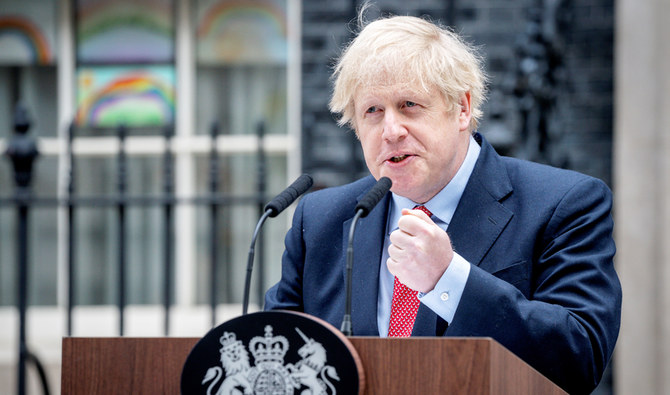
UK Prime Minister Boris Johnson gives a statement outside 10 Downing Street, as he returns to work on Monday after recovering from coronavirus. (AFP)
Short Url
Updated 28 April 2020
Follow

UK denies antibody test ready for rollout

  • Pressure to deliver viable antibody tests has also been driven by a number of existing designs failing en masse in Britain and across Europe

LONDON: The UK government has denied ordering up to 50 million home testing kits for COVID-19 from a consortium based in Oxford, weeks after admitting that along with several EU states, it had imported millions of faulty kits from abroad.
The news has dealt another blow to global efforts to contain the virus. UK Foreign Secretary Dominic Raab on Sunday said it was unclear whether the kits were reliable, warning that faulty testing, potentially giving people the all clear when they were still at risk, would be extremely dangerous.
An antibody test that can be taken at home, and that would be able to tell people whether they had already contracted COVID-19 — and therefore possibly built up a level of immunity — has been seen as a key step in developing a global strategy to end lockdowns worldwide that have caused widespread economic damage.
The hope is that by identifying those with a degree of immunity, and by being able to map the spread of infection, governments might be able to safely restart parts of their economies and reopen areas of major cities without risking a “second peak” of infections.
Reports over the weekend suggested that 50 million tests had been ordered from scientists working for the Rapid Testing Consortium at Oxford University — a partnership between four private companies and the university — which has received UK government backing.

HIGHLIGHT

News deals blow to global hopes of home-use kits to help end lockdowns.

The test, based on analyzing antibodies in blood obtained through a finger prick, and differing from the antigen test needed to identify someone with an active case by taking samples from the throat or nasal cavity, supposedly gives positive or negative results for COVID-19 antibodies in under an hour.
But a source at the UK’s Department of Health and Social Care told the Daily Telegraph newspaper that the test had yet to meet approval.
“The claims are overblown. It is premature to be talking about ordering large numbers of a test that hasn’t passed a regulator,” the source said.
Pressure to deliver viable antibody tests has also been driven by a number of existing designs failing en masse in Britain and across Europe.
The UK admitted that it had been forced to return 17.5 million tests bought from China — the source of the global pandemic — earlier this month.
Spain, the Czech Republic, Slovakia and other EU states have also discarded hundreds of thousands of faulty imported kits.
In the US, meanwhile, the Food and Drug Administration (FDA) has come in for criticism after allowing the sale of more than 90 different test kits on the open market that have been described as being of “dubious quality.”
Eric Topol, director of the Scripps Research Translational Institute, told the Financial Times: “Usually you can rely on the FDA to do due diligence and really make sure the test is valid but here the criteria have been loosened. If anything we need more oversight, rather than less.”
The Switzerland-based Foundation for Innovative New Diagnostics said 280 antibody tests have gone into development or reached markets since the start of the outbreak in late 2019.
But none has yet been found to approach 100 percent accuracy, with some registering as little as 30 percent.
Part of the issue arises from the difficulty in accurately identifying antibodies specific to Sars-CoV-2, the virus responsible for COVID-19, when other antibodies are present in a sample.

The UK’s National Covid Testing Scientific Advisory Panel, also based at Oxford University, has so far trialed, and declined, nine different commercially available antibody tests.

Prime Minister Boris Johnson had previously referred to developing an accurate antibody test as a potential “game changer” in the global quest to overcome the virus.

But in a speech upon his return to work on Monday he did not make any reference to such a test, instead imploring people to stick to lockdown guidelines.


Reference to Trump’s impeachments is removed from the display of his Smithsonian photo portrait

Updated 9 sec ago
Follow

Reference to Trump’s impeachments is removed from the display of his Smithsonian photo portrait

  • For now, references to Presidents Andrew Johnson and Bill Clinton being impeached in 1868 and 1998, respectively, remain as part of their portrait labels, as does President Richard Nixon’s 1974 resignation as a result of the Watergate scandal

WASHINGTON: President Donald Trump’s photo portrait display at the Smithsonian’s National Portrait Gallery has had references to his two impeachments removed, the latest apparent change at the collection of museums he has accused of bias as he asserts his influence over how official presentations document US history.
The wall text, which summarized Trump’s first presidency and noted his 2024 comeback victory, was part of the museum’s “American Presidents” exhibition. The description had been placed alongside a photograph of Trump taken during his first term. Now, a different photo appears without any accompanying text block, though the text was available online. Trump was the only president whose display in the gallery, as seen Sunday, did not include any extended text.
The White House did not say whether it sought any changes. Nor did a Smithsonian statement in response to Associated Press questions. But Trump ordered in August that Smithsonian officials review all exhibits before the nation celebrates the 250th anniversary of the Declaration of Independence on July 4. The Republican administration said the effort would “ensure alignment with the president’s directive to celebrate American exceptionalism, remove divisive or partisan narratives, and restore confidence in our shared cultural institutions.”
Trump’s original “portrait label,” as the Smithsonian calls it, notes Trump’s Supreme Court nominations and his administration’s development of COVID-19 vaccines. That section concludes: “Impeached twice, on charges of abuse of power and incitement of insurrection after supporters attacked the US Capitol on January 6, 2021, he was acquitted by the Senate in both trials.”
Then the text continues: “After losing to Joe Biden in 2020, Trump mounted a historic comeback in the 2024 election. He is the only president aside from Grover Cleveland (1837– 1908) to have won a nonconsecutive second term.”
Asked about the display, White House spokesman Davis Ingle celebrated the new photograph, which shows Trump, brow furrowed, leaning over his Oval Office desk. Ingle said it ensures Trump’s “unmatched aura ... will be felt throughout the halls of the National Portrait Gallery.”
The portrait was taken by White House photographer Daniel Torok, who is credited in the display that includes medallions noting Trump is the 45th and 47th president. Similar numerical medallions appear alongside other presidents’ painted portraits that also include the more extended biographical summaries such as what had been part of Trump’s display.
Sitting presidents are represented by photographs until their official paintings are commissioned and completed.
Ingle did not answer questions about whether Trump or a White House aide, on his behalf, asked for anything related to the portrait label.
The gallery said in a statement that it had previously rotated two photographs of Trump from its collection before putting up Torok’s work.
“The museum is beginning its planned update of the America’s Presidents gallery which will undergo a larger refresh this Spring,” the gallery statement said. “For some new exhibitions and displays, the museum has been exploring quotes or tombstone labels, which provide only general information, such as the artist’s name.”
For now, references to Presidents Andrew Johnson and Bill Clinton being impeached in 1868 and 1998, respectively, remain as part of their portrait labels, as does President Richard Nixon’s 1974 resignation as a result of the Watergate scandal.
And, the gallery statement noted, “The history of Presidential impeachments continues to be represented in our museums, including the National Museum of American History.”
Trump has made clear his intentions to shape how the federal government documents US history and culture. He has offered an especially harsh assessment of how the Smithsonian and other museums have featured chattel slavery as a seminal variable in the nation’s development but also taken steps to reshape how he and his contemporary rivals are depicted.
In the months before his order for a Smithsonian review, he fired the head archivist of the National Archives and said he was firing the National Portrait Gallery’s director, Kim Sajet, as part of his overhaul. Sajet maintained the backing of the Smithsonian’s governing board, but she ultimately resigned.
At the White House, Trump has designed a notably partisan and subjective “Presidential Walk of Fame” featuring gilded photographs of himself and his predecessors — with the exception of Biden, who is represented by an autopen — along with plaques describing their presidencies.
The White House said at the time that Trump himself was a primary author of the plaques. Notably, Trump’s two plaques praise the 45th and 47th president as a historically successful figure while those under Biden’s autopen stand-in describe the 46th executive as “by far, the worst President in American History” who “brought our Nation to the brink of destruction.”