

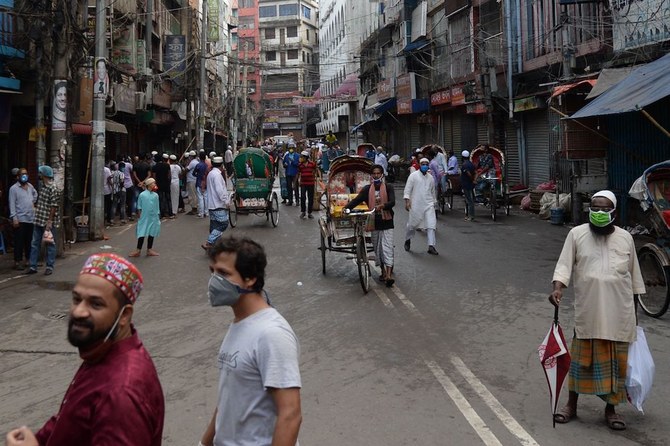
Coronavirus lockdown police officers in Bangladesh get infected 

Around 10,000 members of Bangladesh's armed forces are working to contain the coronavirus outbreak, but the Inter-Services Public Relations (ISPR) department said Saturday that the situation was under control. (AFP)
Short Url
Updated 25 April 2020
Follow

Coronavirus lockdown police officers in Bangladesh get infected 

  • Health experts say police need proper training

DHAKA: Police officers tasked with enforcing a coronavirus lockdown in Bangladesh have contracted the disease.

More than 200,000 officers are working around the clock to ensure that people obey lockdown conditions in Bangladesh, where there are 4,998 confirmed cases and a death toll of 140.

More than 660 police officers have been placed in quarantine and 262 have become infected.

“During this health emergency, police members are in close contact with people — limiting mass gatherings, taking people to hospitals, taking food and essentials to individuals' homes, searching and checking suspicious people — all these tasks create a higher risk of being infected,” Sohel Rana, assistant inspector general of police headquarters, told Arab News. 

He added that provisions had been made at three hospitals to treat the infected officers. “We are keeping the groups away from each other and are sending a separate roster to each of the teams. We are keeping alternative plans so that our services to maintain law and order are not hampered.”

Health experts said police officers should be given proper training on infection control.

“Although police members used some forms of personal protective equipment (PPE), training on infection control and supervision on infection control practice may be lacking, making them more susceptible to the infection," Prof. Be-Nazir Ahmed, former director at the Center for Disease Control and Prevention, told Arab News.  

He said that the government should maximize its efforts to trace, test and treat every case and continue social distancing.

The government has extended public holidays until May 5 to limit the number of infections. 

Around 10,000 members of Bangladesh's armed forces are also working to contain the outbreak, but the Inter-Services Public Relations (ISPR) department said Saturday that the situation was under control.

“A few of the members of our armed forces who got infected with coronavirus while working on the ground are doing well. The number of our infected members are very negligible, and the situation is very much under control," Lt. Colonel Abdullah Ibne Jayed, ISPR director, told Arab News.


EU eyes migration clampdown with push on deportations, visas

Updated 5 sec ago
Follow

EU eyes migration clampdown with push on deportations, visas

  • Irregular arrivals in the 27-nation bloc were down by more than a quarter in 2025
  • “The priority is clear: bringing illegal arrival numbers down and keeping them down,” Brunner said

BRUSSELS: The European Union on Thursday laid out plans to overhaul its visa system and step up deportations as part of a five-year migration strategy that cements a hardening line on the hot-button issue.
Irregular arrivals in the 27-nation bloc were down by more than a quarter in 2025, according to the EU’s border agency — but political pressure to act remains high.
“The priority is clear: bringing illegal arrival numbers down and keeping them down,” Magnus Brunner, the EU’s commissioner for migration, said.
The strategy unveiled Thursday stressed the need to boost deportations of failed asylum-seekers among the bloc’s priorities.
“Abuse gives migration a bad name — it undermines public trust and ultimately takes away from our ability to provide protection and undercuts our drive to attract talent,” said Brunner.
The European Parliament is currently examining a legal text put forward by the European Commission allowing for so-called “return hubs” to be set up outside the EU’s borders.
Criticized by rights groups, the proposal also envisages harsher penalties for migrants who refuse to leave European territory, including longer periods of detention.
European governments are under pressure to take a tougher stance amid a souring of public opinion on migration that has fueled a rightward shift across the bloc.

- ‘Flawed’ approach -

The strategy also mentioned reinforcing an “assertive migration diplomacy” to persuade third countries to help stop migrants from reaching Europe and take back their nationals with no right to stay.
Brussels recently struck or is negotiating deals with Northern African countries including Tunisia, Mauritania, Egypt and Morocco, whereby it gets help controlling migration flows in return for aid and investments.
Amnesty International criticized the EU’s approach as “flawed.”
It “only heightens its dependence on third countries to manage migration, while making it complicit in any rights violations that may result,” said Olivia Sundberg Diez, a policy analyst with the human rights group.
Brussels also put forward a brand-new visa strategy, with the stated objective of using the granting of access to EU territory to certain nationals as a diplomatic means to foster its policy goals.
It’s “one of the strongest tools in our hands,” said a commission source.
In particular, the EU wants to sanction countries that refuse to take back their nationals by restricting the issuance of visas, while easing procedures to attract skilled workers.
The commission is expected to present a plan for reform by the end of the year.