PARIS: Dancer Yara Al-Hasbani is used to causing a stir everywhere she goes.
The Syrian choreographer has drawn crowds across France for her performances in public squares and parks.
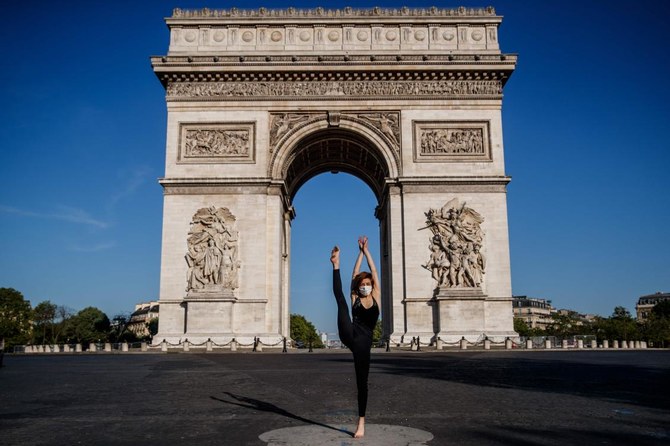
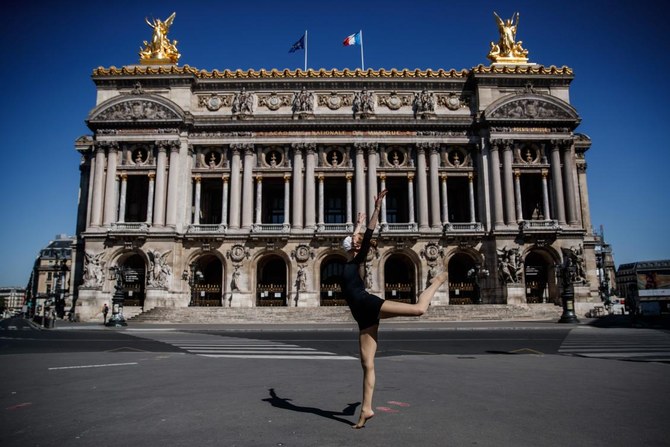
But there wasn’t a soul in sight as she performed a series of spectacular ballet moves in front of the deserted grand monuments of Paris for AFP.
With the French capital in lockdown for nearly six weeks because of the coronavirus, the 26-year-old had some of the most visited sites in the world to herself.
Wearing a white mask, she danced an arabesque in front of the Louvre museum, an “attitude derriere” on the steps of Sacre Coeur and did a “six o’clock” with one leg right up to her head by the Arc du Triomphe.
Trained as a ballet and contemporary dancer in Damascus, Al-Hasbani left her war-torn homeland six years ago and is now a member of the Atelier of Artists in Exile in the French capital, where she has lived since 2016.
“It is really strange to see these monuments deserted,” said the choreographer.
She said it was wonderful “to admire the city without noise and tourists but at the same time it was sad, as if it was abandoned.”
Perhaps the most spectacular images come from Human Rights Square — a cause dear to Al-Hasbani’s heart — at Trocadero looking out at the Eiffel Tower.
She has previously danced at Place de la Republique, a traditional rallying point for protests in the French capital, where she created her first piece outside Syria in memory of the hundreds of children killed in a chemical attack near Damascus in August 2015.

Syrian dancer takes a spookily empty Paris as her canvas
https://arab.news/geabq
Syrian dancer takes a spookily empty Paris as her canvas
- The Syrian choreographer has drawn crowds across France for her performances in public squares and parks
- Trained as a ballet and contemporary dancer in Damascus, Al-Hasbani left her war-torn homeland six years ago and is now a member of the Atelier of Artists in Exile in the French capital
Riyadh to install 25 new public artworks after conclusion of Tuwaiq Sculpture symposium
- Move will extend the impact of the annual art event beyond its conclusion, bringing large-scale contemporary artworks into the city’s streets and parks
- Artworks produced during the symposium will now become part of Riyadh Art’s permanent collection
RIYADH: Some 25 sculptures created during the seventh edition of the Tuwaiq Sculpture symposium and exhibition will soon be installed across public spaces in Riyadh.
The move will extend the impact of the annual art event beyond its conclusion, organizers said, bringing large-scale contemporary artworks into the city’s streets and parks.
Organized by the Royal Commission for Riyadh City through the Riyadh Art Program, the 2026 edition has ended after nearly two months of live sculpting, exhibitions and public programming.
The artworks produced during the symposium will now become part of Riyadh Art’s permanent collection and will appear across the capital as part of a broader effort to integrate art into everyday urban life.
This year’s symposium began in January and took place along Prince Mohammed bin Abdulaziz Road, widely known as Tahlia Street.
The site was transformed into an open-air studio in which visitors could observe artists carving, welding and assembling sculptures.
The live sculpting phase, which was held between Jan. 10 and Feb. 5, brought together leading Saudi and international artists to produce 25 large-scale works.
The sculptures were created using locally sourced granite and reclaimed metal, highlighting both the region’s natural materials and the creative reuse of industrial elements.
Visitors were able to follow the process of each artwork’s development, from raw materials to finished sculptures, while also interacting with the artists and learning about their techniques and concepts.
The event also featured a wide-ranging community engagement program designed to deepen public understanding of contemporary art.
The program included 10 panel discussions, 105 training workshops and 15 masterclasses exploring sculptural techniques, materials and the role of public art in cities.
Educational outreach formed another key component of the symposium. Organizers hosted 25 educational visits for more than 600 students, while daily guided tours enabled visitors to explore the artworks and gain insight into the creative processes behind them.
After the live sculpting phase, the completed sculptures remained on-site until March 8, giving visitors the opportunity to experience the works in their original setting before their distribution across Riyadh.
The symposium was curated by Lulwah Al-Homoud, Sarah Staton, and Rut Blees Luxemburg, who guided the artistic direction around the theme “Traces of What Will Be,” exploring how sculpture can reflect future possibilities while responding to the city’s evolving identity.