

Lebanon slashes exchange rate at money transfer firms

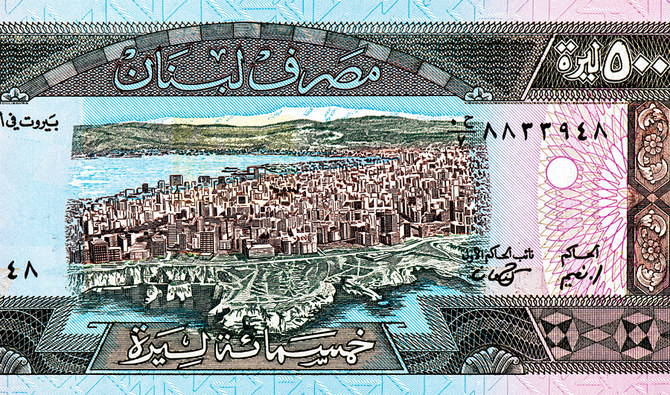
Beirut, as depicted above on a vintage Lebanese banknote, is struggling to keep a lid on the country’s financial problems. (Shutterstock)
Short Url
Updated 25 April 2020
Follow

Lebanon slashes exchange rate at money transfer firms

  • New rate applies to cash sent through wire transfer offices used by Lebanese diaspora to send funds home

BEIRUT: The Lebanese central bank set an exchange rate of 3,625 Lebanese pounds per dollar to be applied by money-transfer firms on Friday, a central bank source said, 58 percent weaker than the official peg as the country grapples with a financial crisis.

The new rate is seen as part of wider moves by the central bank away from a peg in place since 1997, bankers say. Though the official pegged rate of 1,507.5 pounds is still in place, it amounts to an effective devaluation of the pound.
The new rate applies to money sent through wire transfer offices, which are used by many Lebanese abroad to send money to family at home.
The Lebanese pound has slumped on a parallel market since October, when the country’s long-brewing economic troubles came to a head, prompting a financial and banking crisis considered the biggest risk to stability since the 1975-90 civil war.
The authorities are still applying the official pegged rate for essential imports — fuel, wheat and medicine — in an effort to slow spiralling inflation in the import-dependent economy.
“Prices may change every day and will be set the day before,” the central bank source said, adding that the rate reflected the price dollars were fetching at foreign exchange offices. “In the event that there are major fluctuations during the day, the price may be set again during the same day.”
A senior banker said central bank governor Riad Salameh was effectively devaluing the currency without announcing it.
With dollars in short supply, the central bank earlier this month said the money-transfer services must issue cash in the local currency at a “market rate.” This week, the central bank said

FASTFACT

With dollars in short supply, the central bank earlier this month said the money-transfer services must issue cash in the local currency at a “market rate.”

depositors with dollar accounts in Lebanon would be paid cash in pounds, also at a “market rate,” within withdrawal limits.
Banking sources said they expected the rate applied to such withdrawals to be close to the rate set by the central bank for wire transfer firms. Banks, exchange dealers and the central bank will meet on Monday to make a decision.
Parliament speaker Nabih Berri urged the government on Thursday to use its legal powers to halt the pound’s “dramatic collapse” before it is “too late.”
Finance Minister Ghazi Wazni told Al-Joumhuria newspaper on Friday the fall could not be attributed to economic, financial or monetary reasons and said it was down to “strong speculation and manipulation in the market.”
“This increased the fear of citizens and their concern, which brought about an increase in demand for the dollar.”
Foreign currency dealers will strike until Monday “to warn about the continued deterioration of the exchange rate,” their syndicate announced late on Thursday.


Closing Bell: Saudi main market sheds 85 points to finish at 11,098 

Updated 17 February 2026
Follow

Closing Bell: Saudi main market sheds 85 points to finish at 11,098 

RIYADH: Saudi Arabia’s Tadawul All Share Index closed lower in the latest session, falling 85.79 points, or 0.77 percent, to finish at 11,098.06. 

The MSCI Tadawul 30 Index declined 0.63 percent to close at 1,495.23, while the parallel market index Nomu dropped 0.91 percent to 23,548.56.  

Market breadth was firmly negative, with 42 gainers against 218 decliners on the main market. Trading activity saw 226 million shares exchanged, with total turnover reaching SR4.5 billion ($1.19 billion).  

Among the session’s gainers, Tourism Enterprise Co. rose 9.40 percent to SR15.02. SHL Finance Co. advanced 4.51 percent to SR16.00, while Almasar Alshamil for Education Co. gained 3.56 percent to SR23.88.  

Dar Alarkan Real Estate Development Co. added 3.03 percent to SR19.70, and Banque Saudi Fransi climbed 2.61 percent to SR19.30. 

On the losing side, Almasane Alkobra Mining Co. recorded the steepest decline, falling 6.61 percent to SR96.

Al Moammar Information Systems Co. dropped 5.14 percent to SR164.20, while National Company for Learning and Education declined 4.60 percent to SR124.30. Saudi Ceramic Co. slipped 4.14 percent to SR27.30, and Arabian Contracting Services Co. fell 4.12 percent to SR116.50. 

On the announcement front, Saudi Telecom Co. announced the distribution of interim cash dividends for the fourth quarter of 2025 in line with its approved dividend policy.  

The company will distribute SR2.74 billion, equivalent to SR0.55 per share, to shareholders for the quarter.  

The number of shares eligible for dividends stands at approximately 4.99 billion shares. The eligibility date has been set for Feb. 23, with distribution scheduled for March 12.  

The company noted that treasury shares are not entitled to dividends and that payments will be made through Riyad Bank via direct transfer to shareholders’ bank accounts. stc shares last traded at SR44.80, unchanged on the session. 

Separately, National Environmental Recycling Co., known as Tadweer, reported its annual financial results for the year ended Dec. 31, 2025, posting significant growth in revenue and profit.  

Revenue rose 53.5 percent year on year to SR1.24 billion, compared with SR806 million in the previous year. Net profit attributable to shareholders increased 68.4 percent to SR60.9 million, up from SR36.2 million a year earlier, driven by higher sales volumes and operational expansion.

Tadweer shares last traded at SR3.80, up 2.70 percent.