Inject disinfectant? Trump’s idea baffles experts

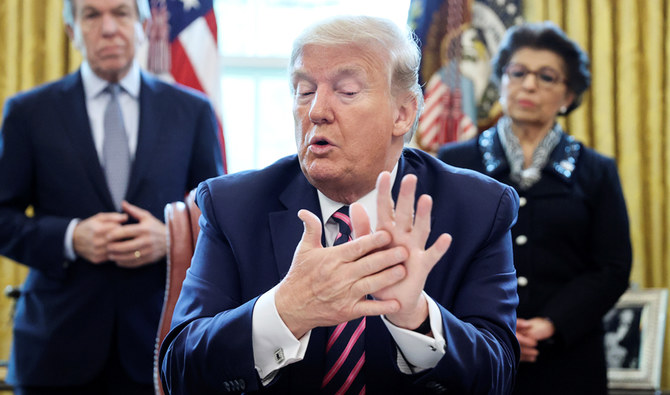
U.S. President Donald Trump rubs his hands and while defending his comments on using disinfectants as a measure against the coronavirus prior to signing the "Paycheck Protection Program and Health Care Enhancement Act," approving additional coronavirus disease (COVID-19) relief for the U.S. (REUTERS)
Short Url
Updated 25 April 2020
Follow

Inject disinfectant? Trump’s idea baffles experts

  • Trump’s claims to medical expertise are endless fuel for late night comedy routines

WASHINGTON: Top White House coronavirus adviser Deborah Birx shrank in horror and around the nation comedians sharpened their pens: President Donald Trump had just asked if virus victims couldn’t be injected with disinfectant.
Even as a new poll shows most Americans wish the former real estate magnate would leave science to the experts, Trump on Thursday evening hit a new high in the annals of amateur presidential doctoring.
Encouraged by tentative findings that summer weather may dampen the novel coronavirus, Trump used his daily live press briefing to ask whether light could become a medical treatment.
“Supposing we hit the body with a tremendous — whether it’s ultraviolet or just very powerful light,” Trump said. “Supposing you brought the light inside the body, which you can do either through the skin or in some other way.”
Birx and another government medical expert looked on warily. The president wasn’t finished. “Then I see the disinfectant, where it knocks (the virus) out in a minute. One minute. And is there a way we can do something like that, by injection inside or almost a cleaning? Because you see it gets in the lungs and it does a tremendous number on the lungs.”
Birx winced and turned her eyes from the president to the floor.
Trump’s actual comments about disinfectants were quickly savaged in memes and jokes on Twitter.
“’Hey guys!!! It’s Dettol o’clock!!!’” said one tweet alongside a picture of a glass filled with cleaner on the rocks. Another tweet looked forward to “breakfast of nice chilled toilet cleaner.”
The British-based manufacturer of Lysol and Dettol felt compelled to put out a statement: “Under no circumstances should our disinfectant products be administered into the human body through injection, ingestion or any other route,” the company, Reckitt Benckiser, said.
Trump’s claims to medical expertise are also endless fuel for late night comedy routines. “Late Show” host Stephen Colbert had just taped an impersonation of the president touting Listerine mouthwash as a remedy on Thursday before the briefing took place.


94 million need cataract surgery, but access lacking: WHO

A Somali patient undergoes free cataract surgery at Al Nuur eye Hospital in Mogadishu, on February 16, 2015. (AFP)
Updated 11 February 2026
Follow

94 million need cataract surgery, but access lacking: WHO

  • Of the 94 million affected, fewer than 20 percent are blind, while the rest suffer from impaired vision

GENEVA: More than 94 million people suffer from cataracts, but half of them do not have access to the surgery needed to fix it, the World Health Organization said Wednesday.
Cataracts — the clouding of the eye’s lens that causes blurred vision and can lead to blindness — are on the rise as populations get older, with age being the main risk factor.
“Cataract surgery — a simple, 15-minute procedure — is one of the most cost-effective medical procedures, providing immediate and lasting restoration of sight,” the WHO said.
It is one of the most frequently performed surgeries undertaken in high-income countries.
However, “half of the world’s population in need of cataract surgery don’t have access to it,” said Stuart Keel, the UN health agency’s technical lead for eye care.
The situation is worst in the WHO’s Africa region, where three in four people needing cataract surgery remain untreated.
In Kenya, at the current rate, 77 percent of people needing cataract surgery are likely to die with their cataract blindness or vision impairment, said Keel.
Across all regions, women consistently experience lower access to care than men.
Of the 94 million affected, fewer than 20 percent are blind, while the rest suffer from impaired vision.

- 2030 vision -

The WHO said that over the past two decades, global cataract surgery coverage had increased by 15 percent.

In 2021, WHO member states set a target of a 30-percent increase by 2030.
However, current modelling predicts that cataract surgery coverage will rise by only about 8.4 percent this decade.
To close the gap, the WHO urged countries to integrate eye examinations into primary health care and invest in the required surgical equipment.
States should also expand the eye-care workforce, training surgeons in a standardised manner and then distributing them throughout the country, notably outside major cities.
The WHO was on Wednesday launching new guidance for countries on how to provide quality cataract surgery services.
It will also issue guidance to help support workforce development.
Keel said the main issue was capacity and financing.
“We do need money invested to get rid of this backlog, which is nearly 100 million people,” he told a press conference.
While age is the primary risk factor for cataracts, others include prolonged UV-B light exposure, tobacco use, prolonged corticosteroid use and diabetes.
Keel urged people to keep up regular eye checks as they get older, with most problems able to be either prevented or diagnosed and treated.
The cost of the new lens that goes inside the eye can be under $100.
However, out-of-pocket costs can be higher when not covered by health insurance.
“Cataract surgery is one of the most powerful tools we have to restore vision and transform lives,” said Devora Kestel, head of the WHO’s noncommunicable diseases and mental health department.
“When people regain their sight, they regain independence, dignity, and opportunity.”