UN chief Guterres: Pandemic nearing ‘human rights crisis’

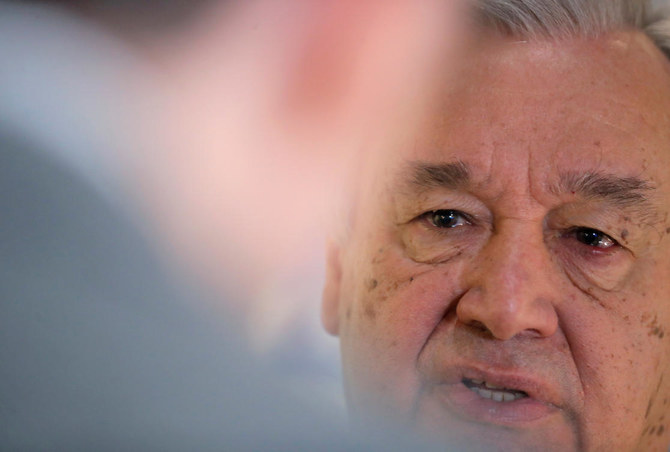
United Nations Secretary-General Antonio Guterres released a report on how human rights must guide the response to COVID-19 and recovery from the pandemic. (Reuters)
Short Url
Updated 23 April 2020
Follow

UN chief Guterres: Pandemic nearing ‘human rights crisis’

  • Discrimination in the delivery of public services to tackle COVID-19
  • UN chief stressed that governments must be ‘transparent, responsive and accountable’

UNITED NATIONS: United Nations Secretary-General Antonio Guterres says the coronavirus pandemic is “a human crisis that is fast becoming a human rights crisis.”
The UN chief said in a video message Thursday that there is discrimination in the delivery of public services to tackle COVID-19 and there are “structural inequalities that impede access to them.”
Guterres said the pandemic has also seen “disproportionate effects on certain communities, the rise of hate speech, the targeting of vulnerable groups, and the risks of heavy-handed security responses undermining the health response.”
And he warned that with “rising ethno-nationalism, populism, authoritarianism and a pushback against human rights in some countries, the crisis can provide a pretext to adopt repressive measures for purposes unrelated to the pandemic.”
The secretary-general did not name any countries or parties but stressed that governments must be “transparent, responsive and accountable,” and that press freedom, civil society organizations, the private sector and “civic space” are essential.
He stressed that any emergency measures — including states of emergency — must be “legal, proportionate, necessary and non-discriminatory, have a specific focus and duration, and take the least intrusive approach possible to protect public health.”
Guterres released a report on how human rights must guide the response to COVID-19 and recovery from the pandemic.
He said: “The message is clear: People — and their rights — must be front and center.”


Backlash as Australia kills dingoes after backpacker death

Updated 3 sec ago
Follow

Backlash as Australia kills dingoes after backpacker death

  • The euthanization program has stirred debate about how to manage the local population of dingoes
  • Wildlife experts said killing the animals was the wrong response and may threaten the island’s dingo population
SYDNEY: Australian authorities have sparked a backlash by killing a group of dingoes linked to the death of a young Canadian woman on an island in the country’s east.
The Queensland government said six animals were put down after 19-year-old backpacker Piper James’s body was found on January 19 at a beach on the World Heritage-listed island of K’gari.
The euthanization program has stirred debate about how to manage the local population of dingoes, a sandy-colored canine believed to have first arrived in Australia 4,000 to 5,000 years ago.
An autopsy conducted on James’ body found evidence “consistent with drowning” but also detected injuries corresponding to dingo bites.
“Pre-mortem dingo bite marks are not likely to have caused immediate death,” said a spokesperson for the Coroners Court of Queensland.
The coroner’s investigation into the cause of death was expected to take several weeks.
In response, the Queensland government said a pack of 10 dingoes involved would be euthanized after rangers had observed some “aggressive behavior.”
Six of the dingoes had already been euthanized, the state’s environment minister, Andrew Powell, told reporters Sunday.
“Obviously, the operation will continue,” he said.
The traditional owners of K’gari, the Butchulla people, said the state’s failure to consult with them before euthanizing the dingoes — or wongari in their language — was “unexpected and disappointing.”
“Once again, it feels as though economic priorities are being placed above the voices of the people and traditional owners, which is frustrating and difficult to accept,” the Butchulla Aboriginal Corporation said in a statement to Australian media this week.
‘You are food’
Wildlife experts said killing the animals was the wrong response and may threaten the island’s dingo population, estimated at just 70-200 animals.
Given their small numbers, killing a pack of 10 animals would harm the population’s genetic diversity, said Mathew Crowther, professor of quantitative conservation biology at the University of Sydney.
“There’s no moral from the dingoes’ point of view. They’re just being wild animals, doing wild things,” Crowther said.
Dingoes tend to lose their fear of people as they interact with tourists, some of whom defy advice against feeding the animals.
“That’s the worst thing you can do to a wild animal,” Crowther said.
“They just relate humans to food, and if you don’t give them food, well, you are food — that’s basically how it is.”
Dingoes are wild, predatory animals and need to be treated with respect, said Bill Bateman, associate professor in the school of molecular and life sciences at Curtin University.
The canines are more likely to attack children or people who are alone, and may be triggered when people turn their backs or run, he said.
“These are important animals, and therefore we need to change the way we deal with them, otherwise we’re just going to keep reacting to these attacks and driving the population of dingoes down,” Bateman said.
Wildlife managers, rangers, Indigenous people and tourism operators need to work together so that humans and dingoes can coexist on the island, he said.
Todd James, the father of Piper, has described on social media how his family’s hearts were “shattered” by her death.
News of the dingoes’ euthanization was “heart-wrenching,” he told Australian media, adding however that he recognized it may be necessary for safety because of the pack’s behavior.