

Saudi hospital uses robot medic to treat virus patients

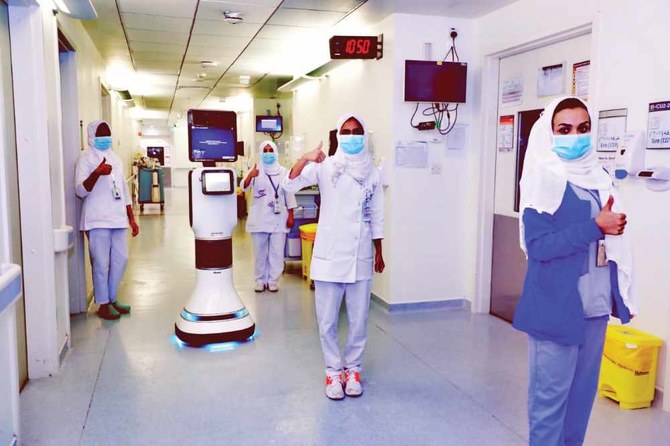
The hi-tech machine at the King Abdullah Medical Complex allows doctors and nurses to work from a safe distance in diagnosing COVID-19 cases. (Supplied)
Short Url
Updated 23 April 2020
Follow

Saudi hospital uses robot medic to treat virus patients

  • Robot equipped with medical devices such as a stethoscope, otoscope, eye camera, and a high resolution camera

JEDDAH: A robot medic is being used to treat coronavirus disease (COVID-19) patients in a Saudi hospital.

The hi-tech machine, in operation at the King Abdullah Medical Complex in Jeddah, is capable of carrying out tests and making diagnoses on people suspected of having contracted the killer virus.

By using the robot, health officials aim to curb the spread of COVID-19 among medical and nursing staff, as well as patients, while conserving stocks of personal protective equipment and other preventive medical supplies.

Dr. Khalid Al-Thumali, the general supervisor of the complex, said the robot had been installed with medical devices such as a stethoscope, otoscope, eye camera, and a camera specialized in examining the skin from afar through a built-in high-resolution lens.

It also carried other tools that allowed doctors and nurses to work from a safe distance in diagnosing COVID-19 cases, providing patients with medical consultations, reading their vital signs, producing radiograph images, and checking patient files via a smartphone app.

Al-Thumali added that the technology not only speeded up response times but provided top-quality medical services both inside and outside the complex. The robot had been given automatic access to isolation rooms and could be programmed to move between them and sanitize after leaving each room.



Celestial spectacle in KSA’s north on first day of Ramadan

Updated 19 February 2026
Follow

Celestial spectacle in KSA’s north on first day of Ramadan

  • Venus-crescent moon alignment visible in Northern Borders
  • Meteorology center issuing swift weather alerts for pilgrims

ARAR/JEDDAH: The holy month of Ramadan has commenced in the Kingdom with a striking astronomical display in the Northern Borders Region, setting a serene tone for the month, the Saudi Press Agency reported.

In addition, the National Center for Meteorology has confirmed its readiness to support pilgrims in Makkah and Madinah.

On Tuesday evening in Arar there was a rare alignment of the planet Venus with the slender crescent moon marking the first day of Ramadan.

Appearing shortly after sunset, the crescent shimmered low on the western horizon above Venus — one of the brightest celestial bodies — in a display enhanced by clear skies.

While the conjunction is a recurring astronomical phenomenon caused by the apparent proximity of the two bodies as viewed from Earth, its coincidence with the start of the holy month added a special aesthetic and spiritual dimension to the atmosphere in the north, the SPA said.

The plan includes heightened performance levels at observatories in the Kingdom’s airports to manage increased flight traffic and aviation safety. (SPA)

Meanwhile, as the faithful began fasting, the NMC announced the readiness of its observatories at the Kingdom’s airports to manage increased flight traffic and ensure aviation safety.

The NCM’s CEO Dr. Ayman bin Salem Ghulam said there would be round-the-clock weather monitoring for Makkah, Madinah, and the roads leading to the two holy mosques.

To ensure pilgrims have real-time access to information, the NCM has integrated its data with the Nusuk and Tawakkalna smart applications. Ten-day forecasts and alerts will also be available via the Anwaa app and on guidance boards along highways.

The center has 14 media platforms to deliver swift weather alerts, ensuring high standards of security and logistical support throughout the season, the SPA reported.