WARSAW/ RAWALPINDI: The Great Gama was going to fight Stanislaus Zbyszko at White City Stadium in London on Sept. 10, 1910. Both were in their prime and British media expected an extraordinary match.
Gama went to Europe on request of his patron, the maharaja of Patiala, who wanted to challenge the greatest wrestlers of the West. Stanislaw Cyganiewicz, the Polish grappler known by the ring name Zbyszko, was one of them.
"The maharaja of Patiala sent the so-called Lion of Punjab abroad after the scalps of Frank Gotch, George Hackenschmidt and Stanislaus Zbyszko. I thought it was a mere advertorial device, and ignored it," Zbyszko wrote in his memoir.
Unknown to the European audience, Ghulam Mohammad Baksh, the Gama, was already a legend in the East, and was said to have defeated hundreds of opponents without a single loss.
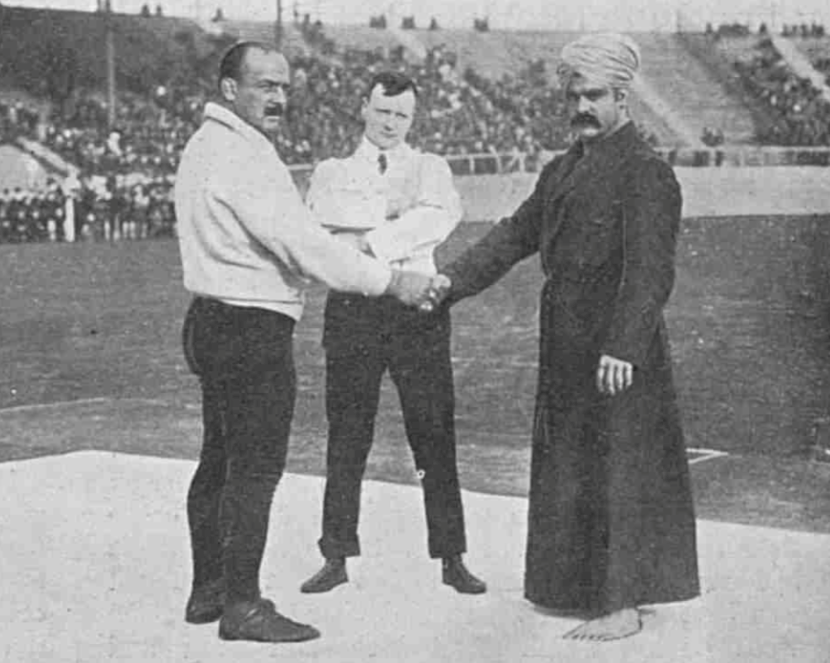
Zbyszko and Gama shake hands ahead of their first match at White City Stadium in London on Sept. 10, 1910. (The Illustrated Sporting and Dramatic News via AN)
While Gotch and Hackenschmidt cautiously refused to face him, Zbyszko eventually agreed and started to watch the rival. He was dazzled when he saw Gama defeat in two straight falls American wrestler Dr. Benjamin Roller.
Roller was Zbyszko's sparring partner. "I was nowhere near achieving this," he said, "Gama indeed deserved to be called the Lion of Punjab. Never before have I seen such bodily harmony, so perfectly developed muscles of the chest, arms, back and legs."
After Roller's humiliating loss in August, Zbyszko still had some time to train and decided to move to the English countryside to focus on strengthening the lower body, which he felt was needed to face Gama's bulky frame. "I was in great form. All sports media acknowledged it and anticipated a great fight."
Finally, the day came. The game organized by the John Bull magazine attracted thousands of spectators, even tens of thousands, according to some newspapers, and it was indeed extraordinary — but in the worst sense.
The Daily Telegraph described the bout as "two hours and 35 minutes of the dreariest work imaginable," the Sporting Life bemoaned "fiasco at the stadium," the Daily News reported how "disgusted spectators" filed out of the venue.
"The fight was stopped in the third hour and we agreed to call it a draw," Zbyszko recalled, "The match was not very entertaining. It often happens so, when the opponents are too similar in their age, weight and craft."
He did not mention he was taken down in less than a minute and spent the entire match on the mat in a defensive position.
"Whichever tackle I used, he freed himself. For three hours he was under my body, but he wasn't defeated," Gama told his biographer Ghazi Ameer Ali decades later.
Zbyszko was ridiculed for the lackluster performance, Gama was reduced to "a novice." The two men failed miserably at entertaining the masses.
But it was not the masses or staged, circus-inspired fights Western champions were offering to their audiences that made Gama come all the way from Punjab to London. He wanted true competition, and in Zbyszko he found it, but not without dismay.
Their fight resumed the following week.

Polish wrestler Stanislaw Cyganiewicz (1879-1967), known by the ring name Zbyszko, poses for a photograph in 1911. (Jakub Piotrkowicz via AN)
"When my name was called, I jumped to the ring," Gama said, "Then Zbyszko was called, but he was not there. After three or four calls, my right arm was raised and I was declared the winner.''
Gama returned to Patiala with John Bull's championship belt, but surely it offered little satisfaction.
Before the match, Zbyszko left for his hometown. "I received no compensation for the game, so I went back to Krakow," he wrote in the memoir, citing a contract under which he was promised 25 percent of the gate receipts, regardless of the first bout's result.
They were to fight each other again, in a rematch organized by the same maharaja of Patiala who sent Gama to Europe. By that time, both reached 50. Zbyszko became a world heavyweight champion and one of the only wrestlers to face Gama without being pinned. Gama, meanwhile, went into in semi-retirement, as no other wrestler wanted to challenge him.
"I haven't thought Zbyszko would ever fight me again. When he challenged me after 20 years, I was happy to see his courage and started training," Gama said.
On Jan. 29, 1928, spectators from all over British India — among them the most prominent rulers of princely states — arrived in Patiala to witness the fight.
"When Zbyszko and I reached the arena, there was silence," Gama recalled, "It felt as if no one else was there but the two of us. We shook hands. Then he took of his robe, handed it to his manager and approached me."
Like in 1910, Zbyszko landed the floor within a moment of entering the ring, but this time it was a fall. A final one. Gama could rest assured his title was secure. Zbyszko retired from wrestling.
"Within seconds I threw him down and for three minutes I was sitting on his chest," Gama said, "Then I was asked to stop. I shook hands with Zbyszko again and presented myself before the maharaja to say 'salam.' The maharaja was so happy!"
The only person unable to rejoice was the English constructor of the special arena that was raised in Patiala for the most awaited wrestling bout of 1928. "You crushed him within seconds, you've ruined my hard work of six months!" he complained.
Gama replied, "There would be no greatness in my craft had it taken me longer than a blink of the eye."