

Short film by KP students takes on patriarchy, wins international prize

In this file photo, women walk past Shafi Market in Peshawar, Khyber Pakhtunkhwa, Dec. 18, 2019. (AN photo)
Short Url
Updated 21 April 2020
Follow

Short film by KP students takes on patriarchy, wins international prize

  • 'The Chain Breaker' portrays a teacher from Charsadda district who challenged the patriarchal norms of Pashtun society
  • Girls Impact the World Film Festival promotes youth voices to spotlight critical issues facing women and girls

PESHAWAR: A short documentary film by journalism students from Mardan, Khyber Pakhtunkhwa, has won the first prize in the Stand Up Men category of the Girls Impact the World Film Festival.

Shot by Muhammad Waseem, Amna Istimraj and Asif Khan from Abdul Wali Khan University Mardan, "The Chain Breaker" portrays Sameer Khan, a teacher from Tangi area in Charsadda district, who challenged the patriarchal norms of Pashtun society and has brought his maternal uncles to court to fight for his mother's right to inheritance.
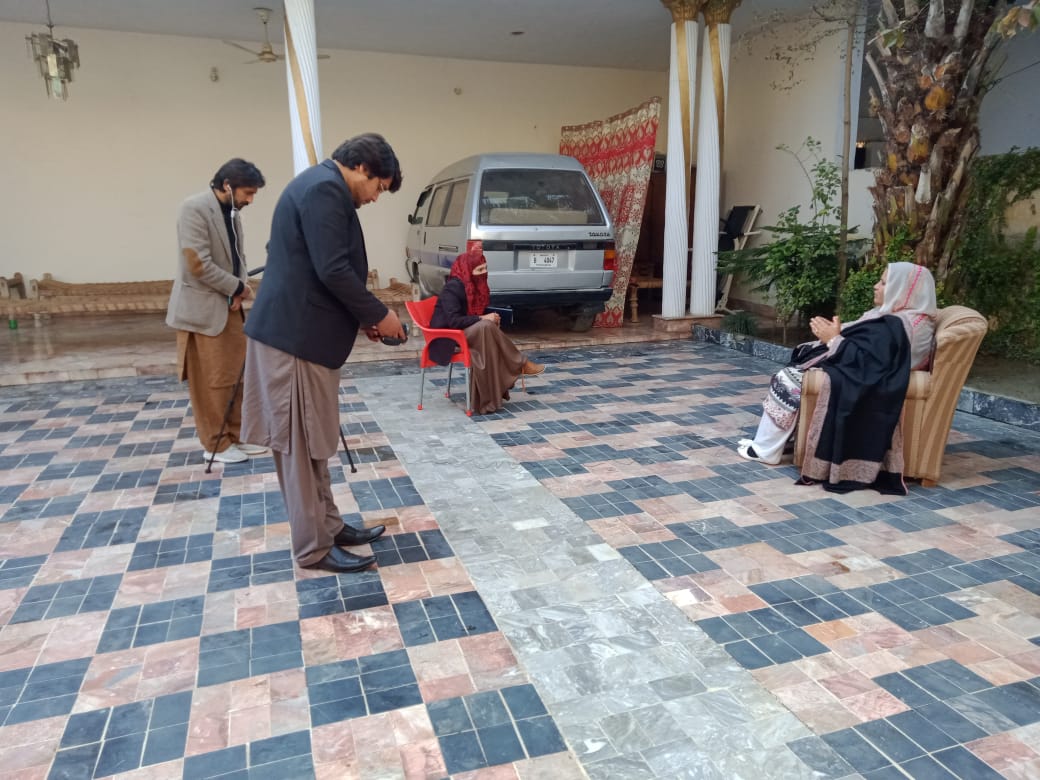


Muhammad Waseem, Amna Istimraj and Asif Khan from Abdul Wali Khan University Mardan are shooting "The Chain Breaker" in Tangi Tehsil, Charsadda district, Khyber Pakhtunkhwa in February 2020. (Photo courtesy: Muhammad Waseem)

"There are many cases where women fight for their right to property, but very rarely men would stand up for them," the students' mentor, Asif Momand, told Arab News.

Despite women's rights to inheritance under Islamic law and the Women's Property Rights Act passed by the Khyber Pakhtunkhwa assembly in 2019, cultural norms make it nearly impossible for women in the region to receive their share in inheritance and ownership of property.

Khan's mother, Husan Zari, broke the taboo, for which she faced social boycott and was disowned by her brothers. Khan vowed to fight for her and other women, making their right to inheritance his main cause.

With two old handy cameras, one of them with a broken screen, the students spoke to Khan and also gained the trust of his mother to record her.

"It is tough to take women on camera, but she opposed all odds," said Istimraj who interviewed Zari for the shot.

"Winning such a prestigious award has encouraged all of us and a few other ideas are now planned," said Istimraj, who wants to focus her future career on women's empowerment. In her new project, she wants to reach out to women politicians in Khyber Pakhtunkhwa to document their struggles and resilience.    

For Waseem, the short film's producer who like Istimraj is in his final year of university, the story was even more personal.

"Some of my relatives have wasted their time and resources in courts only to deprive their women of basic property rights," he said, "It made me want to work on this very issue. I visited five district courts, in Mardan, Swabi, Nowshera, Peshawar and Charsadda to find relevant cases. There were many, by the woman did not agree to be on camera."

The Girls Impact the World Film Festival promotes youth voices to spotlight critical issues facing women and girls.

Sponsored by American charity Connect Her, the festival every year invites submissions from young film makers on subjects such as access to education, ending violence against women, and their economic independence.

The Stand Up Men category in which the AWKUM team won, celebrates men who are taking stand for women's rights.

This year's laureates were announced on Saturday.


Pakistan to begin first phase of Hajj 2026 trainings from today

Updated 31 December 2025
Follow

Pakistan to begin first phase of Hajj 2026 trainings from today

  • Training programs to be held in phases across Pakistan till February, says religion ministry
  • Saudi Arabia allocated Pakistan a total quota of 179,210 pilgrims for Hajj 2026

ISLAMABAD: Pakistan’s religious affairs ministry has said that it will begin the first phase of mandatory Hajj 2026 training for pilgrims intending to perform the pilgrimage from today, Thursday.

The one-day Hajj training programs will be held in phases across the country at the tehsil level until February. The ministry directed intending pilgrims to bring their original identity cards and the computerized receipt of their Hajj application to attend the training sessions.

“Pilgrims should attend the one-day training program according to their scheduled date,” Pakistan’s Ministry of Religious Affairs (MoRA) said in a statement.

The ministry said training schedules are being shared through the government’s Pak Hajj 2026 mobile application as well as via SMS. It added that details of the schedule are also available on its website.

According to the ministry, training programs will be held in Abbottabad on Jan. 2; Ghotki, Thatta and Kotli on Jan. 3; and Tando Muhammad Khan and Khairpur on Jan. 4.

Hajj training sessions will be held in Rawalakot, Badin and Naushahro Feroze on Jan. 5, while pilgrims in Fateh Jang, Dadu and Tharparkar will receive the training on Jan. 6.

The ministry said training programs will be conducted in Umerkot and Larkana on Jan. 7, followed by sessions in Mirpurkhas, Shahdadkot and Mansehra on Jan. 8.

Pakistan’s religious affairs ministry has previously said these trainings will be conducted by experienced trainers and scholars using multimedia.

It said the training has been made mandatory to ensure that intending pilgrims are fully aware of Hajj rituals and administrative procedures.

Saudi Arabia has allocated Pakistan a quota of 179,210 pilgrims for Hajj 2026, of which around 118,000 seats have been reserved under the government scheme, while the remainder will be allocated to private tour operators.

Under Pakistan’s Hajj scheme, the estimated cost of the government package ranges from Rs1,150,000 to Rs1,250,000 ($4,049.93 to $4,236), subject to final agreements with service providers.