

Book review: ‘Fearless: Stories of Amazing Women from Pakistan’ takes readers on a visual journey

“Fearless: Stories of Amazing Women from Pakistan” is by author Amneh Shaikh-Farooqui. (Supplied)
Short Url
Updated 21 April 2020
Follow

Book review: ‘Fearless: Stories of Amazing Women from Pakistan’ takes readers on a visual journey

DHAHRAN: Amneh Shaikh-Farooqui’s book “Fearless: Stories of Amazing Women from Pakistan” chronicles the social, economic, political, and cultural achievements of 50 Pakistani women. The 112-page book – accompanied with vibrant portrait illustrations – highlights the achievements of Pakistani politicians, army generals, artists, humanitarians and philanthropists.

The book introduces Pakistani women to the world and, importantly, provides representation of South Asian women in mainstream literature. In her forward, Shaikh-Farooqui states that her own children were thrilled to read lesser-known stories of women in history. However, she found that accomplishments of women of color were missing from these narratives. With the premise “If you can’t see it, you can’t be it,” the concise book includes a page each, celebrating notable women and how they each inspired change.

The stories are not arranged thematically, however, it makes for an easy read that young adults within the diaspora will appreciate. Released in late February, Shaikh-Farooqui’s book does well at walking a middle line and does not fall into the trap of embellishing each woman’s achievements, however, the author does not fully explain how she whittled down her choice to 50 women — it’s a small detail that would have been appreciated.
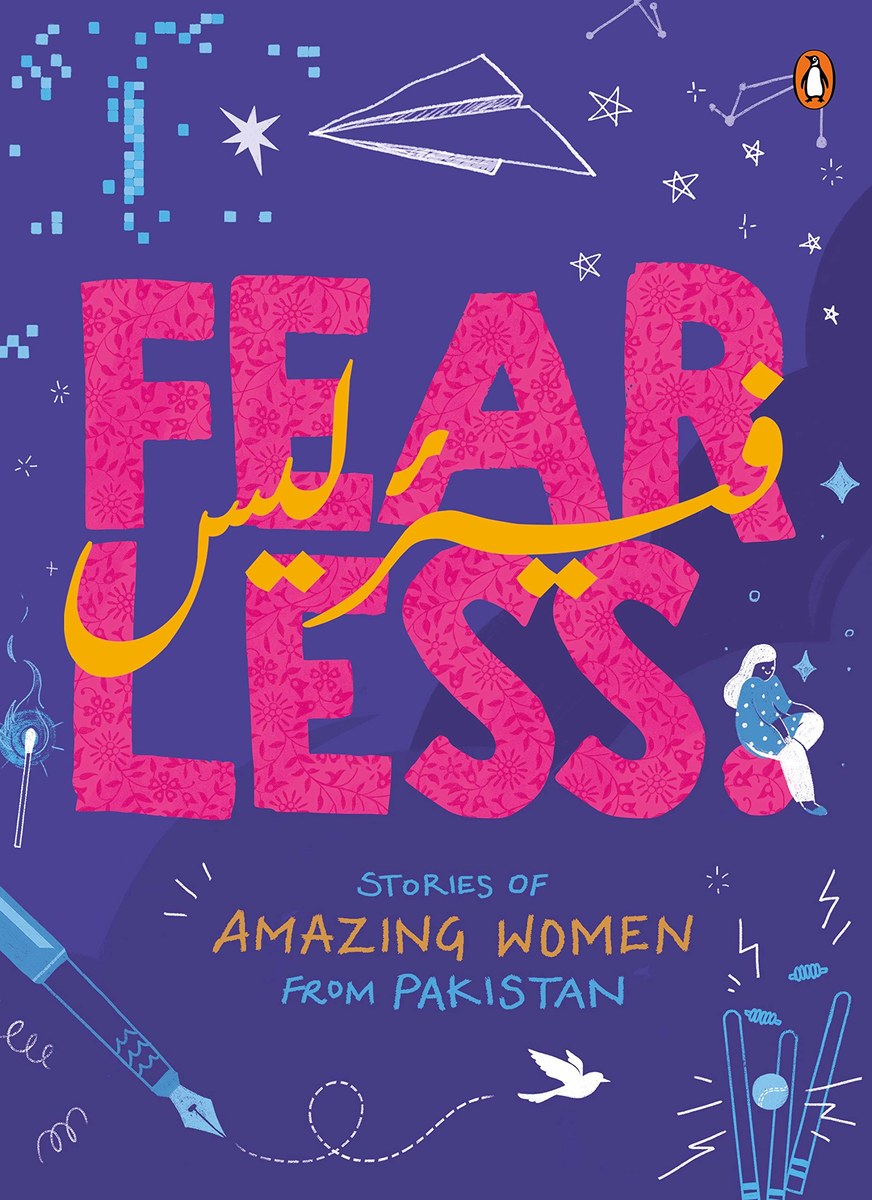


“Fearless: Stories of Amazing Women from Pakistan” is a 112-page book. (Supplied)

Alongside Malala Yousafzai and Fatima Jinnah, the book features women and stories that may be lesser-known to mainstream media, like Majida Rizvi, the first woman judge of a High Court in Pakistan. Rizvi dedicated her life to educating Pakistani women about their legal rights and as a chairperson of the National Commission for the Status of Women, fought for human and gender rights against religious conservative parties. Or actress and director, Putli Bai, known by her screen name, Shamim Ara for her strong, female protagonist roles in a series of movies like Miss Hong Kong, Miss Singapore, Miss Colombo, Lady Smuggler, and Lady Commando. “Her contribution in creating a more balanced industry, with space for nuanced characters and a broader set of roles for women, both on and off screen will not be forgotten,” opines author, Shaikh-Farooqui.

Or even the controversial Qandeel Baloch, whose videos empowered women and led to her eventual murder by her brother. Apart from individuals, the book also features activist groups like the Women’s Association Forum (WAF), a women’s rights organization and Girls at Dhabas (DAG), an initiative that highlights challenges women face in male-dominated public areas and advocates for freedom of movement.


Islamabad dismisses claims about paying up to 8 percent interest on foreign loans as ‘misleading’

Updated 22 February 2026
Follow

Islamabad dismisses claims about paying up to 8 percent interest on foreign loans as ‘misleading’

  • Pakistan has long relied on external loans to help bridge persistent gaps in public finances and foreign exchange reserves
  • Pakistan’s total external debt, liabilities stand at $138 billion at an overall average cost of around 4 percent, ministry says

KARACHI: Pakistan’s finance ministry on Sunday dismissed as “misleading” claims that the country is paying up to 8 percent interest on external loans, saying the overall average cost of external public debt is approximately 4 percent.

Pakistan has long relied on external loans to help bridge persistent gaps in public finances and foreign exchange reserves, driven largely by a narrow tax base, chronic trade deficits, rising debt-servicing costs and repeated balance-of-payments pressures.

Over the decades, successive governments have turned to multilateral and bilateral lenders, including the International Monetary Fund, the World Bank and the Asian Development Bank, to support budgetary needs and shore up foreign exchange reserves.

The finance ministry on Sunday issued a clarification in response to a “recent press commentary” regarding the country’s external debt position and associated interest payments, and said the figures required contextual explanation to ensure accurate understanding of Pakistan’s external debt profile.

“Pakistan’s total external debt and liabilities currently stand at $138 billion. This figure, however, encompasses a broad range of obligations, including public and publicly guaranteed debt, debt of Public Sector Enterprises (both guaranteed and non-guaranteed), bank borrowings, private-sector external debt, and intercompany liabilities to direct investors. It is therefore important to distinguish this aggregate figure from External Public (Government) Debt, which amounts to approximately $92 billion,” it said.

“Of the total External Public Debt, nearly 75 percent comprises concessional and long-term financing obtained from multilateral institutions (excluding the IMF) and bilateral development partners. Only about 7 percent of this debt consists of commercial loans, while another 7 percent relates to long-term Eurobonds. In light of this composition, the claim that Pakistan is paying interest on external loans ‘up to 8 percent’ is misleading.

The overall average cost of External Public Debt is approximately 4 percent, reflecting the predominantly concessional nature of the borrowing portfolio.”

With respect to interest payments, public external debt interest outflows increased from $1.99 billion in Fiscal Year (FY) 2022 to $3.59 billion in FY2025, representing an increase of 80.4 percent, not 84 percent as reported. In absolute terms, interest payments rose by $1.60 billion over this period, not $1.67 billion, it said.

According to the State Bank of Pakistan’s records, Pakistan’s total debt servicing payments to specific creditors during the period under reference were as follows: the IMF received $1.50 billion, of which $580 million constituted interest; Naya Pakistan Certificates payments totaled $1.56 billion, including $94 million in interest; the Asian Development Bank received $1.54 billion, including $615 million in interest; the World Bank received $1.25 billion, including $419 million in interest; and external commercial loans amounted to nearly $3 billion, of which $327 million represented interest payments.

“While interest payments have increased in absolute terms, this rise cannot be attributed solely to an expansion in the debt stock,” the ministry said. “Although the overall debt stock has increased slightly since FY2022, the additional inflows have primarily originated from concessional multilateral sources and the IMF’s Extended Fund Facility (EFF) under the ongoing IMF-supported program.”

Pakistan secured a $7 billion IMF bailout in Sept. 2024 as part of Prime Minister Shehbaz Sharif’s efforts to stabilize the South Asian economy that narrowly averted a default in 2023. The government has since been making efforts to boost trade and bring in foreign investment to consolidate recovery.

“It is also important to note that the increase in interest payments reflects prevailing global interest rate dynamics. In response to the inflation surge of 2021–22, the US Federal Reserve raised the federal funds rate from 0.75-1.00 percent in May 2022 to 5.25–5.50 percent by July 2023. Although rates have since moderated to around 3.75 percent, they remain significantly higher than 2022 levels,” the finance ministry said.

“The government remains committed to prudent debt management, transparency, and the continued strengthening of Pakistan’s macroeconomic stability,” it added.