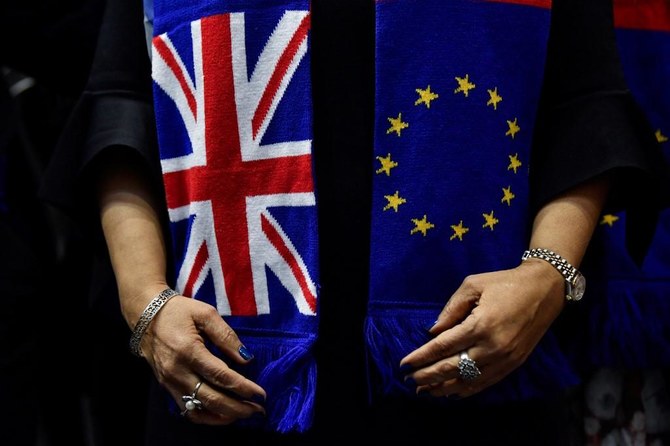
BRUSSELS: British and EU officials were scheduled to restart Brexit trade talks Monday after a break because of the coronavirus, which is making an end-of-year deal look even more unlikely.
After a first round in early March negotiations were suspended for six weeks as officials focused on the deadly virus sweeping Europe.
The June deadline set by London to assess the chances of an agreement is now fast approaching.
The novel coronavirus has affected officials directly, hitting both EU chief negotiator Michel Barnier and his British counterpart David Frost — and then, dramatically, putting Prime Minister Boris Johnson in intensive care.
Despite the ticking clock and the extra pressure brought by the worst global pandemic in living memory, Johnson’s government rules out extending Britain’s transition period to negotiate a future relationship with the EU.
Britain left the EU on January 31 but remains tied to it until the end of December.
Fears are growing that no deal will be reached, meaning that WTO rules with high tariffs and customs barriers would come into force between the UK and EU.
That prospect so alarmed the head of the International Monetary Fund, Kristalina Georgieva, that last week she urged Brussels and London to extend their deadline, saying it was in everyone’s interests to reduce uncertainty amid the economic turmoil wrought by the pandemic.
But Johnson has remained deaf to the appeal, despite Britain’s budget watchdog warning that the coronavirus lockdown could shrink the country’s economy by a massive 13 percent in 2020.
Because of virus restrictions, this week’s talks will take place by videolink.
Fabian Zuleeg of the European Policy Center warned there could be “no meaningful negotiations” at this point — because of the technical limitations of video talks and because politicians’ focus is on fighting the pandemic.
In these circumstances, it will probably be necessary to extend the deadline to avoid Britain crashing out with no deal and facing a further economic shock on top of the coronavirus recession, Zuleeg said.
“But so far, Brexit has never been about the best economic option. It very much depends on what price Boris Johnson is willing to pay for what is portrayed in the UK as ‘sovereignty’ and ‘independence’,” Zuleeg said.
A European source close to the talks said a “Johnson Brexit” — sacrificing close links to the EU in order to be free of its rules — was already going to rattle the economy.
“With corona, it’s going to be a double shock for businesses,” the source told AFP.
The virus adds another layer of difficulty to an already complex negotiation, where, at the end of the first round in March, the two sides could only note their disagreements rather than make concrete progress.
London is trying to negotiate a series of packages in different domains including fishing, goods, aviation, justice and energy. But EU leaders want a single overarching accord.
The thorny problem of fishing rights — deeply important to several key EU states, notably France — could derail the whole process, according to some in Brussels.
This week’s round of talks are to last until Friday. Barnier and Frost were scheduled to open the proceedings on Monday before their teams start technical sector-by-sector negotiations on Tuesday.


![]()


Brexit talks resume under coronavirus cloud
Short Url
https://arab.news/5hvr6
Brexit talks resume under coronavirus cloud
- June deadline set by London to assess the chances of an agreement is fast approaching
- The thorny problem of fishing rights – deeply important to several key EU states – could derail the whole process


Trump says Netanyahu should be pardoned for corruption
- Under Israeli law, the president has the authority to pardon convicts
- Trump has publicly urged the Israeli president to pardon Netanyahu several times
WASHINGTON: US President Donald Trump said on Thursday Israeli Prime Minister Benjamin Netanyahu should receive a pardon for corruption charges, saying Israeli President Isaac Herzog should be “ashamed of himself” for not granting one.
Trump said Netanyahu has been a great wartime prime minister and that the Israeli people should shame Herzog for not pardoning him. “He’s disgraceful for not giving it. He should give it,” Trump said during a White House event.
Netanyahu met Trump in Washington on Wednesday — the seventh meeting between the two leaders since Trump took office last year — for talks about reaching a deal on Iran’s nuclear program and its ballistic missiles.
Netanyahu is Israel’s first sitting prime minister to be charged with a crime and denies bribery, fraud and breach of trust charges dating back to his 2019 indictment.
Trump has publicly urged the Israeli president to pardon Netanyahu several times, and said in late December that Herzog had told him the pardon was on its way. Herzog’s office was quick to dispute it.
Under Israeli law, the president has the authority to pardon convicts. But there is no precedent for issuing a pardon mid-trial.
In response to queries about Trump’s comment, Herzog’s office said Netanyahu’s request was under review at the Israeli Ministry of Justice for a legal opinion, and once that process was completed, Herzog would consider the request.
“Israel is a sovereign state governed by the rule of law. Contrary to the impression created by President Trump’s remarks, President Herzog has not yet made any decision on this matter,” Herzog’s office said.
Trump said Netanyahu has been a great wartime prime minister and that the Israeli people should shame Herzog for not pardoning him. “He’s disgraceful for not giving it. He should give it,” Trump said during a White House event.
Netanyahu met Trump in Washington on Wednesday — the seventh meeting between the two leaders since Trump took office last year — for talks about reaching a deal on Iran’s nuclear program and its ballistic missiles.
Netanyahu is Israel’s first sitting prime minister to be charged with a crime and denies bribery, fraud and breach of trust charges dating back to his 2019 indictment.
Trump has publicly urged the Israeli president to pardon Netanyahu several times, and said in late December that Herzog had told him the pardon was on its way. Herzog’s office was quick to dispute it.
Under Israeli law, the president has the authority to pardon convicts. But there is no precedent for issuing a pardon mid-trial.
In response to queries about Trump’s comment, Herzog’s office said Netanyahu’s request was under review at the Israeli Ministry of Justice for a legal opinion, and once that process was completed, Herzog would consider the request.
“Israel is a sovereign state governed by the rule of law. Contrary to the impression created by President Trump’s remarks, President Herzog has not yet made any decision on this matter,” Herzog’s office said.
Latest updates


Recommended


© 2026 SAUDI RESEARCH & PUBLISHING COMPANY, All Rights Reserved And subject to Terms of Use Agreement.