Turkey criticized over mass prisoner release legislation

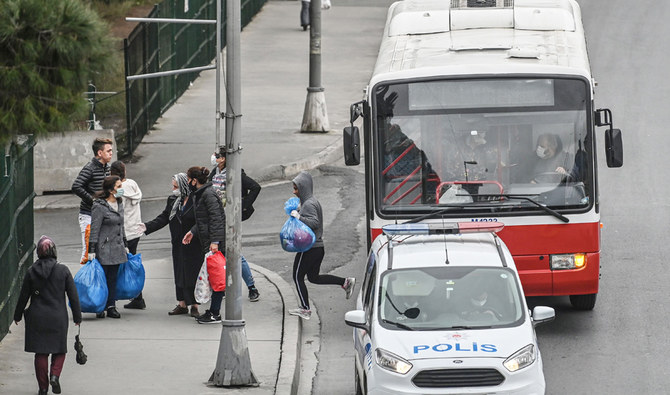
Released women prisoners meet their families as they get off a bus at a bus station near Bakirkoy women prison on April 15,2020 in Istanbul. (AFP)
Short Url
Updated 19 April 2020
Follow

Turkey criticized over mass prisoner release legislation

  • Amnesty International and Human Rights Watch have called on the government to consider releasing older prisoners as well as those with serious medical conditions

ANKARA: Turkey has been criticized for new legislation that allows the mass release of inmates because it excludes journalists, academics, activists and political prisoners.
The legislation is aimed at reducing overcrowding and avoiding the spread of coronavirus. It affects around a third of Turkey’s prison population, or around 90,000 inmates.
The European Commission was among those to condemn Turkey. “We regret that the Turkish authorities excluded the early release of many inmates held in pre-trial detention or convicted for nonviolent offenses: Lawyers, journalists, politicians and human rights defenders,” it said on Friday. “This underlines the arbitrary treatment of their cases.”
Some of Turkey’s most notorious criminals were released a day after the legislation was adopted, but the continued imprisonment of others has disappointed European officials.
The European Parliament’s rapporteur on Turkey, Nacho Sánchez Amor, and the chair of the European Parliament’s Delegation to the EU-Turkey Joint Parliamentary Committee, Sergey Lagodinsky, described the legislation as “a great disappointment.”  
“We had hoped that the Turkish Parliament would adopt a fair, responsible and nondiscriminatory law that would save lives from being lost in overcrowded Turkish prisons,” they said.
The introduction of a last-minute amendment - exempting those imprisoned for breaking National Intelligence Agency laws from the amnesty - was criticized by human rights activists. It is seen as an attempt to prevent the release of four journalists who are behind bars for exposing the identity of Turkish intelligence officers in Libya, as well as to intimidate journalists who are critical of the government.
The amendment prevents dissident journalists Baris Pehlivan, Murat Agirel, Hulya Kilinc and Baris Terkoglu from applying for their release.
Last month the Turkish website OdaTV released a story and showed footage of an intelligence officer’s funeral in the western city of Manisa. The Information and Communication Technologies Authority banned access to the website for a while.

NUMBER

90,000 Inmates, or around a third of Turkey’s prison population are affected by the spread of coronavirus. The legislation is aimed at reducing overcrowding in the prisons.

Agirel released the identities and photos of some Turkish nationals who were killed in Libya after being deployed as part of a security and military cooperation deal between the two countries.
Kazim Yigit Akalin, the lawyer representing Terkoglu and Pehlivan, said it was probably the first time in Turkish history that journalists were facing trial for contravening the laws of the National Intelligence Agency.
“The Constitutional Court should give its decision regarding this issue on the basis of the principle of equality, but considering the current composition of that top constitutional body, it would be too optimistic to have a favorable ruling,” he told Arab News.
Keeping journalists and politicians behind bars would not contribute to social harmony, he added.
The European Court of Human Rights has ordered Turkey to release Kurdish-origin politician Selahattin Demirtas, saying his pre-trial detention was a political act and that his freedom of expression had been curtailed. He has high blood pressure and was taken to hospital recently after collapsing in his cell.
Amnesty International and Human Rights Watch have called on the government to consider releasing older prisoners as well as those with serious medical conditions.



Family of Palestinian-American shot dead by Israeli settler demand accountability

Updated 8 min 41 sec ago
Follow

Family of Palestinian-American shot dead by Israeli settler demand accountability

  • Relatives say Abu Siyam was among about 30 residents from the village of Mukhmas who confronted armed settlers attempting to steal goats from the community

LONDON: The family of a 19-year-old Palestinian-American man reportedly shot dead by an Israeli settler in the occupied West Bank have demanded accountability, amid mounting scrutiny over a surge in settler violence and a lack of prosecutions.

Nasrallah Abu Siyam, a US citizen born in Philadelphia, was killed near the city of Ramallah on Wednesday, becoming at least the sixth American citizen to die in incidents involving Israeli settlers or soldiers in the territory in the past two years.

Relatives say Abu Siyam was among about 30 residents from the village of Mukhmas who confronted armed settlers attempting to steal goats from the community. Witnesses said that stones were thrown by both sides before settlers opened fire, wounding at least three villagers.

Abu Siyam was struck and later died of his injuries.

Abdulhamid Siyam, the victim’s cousin, said the killing reflected a wider pattern of impunity.

“A young man of 19 shot and killed in cold blood, and no responsibility,” he told the BBC. “Impunity completely.”

The US State Department said that it was aware of the death of a US citizen and was “carefully monitoring the situation,” while the Trump administration said that it stood ready to provide consular assistance.

The Israeli embassy in Washington said the incident was under review and that an operational inquiry “must be completed as soon as possible.”

A spokesperson for the Israeli Defense Forces said troops were deployed to the scene and used “riot dispersal means to restore order,” adding that no IDF gunfire was reported.

The military confirmed that the incident remained under review and said that a continued presence would be maintained in the area to prevent further unrest.

Palestinians and human rights organizations say such reviews rarely lead to criminal accountability, arguing that Israeli authorities routinely fail to prosecute settlers accused of violence.

A US embassy spokesperson later said that Washington “condemns this violence,” as international concern continues to grow over conditions in the occupied West Bank.

Palestinians and human rights groups say Israeli authorities routinely fail to investigate or prosecute settlers accused of violence against civilians.

Those concerns were echoed this week by the UN, which warned that Israel’s actions in the occupied West Bank may amount to ethnic cleansing.

A UN human rights office report on Thursday said that Israeli settlement expansion, settler attacks and military operations have increasingly displaced Palestinian communities, with dozens of villages reportedly emptied since the start of the Gaza war.

The report also criticized Israeli military tactics in the northern West Bank, saying that they resembled warfare and led to mass displacement, while noting abuses by Palestinian security forces, including the use of unnecessary lethal force and the intimidation of critics.

Neither Israel’s foreign ministry nor the Palestinian Authority has commented on the findings.