

Pakistani restaurateurs in UAE join hands for compatriots in need

Short Url
Updated 18 April 2020
Follow

Pakistani restaurateurs in UAE join hands for compatriots in need

  • At least 10,000 Pakistani nationals working in UAE have been laid off or sent on unpaid leave
  • Under Rizq initiative, restaurants provide free warm meals to needy families in their areas

DUBAI: With the coronavirus crisis stretching off into the indeterminate future, the Pakistani community in the United Arab Emirates is getting together to help its members affected by business shutdowns in the foreign country.
Over the past weeks, scores of Pakistani nationals working in the UAE have been laid off or sent on unpaid leave. According to Pakistan’s Consulate General in Dubai, at least 10,000 people, many of them daily wage earners, have lost their means of sustenance.
“Some of us may survive for the next few months, but what about the families who are on daily wages?” Talha Ahmed Khan, who runs the Delhi Nihari House in Ajman, told Arab News. “This is what got a few of us thinking,” he said.
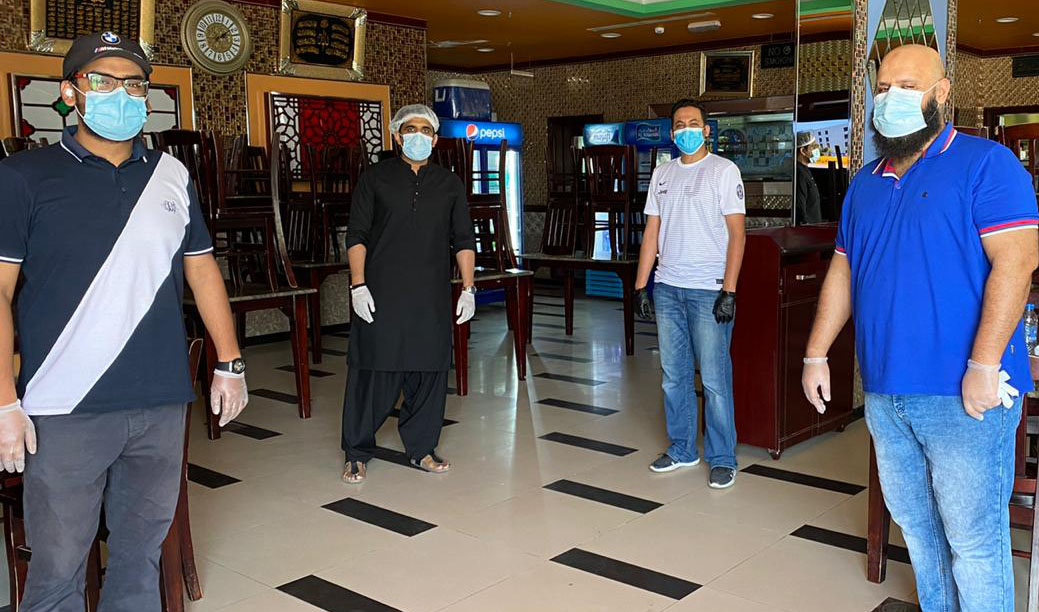


Talha Khan and his team behind the Rizq initiative pose for a photograph in Ajman, United Arab Emirates on April 16, 2020. (Photo courtesy: Talha Khan)

Along with his friends who run restaurant businesses in different cities, he came up with an initiative they called Rizq.
“We all decided to give back to the community that has not only helped form our identities, but also gave us the privileged lifestyles that we are blessed with in this country today,” Khan said.
Under the initiative, which was launched earlier this week, each of the restaurants provides free warm meals to needy families in their areas. As of Friday, over 300 packets of biryani, curries, rice, roti, naan, chicken and vegetables dishes have been distributed among Pakistani families in Dubai, Sharjah and Ajman.
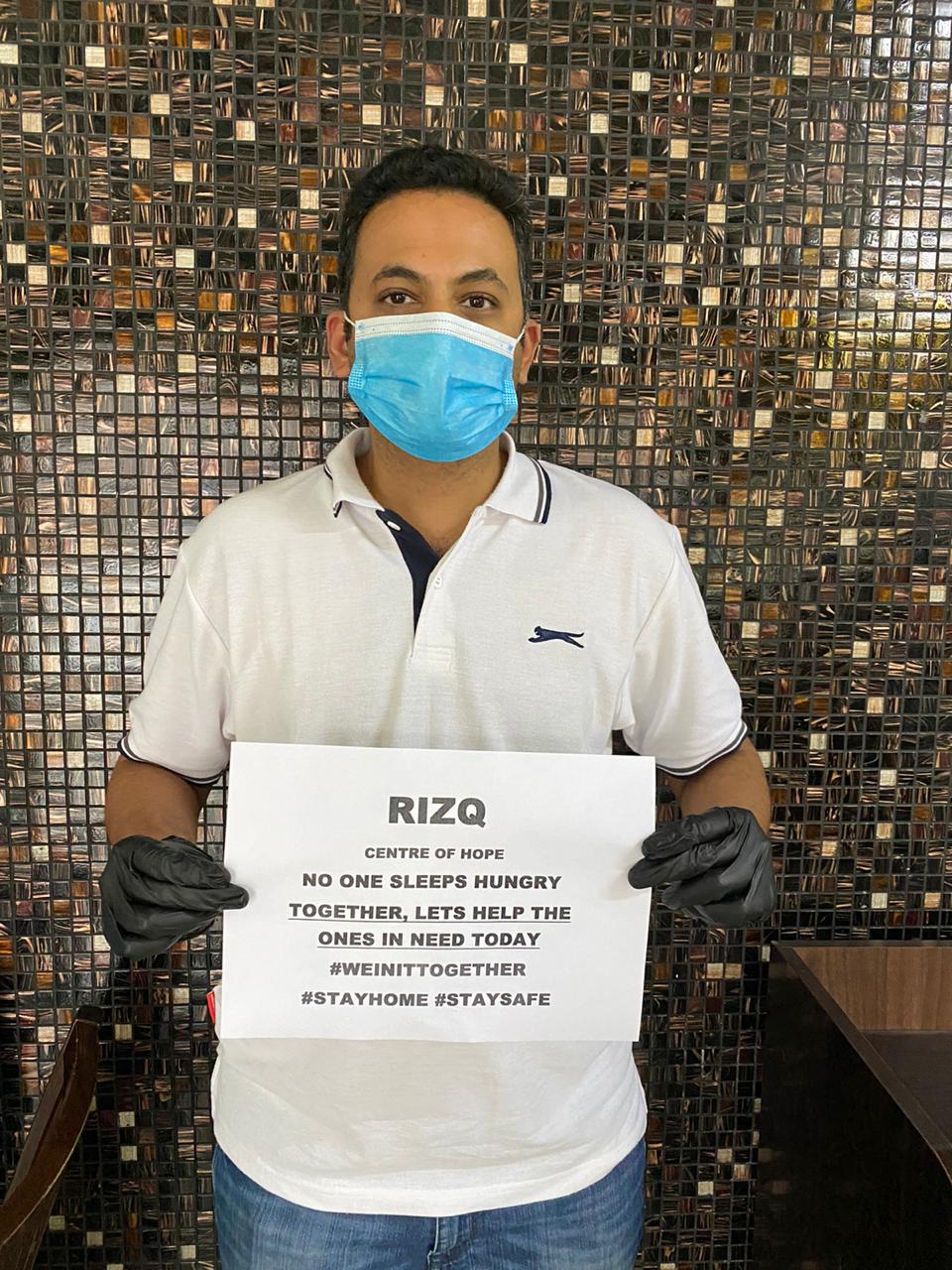


Talha Khan who started the Rizq initiative holds a paper with its motto: “No one sleeps hungry.” (Photo courtesy: Talha Khan)

They distribute the meals in the middle of the day so that if something is left, it can be consumed also in the evening, Khan said, “We make sure there is enough for everyone and we do not want to compromise on quality.”
“There are at least 70,000 restaurants all over UAE and even if one percent of them come forward and take part in this campaign, we would be able to feed the affected families and individuals on a regular basis till the situation is under control,” he said, adding that the restaurants that have already joined the initiative, besides his Delhi Nihari, are Mumtaz Darbar, Mani’s Biryani, Bhaijaan’s Biryani and Delicacy Bakers and Sweets.
The restaurants are bearing all costs themselves as they are not authorized under UAE laws to collect donations, but individuals can contribute by paying for the meals directly. “This operation could sustain itself in a long run if we could ask people to bear the costs of one meal,” Khan said, “We would like people to come forward and play a role in helping through contributions and volunteers who can help with their resources to distribute the meal packets are welcome too.”
Those who need help can register through the Rizq initiative’s Facebook page.

Pakistan says defense pact with Saudi Arabia elevated brotherly ties to ‘new heights’

Updated 6 sec ago
Follow

Pakistan says defense pact with Saudi Arabia elevated brotherly ties to ‘new heights’

  • Pakistan, Saudi Arabia signed strategic defense pact last year pledging aggression against one will be treated as attack on both
  • Deputy PM Ishaq Dar says enduring bonds with Islamic and Arab nations form vital pillar of Pakistan’s foreign policy 

ISLAMABAD: Deputy Prime Minister Ishaq Dar said on Wednesday that Pakistan’s defense pact with Saudi Arabia elevated its brotherly ties with the Kingdom to “new heights,” stressing that close ties with Arab and Islamic nations form a key pillar of Islamabad’s foreign policy. 

Pakistan and Saudi Arabia signed a Strategic Mutual Defense Agreement on Sept. 17 last year, pledging that aggression against one country would be treated as an attack on both, enhancing joint deterrence and formalizing decades of military and security cooperation.

Both nations agreed in October 2025 to launch an economic cooperation framework to strengthen trade and investment ties. 

“In the Middle East, our landmark Strategic Mutual Defense Agreement with Saudi Arabia has elevated our brotherly ties to new heights,” Dar said while speaking at the Pakistan Governance Forum 2026 event in Islamabad. 

The Pakistani deputy prime minister was speaking on the topic “Navigating International Relations Amidst Changing Geo-Politics.”

Dar noted that Pakistan has reinforced partnerships with other Middle Eastern nations such as the UAE, Qatar, Jordan, Oman, Egypt and Bahrain. He said these partnerships have yielded “concrete agreements” in investment, agriculture, infrastructure, and energy sectors. 

“Our enduring bonds with Islamic and Arab nations form a vital pillar of our foreign policy, and we will continue to expand our partnerships across Asia, Latin America, and Africa,” he said. 

Dar pointed out that the presidents of Kazakhstan, Uzbekistan and Kyrgyzstan have undertaken visits to Pakistan in recent months, reflecting Central Asian nations’ desire to boost cooperation with Islamabad.

On South Asia, the Pakistani deputy PM said Pakistan has successfully transformed its fraternal ties with Bangladesh into “a substantive partnership.”

“Similarly, the trilateral mechanism involving China, Pakistan, and Bangladesh has been launched with a view to expanding and deepening regional cooperation and synergy,” the Pakistani minister said. 

He said Islamabad has strengthened its “all-weather” partnership with China via the second phase of the multi-billion-dollar China-Pakistan Economic Corridor agreement and “unwavering support” from both sides for each other’s core interests. 

Dar said Pakistan had also reinvigorated its partnership with the US, advancing cooperation in trade, technology, investment, and regional stability. 

“This calibrated approach has enhanced our ability to navigate complexity with skill and confidence, ensuring that our national interests are served without compromising our core foreign policy principles,” he said.