

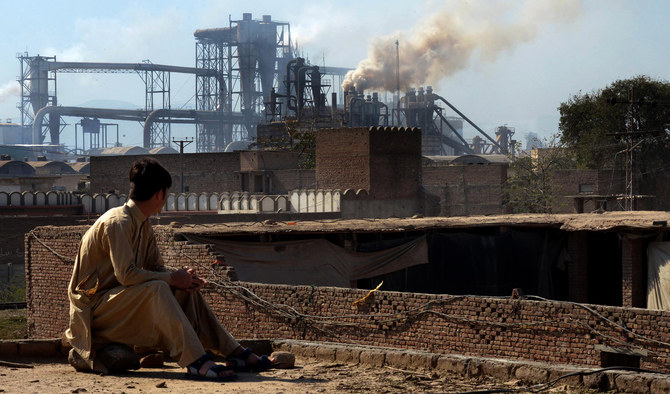

KARACHI: Pakistan on Tuesday decided to resume low-risk industrial operations in a phased manner to mitigate the suffering of its working class amid coronavirus lockdown as global institutions projected that the growth rate of the country’s economy could decline as much as negative 2.2 percent.
The recommendation for the opening of industries and businesses was approved in a meeting of the National Command and Operation Center (NCOC).
“The NCOC has recommended that the sector be opened in sequence/phases with the low risk activities being recommended to open in the first phase starting from 15th April 2020,” said an official statement issued after the meeting.
Federal Minister for Economic Affairs Division Hammad Azhar told a news conference in the presence of Prime Minister Imran Khan that all provinces had agreed to reopen the construction sector. This also implied the opening up of its supply chain, ranging from cement plants to brick kilns, though the NCOC also maintained that all provinces should exercise their own judgment.
Azhar shared a list of about 15 industries, including Chemicals Manufacturing, e-commerce, software development, paper packaging unit, cement plants, fertilizers, mines and minerals plants, that would also reopen.
“The low-risk industries will also be reopened in accordance with the standard operating procedures,” Azhar said, adding that the “provinces did not show consensus” but the government wanted to “allow daily wage earners like electricians, plumbers and others to resume their routine work.”
The safety procedures with regards to the prevention of the spread of COVID-19 infection for general industries and construction sector were circulated to the provinces and relevant departments in the last few days.
Although industrialists appreciated the government’s move to resume economic activities, they also pointed out their reliance on wholesales market operations.
“The local producers sell their output in local market. In its current form, the decision will only benefit the export industry,” Zubair Motiwala, chairman of the Council of All Pakistan Textile Associations, told Arab News.
He added that the industries in Karachi had already enforced the safety procedures since last month. “We have made these procedures and strictly adhere to them because it is the question of our own safety as well.”
Some of the traders in Karachi on Tuesday announced to defy the lockdown and open shops, saying they were unable to bear the financial burden that accompanied social distancing. However, they delayed their decision for two days after their meeting with the commissioner of the city.
On Tuesday, the International Monetary Fund predicted the “Great Lockdown” recession, warning it could be the steepest in almost a century as the world economy would greatly suffer if the virus continued to linger on.
For Pakistan, the IMF projected that the country’s growth for the current fiscal year would be negative 1.5 percent and the unemployment rate would be up from 4.1 to 4.5 percent. On Sunday, the World Bank also projected Pakistan’s economic growth to range between negative 2.2 to negative 1.3 percent.
Economist say the government’s decision to resume industrial activities is an effort to mitigate the suffering of the working class and prevent the country from falling into deeper recession.
“The lockdown could result in layoffs and shrink growth and consumption in manufacturing and services sector. All of this may lead to recession,” Dr Abdul Qayyum Suleri, member of the government’s Economic Advisory Council (EAC), commented.


