

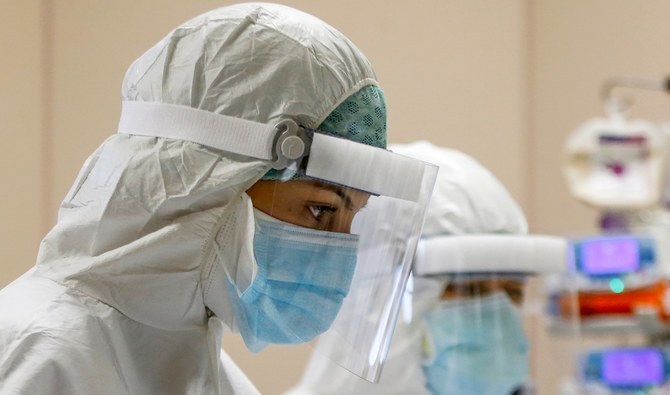

ROME: Hundreds of doctors from Arab countries are fighting coronavirus every day in Italy, and have already paid a heavy price.
According to the Association of Doctors of Foreign Origin in Italy (Amsi), seven of the 107 doctors who have died so far in the country are from Arab states.
“Most of us (Arab doctors) are on the frontlines against the infection, so we risk as much as our Italian colleagues do, but we’re happy to do this. It’s our job. This is what we’ve been trained for,” Dr. Jihad Jabbour, an emergency vascular surgeon in Rome’s Policlinico Umberto I hospital, told Arab News.
Jabbour, 53, came 33 years ago from Lebanon to Italy to study medicine. He is married to an Italian doctor who works at Lazzaro Spallanzani hospital.
“We’re both on the frontlines,” he said, adding that one of his colleagues who he knew personally, a Lebanese GP, died from COVID-19 a few days ago.
“At Policlinico Umberto I we also treat many foreign patients, some of them from Arab countries,” Jabbour said while preparing for an operation.
“I have to use all the precautions, and wear masks and special protective gear, as sometimes we don’t know in advance whether our patient is positive for the virus.”
Jabbour said of the Lebanese GP who died: “We knew each other as we met several times at gatherings organized in Rome by the Lebanese community. He loved this country (Italy), as we all do.”
Italian newspapers reported on the case of Nasser Al-Abdulali, a 28-year-old Saudi doctor who did not join the repatriation plan organized by the Kingdom’s embassy in Italy.
He decided to remain in Lodi, a city in Lombardy, the Italian region worst hit by the virus. Al-Abdulali got a scholarship to study medicine in 2011 at the University of Pavia, Italy.
“Saudi Arabia is known for its humanitarian role worldwide, so I wanted to be here and be the best ambassador for my country with my mastery of English and Italian. I couldn’t back down,” he said while working long hours at a hospital full of COVID-19 patients
He added that the local community is thankful for his engagement. “The owner of the house where I live refused to take rent from me, as an expression of gratitude on behalf of the Italian people,” he said.
The seven doctors from Arab countries who have died are Syrians Abdel Sattar Airoud, Abdulghani Taki Makki, Ghvont Mrad and Samar Sinjab, Palestinian Nabeel Khair, Jordanian Tahsin Khrisat and Lebanese Nabil Chrabie.
FASTFACT
Italian newspapers reported on the case of Nasser Al-Abdulali, a 28-year-old Saudi doctor who did not join the repatriation plan organized by the Kingdom’s embassy in Italy. He decided to remain in Lodi, a city in Lombardy, the Italian region worst hit by the virus.
Amsi President Dr. Foad Aodi called them “martyrs” who “loved Italy, the country where they all happily lived with their families and gave a huge contribution to society with their medical and human skills without any fear.”
He added: “They were family doctors, emergency doctors and dentists. They left sad families with sons and daughters. They will be remembered by city mayors, general managers, and all the patients they helped during their careers in Italy.”
Some Arab countries have been generous in their humanitarian aid to Italy during this crisis. For example, Italy’s Foreign Ministry has expressed gratitude for $5 million from Kuwait and 10 tons of medical equipment from the UAE.
Italy’s Deputy Health Minister Pierpaolo Sileri told Arab News: “There’s more to come, and we’ll thank everyone soon, when we have a complete idea of the situation. All this generosity is overwhelming, and we’re really grateful.”
He added: “We’re fighting the same war, and we’ll win only if we all stay united and help each other, as shared scientific knowledge and medical materials can be an extremely valuable asset.”


