COVID-19 lockdown brings out hidden kitchen talents of Saudi men

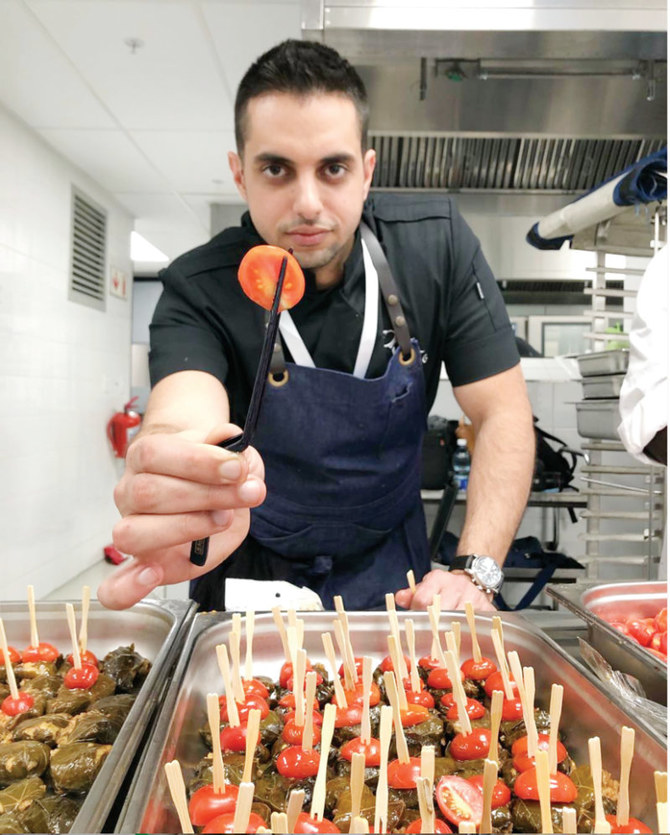
Rakan Aloraifi, self-taught Saudi chef, TV presenter and director of Aregala KSA, has carved out a niche for himself with his culinary talents. (Supplied)
Short Url
Updated 10 April 2020
Follow

COVID-19 lockdown brings out hidden kitchen talents of Saudi men

  • Curfews have provided opportunity for men to show off their kitchen catering abilities by cooking up some tasty meals
  • Saudi mothers and YouTube become culinary instructors for men in developing their cooking skills

RIYADH: The famed home cooking skills of Saudi women have found a surprise challenger during the coronavirus disease (COVID-19) lockdown — with men revealing their hidden culinary talents.

Curfews set up to help stop the spread of the virus have provided the opportunity for men to show off their kitchen catering abilities by cooking up some tasty family meals.

Quality auditor Ahmed bin Ibrahim has been staying at his family’s house during quarantine, and told Arab News that he had enjoyed pitching in on kitchen duties.

“I like to help my mother while she is cooking by cutting some vegetables, but I learned how to cook years ago when I was a student in the US,” he said.

His mom and YouTube became his culinary instructors during his time in America and his favorite dishes are kabsah, steaks and quesadillas.

“Lately, my dad has been cooking a lot and grilling in our back yard, so I’ve been helping him,” he added.
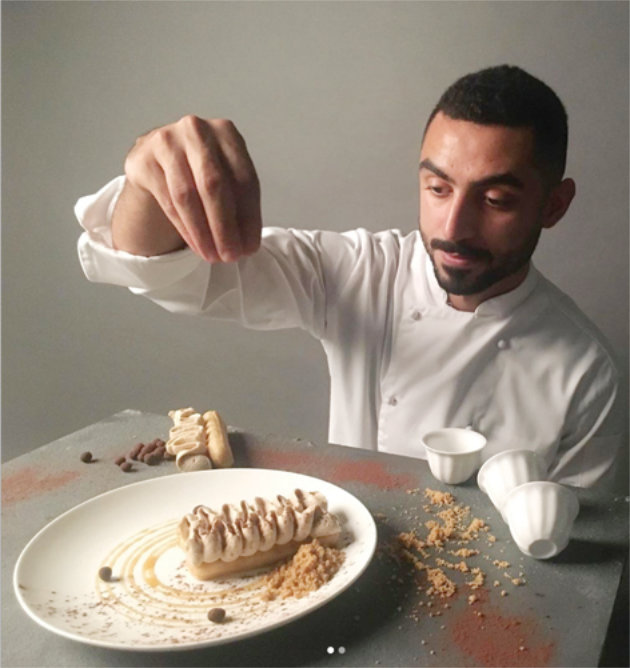


Ammar Albarakati, owner of Ammar Restaurant and TV presenter on Sabahcom on SBC. (Supplied)

Faris Al-Harbi, a college student from Tabuk, has been putting lockdown time to good use in the kitchen trying to create new recipes for his family to lighten the mood.

“Since home isolation started, I have cooked five dishes — mandi (a traditional meal with meat and rice), broasted chicken, pizza, grilled dishes, and pasta with pesto sauce.”

He said that it was only since the COVID-19 restriction measures had been put in place that his talent for cooking healthy food had emerged.

“My family really admires my cooking and loves the taste of my dishes.”

Al-Harbi added that he intended to continue cooking once the COVID-19 health crisis was over, but in the meantime had introduced a kitchen challenge for his cousins and family.

“Every day, a member of the family has to cook a dish and is evaluated by experts — my mother and father. This creates a bit of a competition which is nice. Everyone wants to cook something that is delicious and creative, which makes us excited to cook again.”
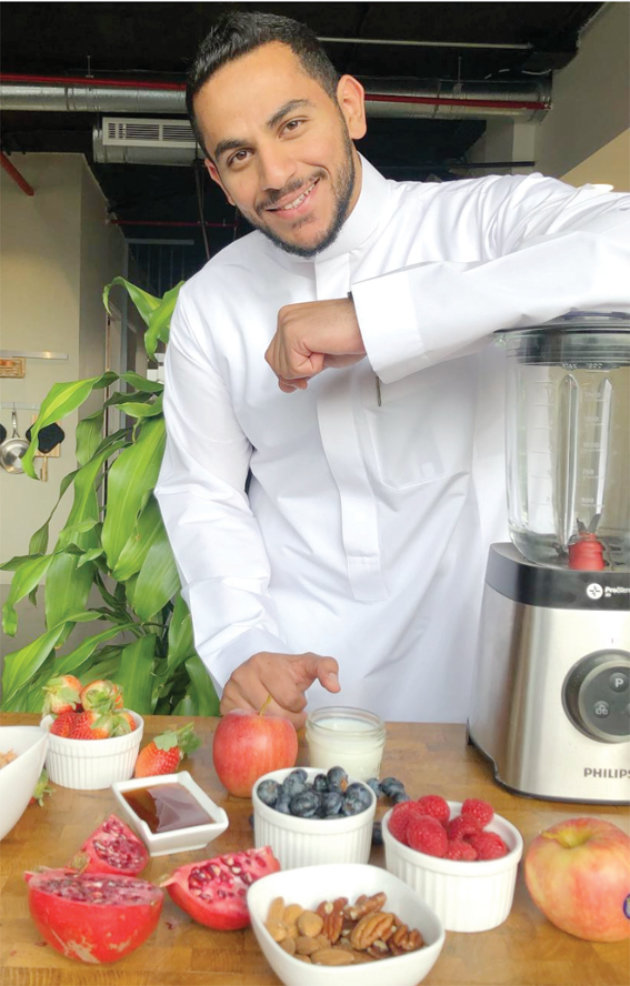


Abdulrahman bin Kasem, Saudi chef and food blogger. (Supplied)

He pointed out that under the current situation it was sometimes hard to find an alternative for some ingredients not available in the home. “It is also difficult to estimate the right amount of ingredients for the family. Preparing the dough and forming it is also hard.”

Al-Harbi’s brother Abdulrahman, an architect, had been challenged to cook madghout — pressure-cooked chicken and rice — for the first time for his family.

“It was the first time I had cooked, so I couldn’t say whether I was talented or not, but it definitely needed some focus,” he said, adding that his creation was well-received. “YouTube has a lot of cool Saudi chefs and their videos are so simple and easy to execute. It helps anyone who wants to try to cook.”

Al-Harbi’s sister Shahad told Arab News that she was surprised to see her brothers’ talent in the kitchen and would struggle to compete with them.

Speaking about her younger brother Khalid, who is currently studying in the US, she said: “He likes to try international foods and he uses fresh ingredients and different spices. He likes to make avocado toast, steaks, cheesecakes, exotic juices, and risotto.

Although a mess is inevitable in some kitchens as male family members go through a trial-and-error phase, most mothers will undoubtedly be proud and happy with the help they are receiving under the current difficult circumstances.


Sheikha Al-Mayassa talks cultural patronage at Art Basel Qatar Conversations panel

Updated 04 February 2026
Follow

Sheikha Al-Mayassa talks cultural patronage at Art Basel Qatar Conversations panel

DOHA: Cultural leaders at the inaugural edition of Art Basel Qatar in Doha have discussed how patronage is reshaping art ecosystems, with Qatar’s own long-term cultural vision at the center.

The opening panel, “Leaders of Change: How is patronage shaping new art ecosystems?” brought together Sheikha Al-Mayassa bint Hamad bin Khalifa Al-Thani, chair of Qatar Museums, and Maja Hoffmann, founder and president of the Luma Foundation, in a discussion moderated by Hans Ulrich Obrist, artistic director of the Serpentine Galleries in London. The talk formed part of the Art Basel Conversations x Qatar Creates Talks program, coinciding with the debut of Art Basel Qatar which runs in Doha until Feb. 8.

Sheikha Al-Thani framed Qatar’s cultural project as a strategic, long-term endeavor anchored in national development. “Qatar has a national vision called 2030 where culture was one of the main pillars for socioeconomic development and human development,” she said. “We have always invested in culture as a means of human development.”

That vision, she explained, underpins the decision to welcome a major international fair like Art Basel to Doha after turning away many previous proposals.

“For the longest time, I can’t tell you how many art fairs came to us wanting to be here, and we never felt it was the right time,” she said. “However, this is an important year for us and we felt, with the surplus of talent and the growing gallery scene we had here, that it was time to bring industry to talent, because that’s how we will spur the economic diversification from hydrocarbon to a knowledge-based society.”

She was also keen to stress that Art Basel Qatar was not conceived as a conventional marketplace.

 “This is not your typical art fair … It’s a humane art fair where engagement is more important than transaction, discourse more important than division, and curiosity more important than conviction,” she added.

That ethos extends to the fair’s artistic leadership. Al-Thani described how the decision to have an artist — Wael Shawky — serve as artistic director emerged collaboratively with Art Basel’s team.

“He’s a global artist who’s now become a very local artist, very invested in our local art scene. And really, I think that’s the beauty of partnerships … There is a safe space for us to critique each other, support each other, and really brainstorm all the possibilities … and then come to a consensus of what would make sense for us,” she said.

Collecting art, she added, has long been embedded in Qatari society: “My grandmother is almost 100 years old. She was collecting in the 60s when Qatar was a very poor country. It’s in our DNA … always with this notion of investing in knowledge and human development.”

Today, that impulse translates into comprehensive, multi-disciplinary collections: “We are both collecting historical objects, contemporary objects, modern objects, architecture, archival material, anything that we feel is relevant to us and the evolution of this nation towards a knowledge-based economy.”

Looking ahead, Al-Thani outlined a new cultural triangle in Doha — the National Museum of Qatar, the Museum of Islamic Art and the forthcoming Art Mill Museum — as engines for both economic diversification and intellectual life.

 “That ecosystem will enhance the economic growth and diversification, but also the knowledge that’s available, because the diversity in the collections between these three institutions will no doubt inspire young people, amateurs, entrepreneurs to think outside the box and inform their next business,” she said.

The panel closed with a focus on the future of large-scale exhibitions with Rubaiya, Qatar’s new quadrennial, timed to coincide with the anniversary of the 2022 World Cup.

“Every four years in memory of the opening of the World Cup, we will open the quadrennial. This year, the theme is ‘Unruly Waters.’ At the center of the theme is Qatar’s trading route to the Silk Road,” explained Al-Thani.

“It’s important for us to trace our past and claim it and share it to the rest of the world, but also show the connectivity that Qatar had historically and the important role it has been playing in diplomacy.”