Taiwan demands apology from WHO chief over virus ‘slander’

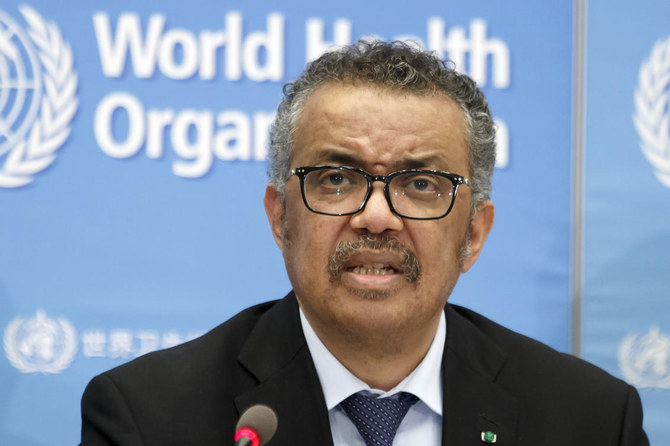
WHO director-general Tedros Adhanom Ghebreyesus spoke of the abuse — including racial slurs — he had been subjected to since the public health crisis began. (Keystone via AP)
Short Url
Updated 09 April 2020
Follow

Taiwan demands apology from WHO chief over virus ‘slander’

  • WHO director-general Tedros Adhanom Ghebreyesus called for unity to fight the disease
  • ‘Three months ago, this attack came from Taiwan’

TAIPEI: Taiwan demanded an apology from the World Health Organization chief on Thursday after he accused the island’s government of leading personal attacks against him and his agency’s response to the coronavirus pandemic.
WHO director-general Tedros Adhanom Ghebreyesus called for unity to fight the disease on Wednesday after US President Donald Trump criticized the global health body and threatened to cut its funding.
During the press conference he spoke of the abuse — including racial slurs — he had been subjected to since the public health crisis began.
Tedros largely avoided mentioning Trump by name but he did single out the government in Taipei, which has been frozen out of the WHO after political pressure from Beijing.
“Three months ago, this attack came from Taiwan,” he told reporters in Geneva.
“They didn’t disassociate themselves. They even started criticizing me in the middle of all that insult and slur, but I didn’t care,” Tedros said.
The comments sparked anger in Taiwan, which described Tedros’ comments as “baseless.”
“Our country has never encouraged the public to launch personal attacks against him or made any racially discriminatory comments,” foreign ministry spokeswoman Joanne Ou told reporters on Thursday.
“Our government demands an immediate clarification and an apology from director-general Tedros over such extremely irresponsible act of slander,” she added.
Relations between the WHO and Taiwan have worsened considerably since the pandemic began, even as health experts have lauded Taiwan for its response to the virus.
It has just 379 confirmed COVID-19 patients and five deaths despite its close proximity and trade links with China, where the pandemic began.
Taiwan used to be able to obtain observer status at the WHO’s annual assembly.
But diplomatic pressure from Beijing in recent years has pushed Taiwan out of major international bodies including the WHO and ICAO — the UN’s aviation agency.
China’s Communist Party regards Taiwan as a breakaway province and has vowed to one day seize the island — by force if necessary.
Beijing’s efforts to isolate the island have ramped up since the election of President Tsai Ing-wen in 2016 because does not view the island as part of a “one China.”
Critics of Tedros have accused the WHO under his leadership of being too close to Beijing and complimentary of China’s response to the coronavirus.
In a tweet threatening to cut funding, Trump called the organization “very China centric.”
Tedros has denied being partisan or holding any geopolitical bias.
“Please quarantine COVID politics. That’s what we want. We don’t care about personal attacks,” he said.


US says Mexican cartel drones breached Texas airspace

Updated 4 sec ago
Follow

US says Mexican cartel drones breached Texas airspace

  • Drone breach comes some five months into a US military campaign targeting alleged drug-smuggling boats
  • US media also reported that the El Paso airspace closure may have been caused by the US military

HOUSTON: The Trump administration said Wednesday that Mexican cartel drones caused the temporary closure of a Texas airport, but some Democratic lawmakers pushed back, suggesting US military activity was responsible for the disruptive shutdown.
The report of the drone breach comes some five months into a US military campaign targeting alleged drug-smuggling boats, and could provide a pretext for President Donald Trump to follow through on his threats to expand the strikes to land.
Trump has specifically threatened to attack cartels inside Mexico, which said it had “no information” on drones at the border.
The US Federal Aviation Administration (FAA) said late Tuesday the airspace over the Texas border city of El Paso would be shut to all aircraft for 10 days, citing unspecified national “security reasons,” only to lift the closure after less than 24 hours.
Transportation Secretary Sean Duffy said in a post on X that the FAA and the Defense Department “acted swiftly to address a cartel drone incursion,” adding: “The threat has been neutralized, and there is no danger to commercial travel in the region.”
A US administration official meanwhile said the breach was by “Mexican cartel drones,” and that US forces “took action to disable the drones,” without providing specifics.
But Democratic Representative Veronica Escobar, whose district includes El Paso, questioned the Trump administration’s explanation, saying it was “not what we in Congress have been told.”
“The information coming from the administration does not add up and it’s not the information that I was able to gather overnight and this morning,” Escobar told journalists.
And top Democratic lawmakers from the House Committee on Transportation suggested the Pentagon may have been responsible for the situation, saying defense policy legislation allows the US military to “act recklessly in the public airspace.”
The lawmakers called for a solution that ensures “the Department of Defense will not jeopardize safety and disrupt the freedom to travel.”

- War against ‘narco-terrorists’ -

US media also reported that the El Paso airspace closure may have been caused by the US military, with CNN saying the shutdown was the result of Pentagon plans to use a counter-drone laser without coordinating with the FAA.
The Pentagon referred questions on the closure to the FAA, which said when it announced the move that “no pilots may operate an aircraft in the areas” covered by the restrictions and warned of potentially “deadly force” if aircraft were deemed a threat.
It updated its guidance Wednesday morning, saying on X that the closure was lifted.
Trump’s administration insists it is effectively at war with “narco-terrorists,” carrying out strikes on alleged traffickers in the Caribbean and eastern Pacific, while the US president has repeatedly said he plans to expand the strikes to land.
Mexican President Claudia Sheinbaum opposes US military intervention in her country but has so far managed to negotiate a fine diplomatic line with Trump.
She has stepped up extradition of cartel leaders to the United States and reinforced border cooperation amid tariff threats from Trump, for whom curbing illegal migration from Mexico was a key election promise.
Sheinbaum told a news conference Wednesday that she had “no information on the use of drones at the border,” but that her government was investigating.
The United States began carrying out strikes on alleged drug-trafficking boats in September, a campaign that has killed at least 130 people and destroyed dozens of vessels in the Caribbean Sea and eastern Pacific Ocean.
US officials have not provided definitive evidence that the vessels are involved in drug trafficking, prompting heated debate about the legality of the operations, which experts say amount to extrajudicial killings.
Trump also ordered a shocking special forces raid in Caracas at the beginning of January to capture Venezuelan leader Nicolas Maduro, whom Washington accused of leading a drug cartel.