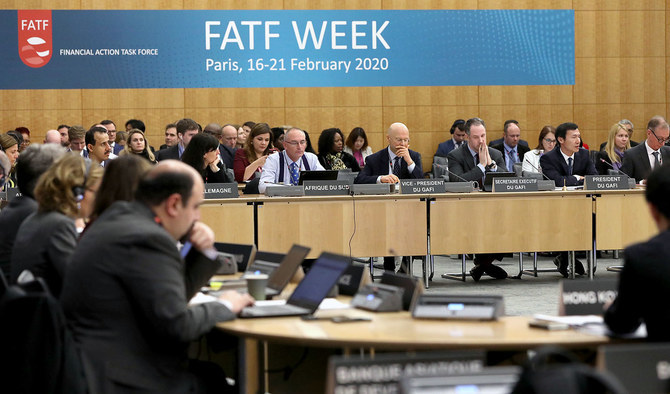
ISLAMABAD: Pakistan welcomes the decision of the Financial Action Task Force (FATF), a global money laundering and terrorist financing watchdog, to postpone its review meeting in June 2020 due to the coronavirus pandemic since it will give the country enough space to sharply focus on the ongoing health care crisis, Parliamentary Secretary for Economic Affairs Division Muhammad Yaqoob Shaikh told Arab News on Wednesday.
Pakistan was placed on the global watchdog’s grey list in 2018 as a country of concern since it lacked a robust financial system that could effectively check money laundering and terrorist financing. In February this year, the Paris-based global watchdog against financial crimes gave Pakistan a four-month grace period to implement its 27-point action plan since the country had delivered on 14 points and missed out on 13 other targets.
“Before this delay, we were required to submit this month our performance report on 13 outstanding benchmarks of the FATF action plan. The report was supposed to be reviewed in the June 2020 meeting. But the situation all over the world has changed now due to the coronavirus pandemic,” Shaikh said, adding that the world’s primary focus was COVID-19 at this point and all other things were secondary.
He said that Pakistan would utilize this time to fully implement the remaining points in the FATF action plan.
“We are part of the global community and will do our best to implement the requirements against money laundering and terror financing,” he continued. “It is good for Pakistan since we do not want to remain part of the grey list or being referred to as a country that has a weak money control system.”
Shaikh was confident that Pakistan would come out of the global watchdog’s grey list in the next meeting.
“Pakistan has implemented a majority of FATF requirements and made significant progress on the remaining 13 points during the last few months. There is not a single point on which Pakistan has not made progress. Pakistan is no more an isolated country, and even if the meeting were to take place in June we were fully prepared with a strong case to take Pakistan out of the grey list,” he added.
Dr. Mohammad Zubair Khan, a renowned economist, said it was in Pakistan’s own interest to stop money laundering and terror financing by strengthening its financial system.
“It is in Pakistan's own interest to curb money laundering. We have also been on the receiving end of terrorism more than any other country due to the foreign funding received by militant elements,” Khan told Arab News.
“Surviving the coronavirus pandemic is a big challenge for the whole world including Pakistan. I don’t think these international financial institutions will be the same in the post-pandemic time as it is already an uncertain and chaotic period,” he said, adding that developing countries like Pakistan needed to utilize all their resources to deal with the pandemic and the FATF should keep that in mind.
“The FATF should not single out Pakistan for its underdeveloped financial sector by constantly asking it to do more despite all the progress the country has shown during the last one year,” Khan said.


Islamabad welcomes postponement of FATF review amid global pandemic
https://arab.news/mppcc
Islamabad welcomes postponement of FATF review amid global pandemic

- The gathering was scheduled to take place in June 2020
- Pakistani officials say they will utilize the time to fully implement the remaining points on the FATF action plan

Peace can only prevail if Afghanistan renounces support for ‘terrorism’— Pakistan defense chief
- Pakistan’s chief of defense forces visits South Waziristan district bordering Afghanistan
- Pakistan says has killed 481 Afghan Taliban operatives since clashes began last Thursday
ISLAMABAD: Pakistan’s Chief of Defense Forces Field Marshal Syed Asim Munir said on Wednesday that peace with Afghanistan can only prevail if Kabul renounces support for “terrorism” and “terrorist” organizations, the military’s media wing said as the two countries remain locked in conflict.
Fighting between the two neighbors, the worst in decades, broke out last Thursday night after Afghan forces attacked Pakistan’s military installations along their shared border. Afghanistan said its attacks were in response to earlier airstrikes by Pakistan against alleged militant hideouts in its country.
Pakistan accuses Afghanistan of sheltering militant outfits such as the Tehreek-e-Taliban Pakistan (TTP) on its soil who have launched attacks against Pakistani civilians and security forces in recent years. Kabul denies the allegations.
Munir visited Wana town in Pakistan’s South Waziristan district to review the security situation and troops’ operational preparedness at the Afghan border, the Pakistani military’s media wing said in a statement.
“The Field Marshal reiterated that peace could only prevail between both sides if the Afghan Taliban renounced their support for terrorism and terrorist organizations,” the Inter-Services Public Relations (ISPR) said.
The military chief said the use of Afghan soil by militant outfits to launch attacks against Pakistan was unacceptable, vowing that “all necessary measures” would be taken to neutralize cross-border threats.
During the visit, Munir was briefed by military commanders about ongoing intelligence-based operations and measures being taken by the military to manage the border with Afghanistan.
He was also briefed about “Operation Ghazab Lil Haq” or “Wrath for the Truth,” the name Pakistan has given to its military operation against Afghan forces, the ISPR said.
The Pakistani military chief spoke to troops deployed in the area, praising their vigilance, professional conduct and high morale, the ISPR said.
Pakistan’s Information Minister Attaullah Tarar said on Wednesday that the military has killed 481 Taliban operatives, injured more than 690 and destroyed 226 Afghan checkposts since clashes began.
Arab News has been unable to verify claims by both sides about the damages they claim to have inflicted on each other.
Afghanistan has signaled it is open for dialogue but Pakistan rejected the offer, saying it would continue its military operations till its objectives were achieved.
Since the conflict began, diplomatic efforts have intensified with several countries, including global bodies such as the European Union and United Nations, urging restraint and calling for talks.
Turkish President Recep Tayyip Erdogan told Pakistani Prime Minister Shehbaz Sharif that Ankara would help reinstate a ceasefire, the Turkish Presidency said on Tuesday, as other countries that had offered to mediate have since been hit by the conflict in the Gulf.


