ISLAMABAD: Pakistan welcomes the decision of the Financial Action Task Force (FATF), a global money laundering and terrorist financing watchdog, to postpone its review meeting in June 2020 due to the coronavirus pandemic since it will give the country enough space to sharply focus on the ongoing health care crisis, Parliamentary Secretary for Economic Affairs Division Muhammad Yaqoob Shaikh told Arab News on Wednesday.
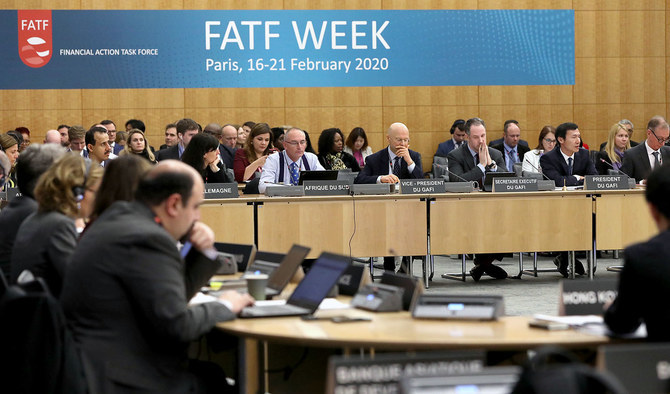
Pakistan was placed on the global watchdog’s grey list in 2018 as a country of concern since it lacked a robust financial system that could effectively check money laundering and terrorist financing. In February this year, the Paris-based global watchdog against financial crimes gave Pakistan a four-month grace period to implement its 27-point action plan since the country had delivered on 14 points and missed out on 13 other targets.
“Before this delay, we were required to submit this month our performance report on 13 outstanding benchmarks of the FATF action plan. The report was supposed to be reviewed in the June 2020 meeting. But the situation all over the world has changed now due to the coronavirus pandemic,” Shaikh said, adding that the world’s primary focus was COVID-19 at this point and all other things were secondary.
He said that Pakistan would utilize this time to fully implement the remaining points in the FATF action plan.
“We are part of the global community and will do our best to implement the requirements against money laundering and terror financing,” he continued. “It is good for Pakistan since we do not want to remain part of the grey list or being referred to as a country that has a weak money control system.”
Shaikh was confident that Pakistan would come out of the global watchdog’s grey list in the next meeting.
“Pakistan has implemented a majority of FATF requirements and made significant progress on the remaining 13 points during the last few months. There is not a single point on which Pakistan has not made progress. Pakistan is no more an isolated country, and even if the meeting were to take place in June we were fully prepared with a strong case to take Pakistan out of the grey list,” he added.
Dr. Mohammad Zubair Khan, a renowned economist, said it was in Pakistan’s own interest to stop money laundering and terror financing by strengthening its financial system.
“It is in Pakistan's own interest to curb money laundering. We have also been on the receiving end of terrorism more than any other country due to the foreign funding received by militant elements,” Khan told Arab News.
“Surviving the coronavirus pandemic is a big challenge for the whole world including Pakistan. I don’t think these international financial institutions will be the same in the post-pandemic time as it is already an uncertain and chaotic period,” he said, adding that developing countries like Pakistan needed to utilize all their resources to deal with the pandemic and the FATF should keep that in mind.
“The FATF should not single out Pakistan for its underdeveloped financial sector by constantly asking it to do more despite all the progress the country has shown during the last one year,” Khan said.


Islamabad welcomes postponement of FATF review amid global pandemic
https://arab.news/mppcc
Islamabad welcomes postponement of FATF review amid global pandemic

- The gathering was scheduled to take place in June 2020
- Pakistani officials say they will utilize the time to fully implement the remaining points on the FATF action plan

Pakistan PM calls for faster CPEC implementation, pledges security for Chinese workers
- Shehbaz Sharif pushes expanded cooperation in agriculture, IT and mining under CPEC phase two
- Chinese envoy reaffirms Beijing’s support for Pakistan’s sovereignty and economic development
ISLAMABAD: Prime Minister Shehbaz Sharif on Friday called for speeding up projects under the China-Pakistan Economic Corridor (CPEC) and pledged stronger security guarantees for Chinese workers and investments, during a meeting with China’s ambassador in Islamabad.
Sharif made the remarks as the two countries strive to launch the second phase of CPEC, a multibillion-dollar infrastructure and energy initiative launched in 2015 as part of China’s Belt and Road Initiative (BRI).
CPEC’s first phase focused largely on power generation and transport infrastructure aimed at easing Pakistan’s chronic energy shortages and improving connectivity. The second phase seeks to expand cooperation into industrial development, with an emphasis on special economic zones and export-oriented growth.
“While highlighting the importance of accelerating ongoing CPEC projects, the Prime Minister stressed on the need to enhance cooperation in agriculture and IT and mining & minerals,” said a statement circulated by the PM Office after the meeting.
“He also underscored Pakistan’s resolve to provide a secure and conducive environment for Chinese personnel, investments, and institutions in Pakistan,” it added.
Chinese nationals and projects in Pakistan have faced security threats in the past, including attacks by militant groups targeting infrastructure sites and convoys. Islamabad has repeatedly vowed to tighten security and has deployed special protection units for Chinese workers.
China is Pakistan’s closest ally in the region and a key economic partner, with CPEC widely regarded by Islamabad as central to long-term economic growth.
During the meeting, the prime minister conveyed greetings to Chinese President Xi Jinping and Premier Li Qiang, particularly on the occasion of the Chinese New Year.
China’s Ambassador to Pakistan, Jiang Zaidong, reiterated Beijing’s support for Pakistan’s sovereignty and socioeconomic development, according to the statement. Both sides also exchanged views on regional and international issues and agreed to maintain close coordination.


