

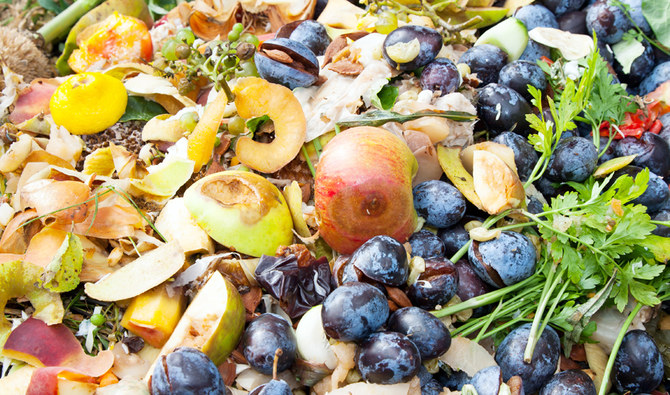

RIYADH: More than 33 percent of food is wasted in Saudi Arabia, costing the Kingdom SR40 billion ($10.6 billion) annually, according to a study conducted by the Saudi Grains Organization (SAGO).
The nationwide field study showed that each individual in the Kingdom wastes almost 184 kg of food each year.
Targeting 19 food commodities divided into eight groups, the study revealed that 917,000 tons of flour and bread are wasted annually, as well as 557,000 tons of rice, 444,000 tons of poultry meat and more than 335,000 tons of vegetables.
Meanwhile, the Ministry of Environment, Water and Agriculture said in a statement that the Kingdom has achieved a qualitative leap in the rates of local production of agricultural and animal products this year compared to previous years. Saudi Arabia’s production of milk and its derivatives reached 7.5 million tons per day, achieving self-sufficiency of more than 100 percent and covering 109 percent of local consumption.
Poultry production also exceeded 900,000 tons annually, covering 60 percent of local consumption.
In collaboration with SAGO, the ministry launched a campaign to raise public awareness, sharing several tips and ideas on reducing food waste and making the most
of leftovers.
FASTFACTS
• Saudi Arabia loses SR40 billion annually from waste.
• Each individual in the Kingdom wastes almost 184 kg of food each year.
Khalid Al-Ghamdi, a supply chain expert, said: “The coronavirus disease (COVID-19) global crisis showed a glut of food stockpiles in the Kingdom.”
He called for further improvements in all stages of food supply chains to minimize food waste — from agriculture to manufacturing, distribution and consumption.
“The biggest challenge that faces the food supply chain is the increase in food loss and waste to SR40 billion, i.e., 33 percent. That affects the nation’s economy and represents a loss of fortune,” he said.
In January, the Ministry of Municipality and Rural Affairs issued a decree mandating all restaurants and wedding halls to contract with food banks to preserve excess food.
Khiyrat, a food bank in Riyadh, collected and preserved about 1.8 million meals in 2019, and provided its services to about 676,000 families, according to media representative Thekra Al-Abdulatif.
“People’s awareness about food waste has improved in the Kingdom in recent years, however, further efforts are needed to improve the work of food banks and spread the culture of food preservation,” Al-Abdulatif said.


