


Saudi charitable efforts increase amid rising coronavirus cases 

1 / 3
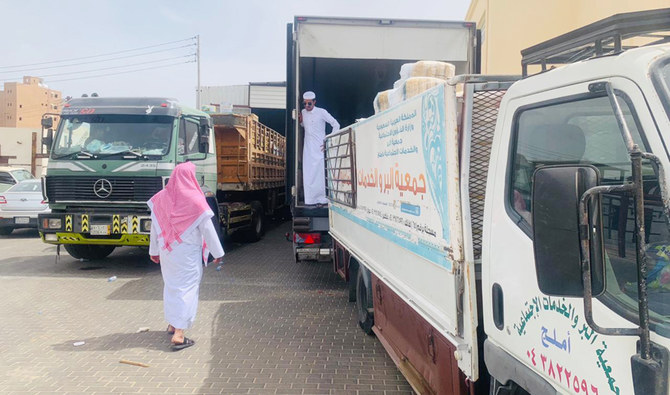
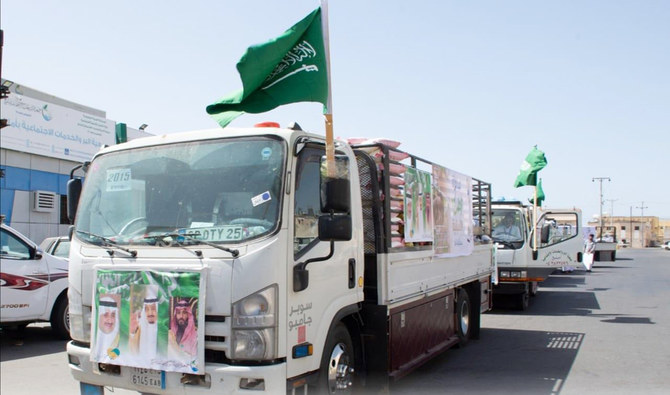
Authorities in Tabuk are carrying out a relief drive in partnership with the private sectors to help the needy people in the ongoing global health crisis. (SPA)
2 / 3
Authorities in Tabuk are carrying out a relief drive in partnership with the private sectors to help the needy people in the ongoing global health crisis. (SPA)
3 / 3
Authorities in Tabuk are carrying out a relief drive in partnership with the private sectors to help the needy people in the ongoing global health crisis. (SPA)
Short Url
Updated 05 April 2020
Follow

Saudi charitable efforts increase amid rising coronavirus cases 

  • Individuals are taking it upon themselves to help with virus control by providing services and goods free of charge

RIYADH: Charities, nonprofit organizations and businesses in Saudi Arabia are providing financial aid, distributing medical supplies and raising awareness in the country in response to the coronavirus disease (COVID-19) pandemic.
The Kingdom is taking several measures to control the spread of the virus. Efforts to help people during the pandemic have emerged from civil society, as well as the country’s private sector.
Riyadh’s Ensan Charity Organization for Orphan Care has set up a website (https://store.ensan.org.sa/) where people can make donations online. In addition to the normal donation options that are available throughout the year, there is now an opportunity to purchase a “protective basket” which contains sanitizers, gloves and masks.
The Princess Seetah bint Abdul Aziz Award for Excellence in Social Work has dedicated its eighth session to “social work in the face of crises and risks” in reaction to the pandemic.
In Jeddah, preventive measures have been put in place to reduce the spread of COVID-19 at the Albir Society and ensure the safety of its beneficiaries. It is launching an online platform to further support families and the society’s chairman, Dr. Suhail bin Hassan Qadi, said 20 preventive measures had been implemented across centers and orphanages to fight the pandemic.
The Kingdom’s private sector is also contributing to the fight against coronavirus through donations to the Ministry of Health’s Health Endowment Fund. These will be used to provide the medical devices required to address the pandemic. ​
On Friday, the Samba Financial Group announced it was donating SR16.5 million ($4.4 million) to the fund. Riyad Bank is giving SR17 million, and Al Ahli Bank is donating SR33 million.
Other companies have also joined in, such as the ​Bupa Arabian Company. The insurance giant has provided $20 million to the fund to fight the spread of the virus. The Saudi Pharmaceutical Industries & Medical Appliances Corporation has given SR11 million.

HIGHLIGHTS

• Banks donate millions of dollars to fight virus spread.

• Charities, individuals offer care packages.

Not all contributions are financial. In light of school and college closures, leaving low-income students unable to access online lectures and exams, Jarir Bookstore said it would donate 10,000 laptops through official charity societies endorsed by the Ministry of Human Resources.
Individuals are also taking it upon themselves to help with virus control by providing services and goods free of charge.
Maryam Bint Hamad Al-Mutairi, a resident of Unaizah who owns a taxicab business, is delivering medicine to people in Unaizah for free. She has distributed care packages consisting of masks, gloves, and hand sanitizer, and has been honored Qassim Gov. Prince Faisal Bin Mishaal.
Al-Mutairi told local media that everything she did was and would remain free of charge, and that she had no intention of exploiting the high demand for delivery services.
“It’s not the time to be thinking of profits,” she said. “We have all benefited from the great bounty of our country, and it’s time to give back even a small part of what this country has given to us. There will be time enough to think of profit when all this is over.”


Experimental farm in Al-Lith looks into future of Saudi Arabian agriculture

Updated 01 February 2026
Follow

Experimental farm in Al-Lith looks into future of Saudi Arabian agriculture

  • Research initiative reflects strategic transformation

JEDDAH: An experimental farm in Saudi Arabia’s Al-Lith Governorate is one of the research initiatives reflecting the strategic transformation taking place in the Kingdom’s agricultural sector.

The farm uses highly efficient, sustainable production models that combine scientific research with commercial application, contributing to strengthening the country’s food security system and the sustainability of water resources.

Located in the Ghumaiqa Center on an area of about 10 hectares, the cutting-edge farm is a testing platform for modern agricultural technologies that tackle the challenge of water scarcity.

The farm includes developed open fields and modern greenhouses, supported by smart irrigation encompassing drip and sprinkler irrigation alongside surface and subsurface technologies.

All the systems operate via smart controls that enable the monitoring of water consumption and ensure improved efficiency, thereby achieving a balance between agricultural production and water conservation.

The farm also uses treated and diluted low-salinity seawater.

It aims to diversify agricultural water sources, reduce reliance on freshwater, and open new horizons for agriculture in coastal and semi-arid environments.

The project represents a promising investment opportunity in the field of smart agriculture, enabling the development of commercially scalable production models, particularly for high-value vegetables and fruits, while reducing operational costs associated with water and energy, enhancing the economic feasibility of future agricultural projects.

In addition, the project contributes to transferring and localizing agricultural expertise, supporting local food supply chains, and creating an attractive environment for agricultural investment.

This aligns with Sustainable Development Goals and enhances the efficiency of the private sector in adopting innovative agricultural solutions.

Yahya bin Abdulrahman Al-Mahabi, the director of the Ministry of Environment, Water and Agriculture office in Al-Lith Governorate, told the Saudi Press Agency that the project represented the future of agriculture in the Kingdom.

He explained that the vision was based on investing in technology, enhancing the return on water per unit, and integrating scientific research with investment opportunities.

Al-Mahabi spoke of the experimental farm as a modern, scalable and replicable model applicable in several regions of the Kingdom, particularly in coastal environments.

Al-Mahabi highlighted the Ministry of Environment, Water and Agriculture’s commitment to supporting distinctive projects that contributed to achieving food security while developing rural areas and enhancing agricultural production efficiency, in line with the objectives of the Kingdom’s Vision 2030.