Coronavirus: ‘Worst yet to come’ for countries in conflict, says UN chief

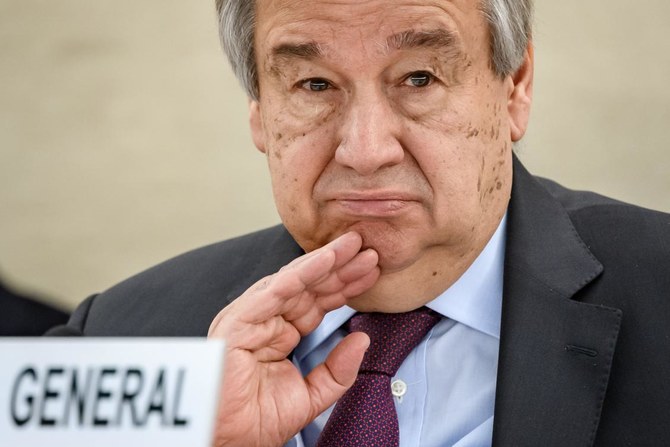
Guterres said that the scale of the crisis was due to “a disease that represents a threat to everybody in the world and... an economic impact that will bring a recession that probably has no parallel in the recent past.” (AFP/Fabrice Coffrini)
Short Url
Updated 03 April 2020
Follow

Coronavirus: ‘Worst yet to come’ for countries in conflict, says UN chief

  • Guterres said there had been some progress following his March 23 call for peace, but that fighting still rages in a number of countries
  • Guterres appealed for developed countries and multilateral institutions to do more to aide poorer countries face the pandemic

UNITED NATIONS, United States: UN Secretary-General Antonio Guterres Friday renewed his call for a global ceasefire, urging all parties to conflict to lay down arms and allow war-torn nations to combat the coronavirus pandemic.
"The worst is yet to come," Guterres said, referring to countries beset with fighting like Syria, Libya and Yemen.
"The COVID-19 storm is now coming to all these theatres of conflict."
Guterres said there had been some progress following his March 23 call for peace, but that fighting still rages in a number of countries, hampering the ability to put into place plans to combat the virus.
"The need is urgent," Guterres said at a UN press conference.
"The virus has shown how swiftly it can move across borders, devastate countries and upend lives."
He said that parties to conflict in a number of countries, including Cameroon, the Central African Republic, Colombia, Libya, Myanmar, the Philippines, South Sudan, Sudan, Syria, Ukraine and Yemen, have expressed support for his call.
"But there is a huge distance between declarations and deeds -- between translating words into peace on the ground and in the lives of people," Guterres said.
"In many of the most critical situations, we have seen no let-up in fighting -- and some conflicts have even intensified."
While expressing gratitude for support of his earlier call from some 70 countries, NGO groups and religious leaders worldwide including Pope Francis, Guterres said more concrete work was necessary.
"We need robust diplomatic efforts to meet these challenges. To silence the guns, we must raise the voices for peace," he said.
Guterres did not mention the UN Security Council, where divisions between the United States and China have blocked action.
Since the beginning of the global pandemic, the Security Council has not met once on COVID-19, making no statement or joint resolution.
On Thursday the UN General Assembly adopted a resolution calling for international cooperation and "multilateralism" in addressing the virus, which has infected more than one million worldwide and killed more than 50,000.
Guterres appealed for developed countries and multilateral institutions to do more to aide poorer countries face the pandemic.
"To act early rather than later is essential... This is particularly true with the developing world," he said.
Guterres noted that the ceasefire in Idlib, Syria is holding but said it needs to be expanded to the entire country to allow full efforts to slow the coronavirus spread.
But he noted that expressions of support for a ceasefire by different factions fighting in Libya had not ended the violence.
"This war is now not allowing the response to COVID-19 to take place," he said.
"This is the moment to stop. It's not morally acceptable to continue with this conflict."


Court ruling jeopardizes freedom for pro-Palestinian activist Mahmoud Khalil

Updated 10 sec ago
Follow

Court ruling jeopardizes freedom for pro-Palestinian activist Mahmoud Khalil

  • The panel ruled a federal judge in New Jersey didn’t have jurisdiction to decide the matter at this time
  • The law bars Khalil “from attacking his detention and removal in a habeas petition,” the panel added

WASHINGTON: A federal appeals panel on Thursday reversed a lower court decision that released former Columbia University graduate student Mahmoud Khalil from an immigration jail, bringing the government one step closer to detaining and ultimately deporting the Palestinian activist.
The three-judge panel of the 3rd US Circuit Court of Appeals didn’t decide the key issue in Khalil’s case: whether the Trump administration’s effort to throw Khalil out of the US over his campus activism and criticism of Israel is unconstitutional.
But in its 2-1 decision, the panel ruled a federal judge in New Jersey didn’t have jurisdiction to decide the matter at this time. Federal law requires the case to fully move through the immigration courts first, before Khalil can challenge the decision, they wrote.
“That scheme ensures that petitioners get just one bite at the apple — not zero or two,” the panel wrote. “But it also means that some petitioners, like Khalil, will have to wait to seek relief for allegedly unlawful government conduct.”
The law bars Khalil “from attacking his detention and removal in a habeas petition,” the panel added.
Ruling won’t result in immediate detention
It was not clear whether the government would seek to detain Khalil, a legal permanent resident, again while his legal challenges continue.
Thursday’s decision marked a major win for the Trump administration’s sweeping campaign to detain and deport noncitizens who joined protests against Israel.
In a statement distributed by the American Civil Liberties Union, Khalil said the appeals ruling was “deeply disappointing, but it does not break our resolve.”
He added: “The door may have been opened for potential re-detainment down the line, but it has not closed our commitment to Palestine and to justice and accountability. I will continue to fight, through every legal avenue and with every ounce of determination, until my rights, and the rights of others like me, are fully protected.”
Baher Azmy, one of Khalil’s lawyers, said the ruling was “contrary to rulings of other federal courts.” He noted the panel’s finding concerned a “hypertechnical jurisdictional matter,” rather than the legality of the Trump administration’s policy.
“Our legal options are by no means concluded, and we will fight with every available avenue,” he added, saying Khalil would remain free pending the full resolution of all appeals, which could take months or longer.
The ACLU said the Trump administration cannot lawfully re-detain Khalil until the order takes formal effect, which won’t happen while he can still immediately appeal.
Khalil has multiple options to appeal
Khalil’s lawyers can request the active judges on the 3rd Circuit hear an appeal, or they can go to the US Supreme Court.
An outspoken leader of the pro-Palestinian movement at Columbia, Khalil was arrested on March 8, 2025. He then spent three months detained in a Louisiana immigration jail, missing the birth of his firstborn.
Federal officials have accused Khalil of leading activities “aligned to Hamas,” though they have not presented evidence to support the claim and have not accused him of criminal conduct. They have also accused Khalil, 30, of failing to disclose information on his green card application.
The government has justified the arrest under a seldom-used statute that allows for the expulsion of noncitizens whose beliefs are deemed to pose a threat to US foreign policy interests.
In June, a federal judge in New Jersey ruled that justification would likely be declared unconstitutional and ordered Khalil released.
President Donald Trump’s administration appealed that ruling, arguing the deportation decision should fall to an immigration judge, rather than a federal court.
Khalil has dismissed the allegations as “baseless and ridiculous,” framing his arrest and detention as a “direct consequence of exercising my right to free speech as I advocated for a free Palestine and an end to the genocide in Gaza.”
Dissenting judge says Khalil has right to fight detention

Judge Arianna Freeman dissented Thursday, writing that her colleagues were holding Khalil to the wrong legal standard. Khalil, she wrote, is raising “now-or-never claims” that can be handled at the district court level. He does not have a final order of removal, which would permit a challenge in an appellate court, she wrote.
Both judges who ruled against Khalil, Thomas Hardiman and Stephanos Bibas, were Republican appointees. President George W. Bush appointed Hardiman to the 3rd Circuit, while Trump appointed Bibas. President Joe Biden, a Democrat, appointed Freeman.
The majority opinion noted Freeman worried the ruling would leave Khalil with no remedy for unconstitutional immigration detention, even if he later can appeal.
“But our legal system routinely forces petitioners — even those with meritorious claims — to wait to raise their arguments, the judges wrote. “To be sure, the immigration judge’s order of removal is not yet final; the Board has not affirmed her ruling and has held the parties’ briefing deadlines in abeyance pending this opinion. But if the Board ultimately affirms, Khalil can get meaningful review.”
The decision comes as an appeals board in the immigration court system weighs a previous order that found Khalil could be deported. His attorneys have argued that the federal order should take precedence.
That judge has suggested Khalil could be deported to Algeria, where he maintains citizenship through a distant relative, or Syria, where he was born in a refugee camp to a Palestinian family.
His attorneys have said he faces mortal danger if forced to return to either country.