JERUSALEM: Israeli police arrested the Palestinian minister for Jerusalem affairs early Friday for allegedly violating an Israeli ban on Palestinian political activities in east Jerusalem.
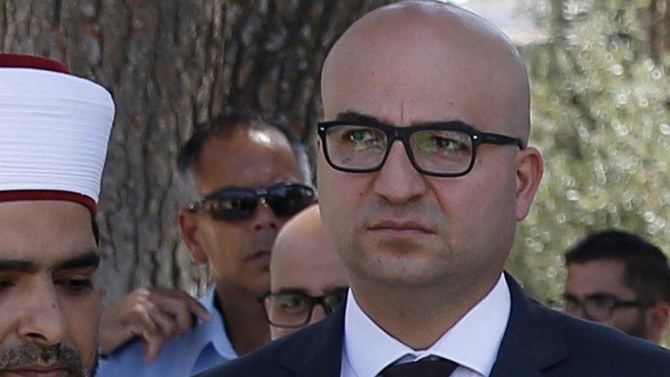
Fadi Al-Hidmi was arrested at his home near the Mount of Olives. His office circulated surveillance camera footage showing police searching his home with dogs. It said they confiscated 10,000 shekels (around $2,750). It was the fourth time he has been arrested.
Israel captured east Jerusalem in the 1967 war and annexed it in a move not recognized internationally. The Palestinians want east Jerusalem to be the capital of their future state. Israel views the entire city as its capital.
Israel bars the Palestinian Authority, which governs parts of the occupied West Bank, from operating in east Jerusalem or carrying out any political activities there.
Palestinian officials said Al-Hidmi was working to assist residents as part of their response to the coronavirus pandemic.
“Israel targets (those) who work for Jerusalem, even at such critical moments as we work to save our people’s lives from COVID19,” Prime Minister Mohammad Shtayyeh tweeted, referring to the illness caused by the virus. “We demand his immediate release.”
Israeli police spokesman Micky Rosenfeld said Al-Hidmi was arrested “on suspicions of Palestinian activities in Jerusalem.” He said police searched the home and confiscated documents as well as “large sums of money.”
He said the arrest was not connected to any efforts to combat the pandemic.
Israel has reported more than 7,000 cases and at least 36 deaths. The Palestinian Authority has reported 143 cases and one death in the territories it administers in the West Bank. Both have imposed sweeping lockdowns to try and slow the spread of the virus.
The virus causes mild to moderate symptoms in most patients, who recover within a few weeks. But it is highly contagious and can cause severe illness or death, particularly in older patients or those with underlying health problems.

Israel arrests Palestinian official in east Jerusalem
https://arab.news/yse7j
Israel arrests Palestinian official in east Jerusalem
- Palestinian officials said Al-Hidmi was working to assist residents as part of their response to the coronavirus pandemic
- Israel bars the Palestinian Authority, which governs parts of the occupied West Bank, from operating in east Jerusalem or carrying out any political activities there
Fuel surcharge, airspace disruptions push up airfares for Pakistani travelers
- Airlines add $20–100 fuel surcharge per leg amid global oil supply disruptions due to the Middle East conflict
- Travel agents say around 80 daily flights to Gulf countries are being canceled, increasing the demand further
ISLAMABAD: Airlines operating in Pakistan have imposed additional fuel surcharges on tickets as jet fuel prices rise and regional airspace disruptions reduce availability of flights, industry officials said on Wednesday.
Jet fuel this month surged in Pakistan from ₨188.93 to ₨342.32 per liter, according to local media reports. It followed global oil and airspace disruptions amid ongoing United States-Israeli strikes on Iran and Tehran’s counterattacks in the Gulf.
Aviation fuel typically accounts for 30–40 percent of an airline’s operating expenses, which means the recent price surge has significantly affected the cost for Pakistani carriers, according to industry experts.
Abdullah Hafeez, a spokesman for the Pakistan International Airlines (PIA), said air carriers have not formally increased base ticket prices but have introduced a fuel surcharge to offset the impact of higher aviation fuel costs.
“Airlines have imposed a fuel surcharge to the tune of $20 to $100 per leg on domestic and international flights to mitigate the effects of jet fuel price increase, which means a two-way ticket will be expensive by $40 to $200, depending on distance and route,” he said.
The decision was taken on Monday following a rise in jet fuel prices in Pakistan, according to Hafeez.
For flights to Saudi Arabia, including Riyadh, Dammam, Jeddah and Madinah, airlines have imposed a fuel surcharge of $50 per leg, meaning $100 for a return ticket, while $75 dollar per leg charges have been imposed on flights to London.
Travel agents say the impact is already being felt by passengers as ticket prices climb and flight options shrink.
Muhammad Sajjad Bashir, a representative of Aroma Travels in Karachi, said fares across airlines have risen since the Middle East crisis disrupted several regional air routes.
“The fuel price has gone up while the seats are also not available due to increased demands on some open routes,” he said.
Nearly 80 flights from Pakistan to Gulf countries, particularly the United Arab Emirates, Qatar and Bahrain, are being canceled daily due to airspace disruptions, Bashir said.
“This airspace issue has left passengers with fewer options and the increasing demand is hiking ticket prices,” he added.
Fares on some UK-bound flights have jumped from around Rs250,000 ($891) to as high as Rs1 million ($3565), while ticket prices between Pakistan and Saudi Arabia have increased from Rs125,000 ($445) to around Rs200,000 ($713), according to Bashir.
Airlines have raised fares by Rs10,000 ($35) to Rs28,000 ($99) per ticket depending on the destination, with flights to the Middle East and Central Asia seeing increases of about Rs15,000 ($53). Long-haul routes like Pakistan to Toronto and Manchester have recorded the highest hikes, with ticket prices rising by up to Rs28,000 per passenger.
A marketing official at a Saudi airline also said airlines have not officially raised base fares but are selling seats across different booking classes, meaning passengers booking late have to buy more expensive tickets once cheaper fare categories are sold out.
One-way fares from Pakistan to some Saudi destinations currently range between Rs87,000 and Rs88,000 ($310-313), while return tickets cost around Rs160,000 to Rs165,000 ($570-588), the official added.


